
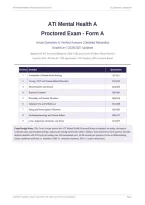
ATI Mental Health A Proctored Exam | Form A 75 Questions | Graded A+
ATI Mental Health A
Proctored Exam - Form A
Actual Questions & Verified Answers | Detailed Rationales
Graded A+ | 2026/2027 Updated
Aligned with ATI Proctored Blueprint, DSM-5-TR, and Current Evidence-Based Practice
Cognitive Mix: 30% Recall / 50% Application / 20% Analysis | 80% Scenario-Based
Section Domain Questions
1 Foundations of Mental Health Nursing Q1-Q12
2 Anxiety, OCD, and Trauma-Related Disorders Q13-Q23
3 Mood Disorders and Suicide Q24-Q34
4 Psychotic Disorders Q35-Q43
5 Personality and Somatic Disorders Q44-Q50
6 Substance Use and Withdrawal Q51-Q58
7 Eating and Neurocognitive Disorders Q59-Q65
8 Psychopharmacology and Adverse Effects Q66-Q71
9 Crisis, Aggression, Restraints, and Abuse Q72-Q75
Exam Design Notes: This Form A exam mirrors the ATI Mental Health Proctored blueprint emphasis on safety, therapeutic
communication, psychopharmacology, and priority-setting frameworks (ABC, Maslow, least-restrictive). Each question includes
detailed rationale with ATI-style test-taking cues. Recommended pace: 60-90 seconds per question. Focus on differentiating
similar conditions (delirium vs. dementia, NMS vs. serotonin syndrome, EPS vs. tardive dyskinesia).
2026/2027 Updated | Aligned with DSM-5-TR, CMS, and ATI Proctored Blueprint Page 1
,ATI Mental Health A Proctored Exam | Form A 75 Questions | Graded A+
Section 1: Foundations of Mental Health Nursing
Mental Status Examination, Therapeutic Communication, Nurse-Client Relationship, Boundaries, & Legal/Ethical Issues
(Q1-Q12)
Q1. A nurse is performing a mental status examination on a newly admitted client. Which
component of the MSE assesses the client's ability to think logically and reason?
A. Sensorium
B. Cognition and intellectual performance [CORRECT]
C. Mood and affect
D. Thought process
Correct Answer: B
Rationale: Cognition and intellectual performance evaluate thinking, reasoning, judgment, memory, and abstract
thinking—assessed through orientation, attention span, calculation, recall, and proverbs. Sensorium (A) assesses
level of consciousness. Mood and affect (C) assess emotional state. Thought process (D) evaluates the form of
thinking (tangent, circumstantial, loose). Each MSE component targets a distinct domain; identifying the correct
domain is foundational to accurate documentation and care planning.
Q2. A client tells the nurse, "I'm just so tired of everything." Which response by the nurse is
MOST therapeutic?
A. "Everything will get better soon."
B. "Tell me more about what you mean by 'tired of everything.'" [CORRECT]
C. "You should try to focus on the positive things in your life."
D. "I know how you feel; I've been there too."
Correct Answer: B
Rationale: The therapeutic technique of exploring ("Tell me more...") invites the client to elaborate and validates
their feelings without judgment. False reassurance (A), giving advice (C), and focusing on the nurse's experience (D)
are nontherapeutic responses that block communication and minimize the client's feelings. ATI frequently tests these
techniques; remember to choose responses that are client-centered, open-ended, and nonjudgmental.
Q3. During the working phase of a nurse-client relationship, the client becomes angry and
shouts, "You're just like my mother—always telling me what to do!" Which phenomenon is the
client demonstrating?
A. Countertransference
B. Transference [CORRECT]
C. Reaction formation
D. Projection
Correct Answer: B
Rationale: Transference occurs when the client unconsciously redirects feelings about a significant person (often a
parent) onto the nurse. The therapeutic response is to explore the feelings rather than react personally.
Countertransference (A) is the nurse's emotional response to the client. Reaction formation (C) is expressing the
opposite of one's true feelings. Projection (D) is attributing one's own unacceptable feelings to others. Recognizing
transference helps maintain therapeutic boundaries.
2026/2027 Updated | Aligned with DSM-5-TR, CMS, and ATI Proctored Blueprint Page 2
, ATI Mental Health A Proctored Exam | Form A 75 Questions | Graded A+
Q4. A nurse is caring for a client on an involuntary psychiatric hold. The client demands to
leave the hospital. Which action by the nurse is appropriate?
A. Allowing the client to leave because they have the right to refuse treatment.
B. Informing the client they cannot leave because they are on an involuntary hold and documenting the
encounter. [CORRECT]
C. Calling security to physically restrain the client immediately.
D. Asking the provider to discharge the client to avoid conflict.
Correct Answer: B
Rationale: An involuntary hold (e.g., Baker Act, Sectioning) means the client cannot leave against medical advice
due to danger to self or others or grave disability. The nurse must inform the client of their status, explain rights,
document the encounter, and notify the provider. Allowing the client to leave (A) violates the legal hold. Immediate
restraint (C) is unnecessary unless the client becomes dangerous. Discharging to avoid conflict (D) is inappropriate;
the hold exists for safety.
Q5. A client tells the nurse during a therapy session, "If I tell you who abused me, you have to
promise not to tell anyone." Which response by the nurse is MOST appropriate?
A. "I promise I won't tell anyone."
B. "I can't promise that; I am required by law to report abuse, but I will only share what is necessary to
keep you safe." [CORRECT]
C. "Don't worry; whatever you say stays between us."
D. "You should tell your therapist instead."
Correct Answer: B
Rationale: Confidentiality has limits: nurses are mandated reporters of abuse, neglect, and threats of harm to self or
others. Promising confidentiality that cannot be kept (A, C) breaches trust and violates legal duties. The nurse should
clearly explain the limits of confidentiality upfront and reinforce them as needed. Deflecting (D) dismisses the client.
ATI tests this concept frequently—remember the duty to warn/report always supersedes confidentiality.
Q6. A client with schizophrenia tells the nurse, "The FBI is monitoring my thoughts through
the television." Which response by the nurse is MOST therapeutic?
A. "That's not true; the FBI isn't monitoring you."
B. "I understand you believe that, but I don't see evidence of it. Let's focus on how you're feeling today."
[CORRECT]
C. "Why do you think the FBI is monitoring you?"
D. "That sounds crazy."
Correct Answer: B
Rationale: The therapeutic approach is to acknowledge the client's belief without validating the delusion ("I
understand you believe that"), present reality gently ("I don't see evidence of it"), and redirect to feelings or safe
topics. Arguing (A) increases agitation. Asking "why" (C) reinforces the delusion and demands logic the client
cannot provide. Dismissing (D) is nontherapeutic. ATI frequently tests the principle: never argue with delusions, but
do not validate them either.
2026/2027 Updated | Aligned with DSM-5-TR, CMS, and ATI Proctored Blueprint Page 3


