
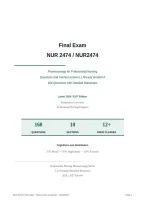
Final Exam
NUR 2474 / NUR2474
Pharmacology for Professional Nursing
Questions and Verified Answers | Already Graded A
160 Questions with Detailed Rationales
Latest Edition
Rasmussen University
Professional Nursing Program
160 10 12+
QUESTIONS SECTIONS DRUG CLASSES
Cognitive Level Distribution
25% Recall — 55% Application — 20% Analysis
Professional Nursing Pharmacology Series
Z.ai Nursing Education Resources
Edition
NUR 2474 Final Exam - Rasmussen University - 2026/2027 Page 1
, Examination Overview and Instructions
This comprehensive 160-question final exam review for NUR 2474 (Rasmussen University Pharmacology for
Professional Nursing) covers the cumulative course objectives across ten content sections aligned with the
2026-2027 curriculum standards. Each question follows the 'Already Graded A' format with four options (A-D), one
verified correct answer, and a detailed pharmacologic rationale explaining the mechanism of action, monitoring
parameters, adverse effects, and patient safety considerations.
Structure
The exam is organized into ten sections covering: (1) Pharmacologic Foundations and Safe Administration; (2)
Dosage Calculations and IV Therapy; (3) Cardiovascular Pharmacology; (4) Endocrine Pharmacology; (5)
Respiratory and Autonomic Pharmacology; (6) Anti-Infective Pharmacology; (7) CNS and Psychopharmacology; (8)
Gastrointestinal, Genitourinary, and Musculoskeletal Pharmacology; (9) Lifespan, Special Populations, and
Prescribing Safety; and (10) Prioritization, Patient Education, and Clinical Judgment. Questions appear sequentially
Q1 through Q160 with section headers clearly delineating topic transitions.
Question Design Philosophy
Approximately 80% of items are scenario-based clinical application questions requiring integration of patient
assessment data, pharmacologic mechanisms, and nursing clinical judgment. The remaining 20% are direct recall of
mechanisms, definitions, and dosage calculations. Distractors are constructed to represent common pharmacology
nursing pitfalls - including confusing insulin onset/peak times, misidentifying anticoagulant monitoring parameters,
incorrect dosage calculation, confusing beta blocker vs. ACE inhibitor adverse effects, improper digoxin monitoring,
misattributing antibiotic spectrum, and misunderstanding Beers Criteria restrictions.
Special Inclusions
Comparison questions require differentiation of similar drug classes (ACE inhibitor vs. ARB, Loop vs. Thiazide
diuretics, Heparin vs. Warfarin, SSRI vs. SNRI, SABA vs. LABA). High-alert medication safety questions cover
anticoagulants, insulin, digoxin, and opioids. 'Which action should the nurse take FIRST?' medication safety formats
emphasize prioritization. Drug-drug and drug-disease interaction questions emphasize CYP450 recognition. Lifespan
questions address pediatric, geriatric, pregnancy, and renal/hepatic impairment prescribing. Beers Criteria and
deprescribing principles are integrated throughout. The 2026/2027 edition incorporates current FDA safety
communications and evidence-based prescribing guidelines.
Cognitive Level Distribution
Questions are distributed across three cognitive tiers consistent with the NCLEX-RN cognitive domain framework:
25% assess recall and understanding of foundational pharmacology concepts; 55% assess application of
pharmacologic principles to clinical scenarios; and 20% assess analysis and prioritization in complex patient
situations requiring nursing clinical judgment.
Disclaimer
This educational test bank is independent study material aligned with NUR 2474 course objectives at Rasmussen
University. It is not affiliated with, endorsed by, or sponsored by Rasmussen University. Always verify drug doses,
monitoring parameters, and clinical decisions against institutional policy, manufacturer prescribing information, and
NUR 2474 Final Exam - Rasmussen University - 2026/2027 Page 2
, current evidence-based clinical practice guidelines before any patient care decision.
NUR 2474 Final Exam - Rasmussen University - 2026/2027 Page 3
, Section 1: Pharmacologic Foundations and Safe Administration
Q1 - Q20
Q1: A nurse is preparing to administer an oral medication to a patient with a history of gastric bypass
surgery. Which pharmacokinetic change should the nurse anticipate?
A. Increased first-pass metabolism causing supratherapeutic effects
B. Decreased gastric acidity enhancing absorption of weak bases
C. Reduced absorptive surface area causing decreased bioavailability of many oral medications
[CORRECT]
D. Prolonged gastric emptying increasing onset of action
Correct Answer: C
Rationale:
Gastric bypass dramatically reduces the functional absorptive surface area of the small intestine (the primary site of
drug absorption). Decreased surface area lowers bioavailability of many medications, especially extended-release
formulations and drugs with narrow absorption windows. The nurse should monitor for therapeutic failure and
consider alternative routes (sublingual, transdermal, IV) or non-extended-release formulations when available. Dose
adjustments and closer therapeutic monitoring may be required.
Q2: A patient receiving a highly protein-bound drug (warfarin, 99% bound) is started on
sulfamethoxazole-trimethoprim. Which interaction should the nurse monitor for?
A. Decreased free fraction of warfarin causing subtherapeutic INR
B. Displacement of warfarin from albumin binding sites increasing free drug and bleeding risk
[CORRECT]
C. Enhanced hepatic metabolism shortening warfarin half-life
D. Increased renal clearance reducing anticoagulant effect
Correct Answer: B
Rationale:
Sulfamethoxazole competes with warfarin for albumin-binding sites, displacing warfarin and increasing the free
(active) fraction. Because 99% of warfarin is normally protein-bound, even a small increase in free fraction
significantly elevates INR and bleeding risk. The nurse should monitor INR closely (every 2-3 days) and assess for
bleeding (bruising, melena, hematuria, headache) when this combination is unavoidable. Anticipate warfarin dose
reduction of 25-50%.
Q3: A patient with cirrhosis is prescribed a hepatically metabolized medication. Which pharmacokinetic
parameter is most likely altered?
A. Decreased first-pass metabolism INCREASING bioavailability of oral drugs [CORRECT]
B. Enhanced CYP450 enzyme induction accelerating drug clearance
C. Increased plasma protein synthesis raising bound drug fraction
D. Improved biliary excretion shortening drug half-life
Correct Answer: A
Rationale:
Cirrhosis reduces hepatic synthetic function and first-pass metabolism, decreasing clearance of hepatically
metabolized drugs and increasing oral bioavailability. Reduced albumin synthesis also increases free drug fraction
NUR 2474 Final Exam - Rasmussen University - 2026/2027 Page 4


