
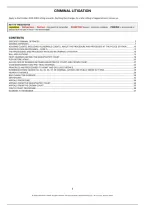
CRIMINAL LITIGATION
Apply to the October 2026 SQE2 sitting onwards. Anything that changes for a later sitting is flagged where it comes up.
KEY TO THESE NOTES
Legislation · Defined term · Red text = key point to remember · EXAM TRAP boxes = common mistakes · PENDING = announced or
passed but not yet in force – not examinable
CONTENTS
SPECIFIED CRIMINAL OFFENCES..........................................................................................................................................................................2
GENERAL DEFENCES..............................................................................................................................................................................................7
ADVISING CLIENTS, INCLUDING VULNERABLE CLIENTS, ABOUT THE PROCEDURE AND PROCESSES AT THE POLICE STATION.............10
IDENTIFICATION PROCEDURES – CODE D...........................................................................................................................................................11
THE PROCEDURES AND PROCESSES INVOLVED IN CRIMINAL LITIGATION.....................................................................................................15
BAIL APPLICATIONS............................................................................................................................................................................................. 15
FIRST HEARINGS BEFORE THE MAGISTRATES’ COURT.....................................................................................................................................19
PLEA BEFORE VENUE...........................................................................................................................................................................................20
ALLOCATION OF BUSINESS BETWEEN MAGISTRATES' COURT AND CROWN COURT...................................................................................21
CASE MANAGEMENT AND PRE-TRIAL HEARINGS.............................................................................................................................................22
PRINCIPLES AND PROCEDURES TO ADMIT AND EXCLUDE EVIDENCE............................................................................................................24
INFERENCES FROM SILENCE SS. 34, 35, 36, 37, 38 CRIMINAL JUSTICE AND PUBLIC ORDER ACT 1994.....................................................25
HEARSAY EVIDENCE............................................................................................................................................................................................26
BAD CHARACTER EVIDENCE...............................................................................................................................................................................28
SENTENCING........................................................................................................................................................................................................32
APPEALS PROCEDURE.........................................................................................................................................................................................34
APPEALS FROM THE MAGISTRATES’ COURT....................................................................................................................................................34
APPEALS FROM THE CROWN COURT................................................................................................................................................................ 35
YOUTH COURT PROCEDURE...............................................................................................................................................................................36
NUMBERS TO REMEMBER................................................................................................................................................................................... 37
1
© 2026 Pass Notes Limited. All rights reserved. For the purchaser’s personal study only – do not copy, share or resell.
,Magistrates: max 6 months for a summary only offence (consecutive summary terms cannot exceed 6 months in total); max 12 months
for an either-way offence (consecutive either-way terms max 12 months in total) – s.224 Sentencing Act 2020 and s.133 Magistrates’
Courts Act 1980 (12-month limit for convictions on or after 18 November 2024, SI 2024/1067). Fines: unlimited for most offences.
SPECIFIED CRIMINAL OFFENCES:
OFFENCES AGAINST THE PERSON
Offence DEFINITION Actus reus Mens rea PENALTY
SIMPLE (COMMON) Causing another person Causing someone to fear Intention or recklessness Summary only
ASSAULT – to apprehend immediate immediate unlawful force. No as to causing the victim
Common assault unlawful personal physical contact required. to fear immediate 6 months'
violence. unlawful force. imprisonment and/or
s.39 CJA 1988 and fine
common law
BATTERY The actual infliction of Application of unlawful force, Intention or recklessness Summary only
(PHYSICAL unlawful force on however slight (e.g., touching, as to the application of
ASSAULT) – assault another person. pushing). unlawful force. 6 months'
by beating imprisonment and/or
fine
s.39 CJA 1988 and
common law
ABH Assault or battery which Assault or battery causing Same mens rea as Either way
causes actual bodily actual bodily harm – includes assault or battery – no
s. 47 OAPA harm (more than trivial minor fractures, cuts, need to intend or 5 years’
hurt). psychiatric injury (if medically foresee ABH. imprisonment
recognised).
Malicious wounding Unlawfully wounding or Wound = break in both layers Intention or Either way
or GBH inflicting grievous of skin. recklessness as to
bodily harm. GBH = serious harm (can be causing some harm (not 5 years’
s.20 OAPA physical or psychological). necessarily serious imprisonment
harm).
GBH with intent – Unlawfully wounding or Same as s.20 – wounding or Specific intent to cause Indictable only
causing GBH with GBH. GBH (or to
s.18 OAPA 1861 intent to cause GBH or resist/prevent lawful Life imprisonment
resist arrest arrest).
or
‘Maliciously’ i.e.
intention or recklessness
as to causing some harm
(R v Morrison) plus an
intent to resist / prevent
arrest.
THEFT OFFENCES:
OFFENCE DEFINITION ACTUS REUS MENS REA PENALTY
THEFT A person dishonestly Appropriating property “Dishonestly” (1) Either way offence
appropriates property belonging to another First check s.2(1)
s.1 THEFT ACT belonging to another with the Theft Act 1968: not Up to 7 years’ imprisonment
1968 - intention of permanently dishonest if D
depriving the other of it believes he has a
legal right / owner
would consent /
owner cannot be
found. Otherwise
apply the Ivey/Barton
test: (a) what was
D’s actual state of
knowledge or belief
as to the facts? (b)
was the conduct
dishonest by the
standards of ordinary
decent people? (2)
Intention to
permanently deprive
(s.6 Theft Act 1968).
ROBBERY Theft + using force + Appropriating property Intention of Indictable only offence
immediately before or at time belonging to another + appropriating
s.8 THEFT ACT of theft to effect theft; degree immediately before using property belonging Max life imprisonment
1968 of force is a matter for the jury or threatening force to another. If force
was for another
purpose, will not be
2
© 2026 Pass Notes Limited. All rights reserved. For the purchaser’s personal study only – do not copy, share or resell.
, OFFENCE DEFINITION ACTUS REUS MENS REA PENALTY
convicted of robbery
BURGLARY To enter a building as a (1) Unlawful entry must be Trespass = civil Either way, BUT indictable
trespasser with intent to effective concept and requires only if: (i) it involves an
s.9 THEFT ACT commit theft, GBH or criminal D to enter building indictable-only offence (or
1968 damage or having entered as (2) Some degree of intentionally or intent to commit one); (ii) a
a trespasser, steals or permanent structure recklessly dwelling where anyone
attempts to steal, or inflicts or required inside was subjected to
attempts to inflict GBH (s.9(1) Subjective standard violence or a threat of
(b)) violence; or (iii) it would be
D’s third domestic burglary
(min 3 years, s.314 SA
2020) – MCA 1980 Sch 1
para 28
Up to 10 years: non –
dwelling
Up to 14 years: dwelling
Related offence: aggravated
burglary
AGGRAVATED As above but with weapon or (1) Unlawful entry must be Trespass = civil Indictable only
BURGLARY firearm: effective concept and requires
D to enter building Up to life imprisonment
s.10 THEFT To enter a building as a (2) Some degree of intentionally or
ACT 1968 trespasser with intent to permanent structure recklessly
commit theft, GBH or criminal required
damage or having entered a Subjective standard
building, attempt to steal or (3) has weapon / firearm
commit GBH + has weapon /
firearm
CRIMINAL DAMAGE
OFFENCE DEFINITION ACTUS REUS MENS REA PENALTY
SIMPLE CRIMINAL Where without lawful (1) Destroy or damage (1) Intentionally or Either way offence,
DAMAGE excuse, destroy or property which must be recklessly (subjective but under £5k
S.1(1) CDA 1971 damage property tangible test) damage will be tried
belonging to another, summarily. If damage
intentionally or recklessly Damage does not need D will have lawful by arson, then either
to be permanent, but excuse where: way offence.
must be more than
merely trivial or nominal (a) Believed owner If tried on indictment,
damage found where would have consented, max. sentence is 10
the object’s value or enough that belief was years.
usefulness is impaired. honestly held, will be
defence if honest
(2) belonging to another mistake.
(b) If D acted to protect
property
AGGRAVATED Where destroy property Same as criminal (1) D intends by Indictable only
CRIMINAL DAMAGE with intent or reckless as damage, BUT does not destruction or damage
to whether life of matter who property to endanger life of Maximum – life
s.1(2) CDA 1971 someone else would be belongs to (point (2) another, or is reckless imprisonment
endangered above irrelevant)
(2) must be connection
Endangerment of life between destruction /
must result from damage to property and
damage or destruction intention
of property, not merely
danger itself. The s.5 CDA 1971
lawful excuse
defences do not apply
to aggravated criminal
damage
Must have intention / be
reckless that by
destruction of property,
3
© 2026 Pass Notes Limited. All rights reserved. For the purchaser’s personal study only – do not copy, share or resell.
, OFFENCE DEFINITION ACTUS REUS MENS REA PENALTY
life would be
endangered. i.e. D was
aware of the risk that
life would be
endangered by the
damage.
ARSON Any offence under s.1 Triable either way
(simple or aggravated
s.1(3) CDA 1971 criminal damage) Where aggravated
committed by destroying arson = indictable
or damaging property by
fire (s.1(3) CDA 1971). Maximum – life
imprisonment.
Can be either simple
criminal damage or
aggravated criminal
damage
HOMICIDE
OFFENCE DEFINITION ACTUS REUS MENS REA PENALTY
MURDER The unlawful killing of a (1) Unlawful killing (not (1) Intention to kill Mandatory life
human being with malice in self-defence or lawful imprisonment (Judge
COMMON LAW aforethought act). OR sets a minimum term
under Sch 21
(2) Victim must be a (2) intention to cause Sentencing Act
human being. grievous bodily harm 2020).
(GBH)
(3) Death must be
caused by the
defendant’s act or
omission.
(4) Must occur under
the King’s peace (not
wartime combat).
LOSS OF CONTROL: A killing that would be (1) Unlawful killing with (1) Intent to kill or Discretionary life
murder but for a loss of the mens rea for cause GBH (same as sentence or a lesser
Voluntary Manslaughter control due to a qualifying murder; (2) loss of self- murder). term.
trigger. control; (3) qualifying
trigger (ss.54–55 (2) BUT must result
Coroners and Justice from a qualifying
Act 2009). trigger.
(3) A person of D’s sex
and age with normal
tolerance and self-
restraint would have
reacted similarly.
DIMINISHED A killing where D suffered (1) Unlawful killing. (1) D must have an Discretionary life
RESPONSIBILITY: an abnormality of mental abnormality of mental sentence or a lesser
functioning that (2) D must suffer from functioning (e.g., term.
Voluntary Manslaughter substantially impaired an abnormality of schizophrenia,
their responsibility. mental functioning. depression, PTSD).
(3) Abnormality must (2) This must
arise from a recognised substantially impair D’s
medical condition. ability to form rational
judgment or self-
(4) Abnormality must control.
substantially impair D’s
ability to understand (3) It must provide an
their conduct, form explanation for the
rational judgment, or killing.
exercise self-control.
UNLAWFUL ACT Where D causes death by (1) D must commit an (1) Intention to commit Maximum life
MANSLAUGHTER: an unlawful and unlawful act (not an the unlawful act (but no imprisonment
dangerous act. omission). need to intend death or (discretionary).
Involuntary serious harm).
Manslaughter (2) Act must be
objectively dangerous. (2) Act must be
4
© 2026 Pass Notes Limited. All rights reserved. For the purchaser’s personal study only – do not copy, share or resell.


