
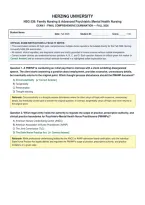
HERZING UNIVERSITY
NSG 526: Family Nursing & Advanced Psychiatric Mental Health Nursing
EXAM 1 / FINAL COMPREHENSIVE EXAMINATION — FALL 2026
Student Name:
Date: Fall 2026 Student ID: ______________ Score: _____ / 100
___________________________
OFFICIAL EXAM INSTRUCTIONS & FACULTY NOTES:
• This examination contains 20 high-yield, comprehensive multiple-choice questions formulated directly for the Fall 2026 Herzing
University NSG 526 examination.
• All content, clinical vignettes, and diagnostic criteria are strictly grounded in course sources without outside interpolation.
• Correct answer choices are randomized across positions A, B, C, and D. Each question features an official green tick marker (✔
Correct Answer) and an extensive clinical rationale formatted in a highlighted yellow explanation box.
Question 1. A PMHNP is conducting an initial psychiatric interview with a client exhibiting disorganized
speech. The client starts answering a question about employment, provides excessive, unnecessary details,
but eventually returns to the original point. Which thought process disturbance should the PMHNP document?
A) Circumstantiality [✔ Correct Answer]
B) Tangentiality
C) Perseveration
D) Thought blocking
Rationale: Circumstantiality is a thought process disturbance where the client strays off-topic with excessive, unnecessary
details, but eventually circles back to answer the original question. In contrast, tangentiality strays off-topic and never returns to
the original point.
Question 2. Which legal entity holds the authority to regulate the scope of practice, prescriptive authority, and
clinical practice boundaries for Psychiatric-Mental Health Nurse Practitioners (PMHNPs)?
A) American Nurses Credentialing Center (ANCC)
B) American Association of Nurse Practitioners (AANP)
C) The Joint Commission (TJC)
D) The State Nurse Practice Act [✔ Correct Answer]
Rationale: While professional credentialing bodies like the ANCC or AANP administer board certification, only the individual
State Nurse Practice Act legally defines and regulates the PMHNP's scope of practice, prescriptive authority, and practice
limitations in a given state.
, Question 3. In the DSM-5 and DSM-5-TR, how are psychiatric and medical diagnoses presented compared to
the multi-axial system (Axes I-V) used in the DSM-IV?
A) Medical conditions are listed first, followed by primary psychiatric disorders.
B) Diagnoses are presented in a single, unified list with primary mental health disorders listed first, followed by
medical conditions and psychosocial factors (Z-codes). [✔ Correct Answer]
C) Personality disorders remain separated on Axis II, while GAF scores are mandatory.
D) A three-axis system replaced the five-axis system to separate adult and pediatric disorders.
Rationale: The DSM-5 eliminated the multiaxial system (Axes I-V). All diagnoses are now listed together in a single, hierarchical
list: 1) Primary mental health diagnosis, 2) Relevant medical diagnoses, and 3) Psychosocial and environmental factors
documented using Z-codes. Personality disorders are now integrated into the main diagnostic category.
Question 4. During an initial therapy session, a client who recently lost a spouse expresses severe grief and
sadness. The PMHNP states, 'It makes complete sense that you feel overwhelmed and deeply hurt after losing
your partner.' Which therapeutic communication strategy is the PMHNP demonstrating?
A) Reflection
B) Clarification
C) Validation [✔ Correct Answer]
D) Offering general leads
Rationale: Validation acknowledges and affirms the client's emotional experience without judgment, normalizing their feelings to
help them feel heard and understood. Reflection, in contrast, involves paraphrasing or restating the client's spoken words to
clarify meaning.
Question 5. According to Hildegard Peplau’s Interpersonal Theory, what is the initial role assumed by the
psychiatric nurse during the Orientation Phase of the nurse-patient relationship?
A) Stranger [✔ Correct Answer]
B) Counselor
C) Surrogate
D) Leader
Rationale: During the Orientation Phase, Peplau states that the nurse's first role is that of a 'stranger,' greeting the patient with
respect and positive interest while establishing trust, rapport, boundaries, confidentiality, and initial expectations.
Question 6. A PMHNP is evaluating a 68-year-old client presenting with new-onset depressive symptoms,
severe fatigue, weight gain, and slowed cognition. Which laboratory test is most critical to rule out a medical
mimic before confirming a primary psychiatric diagnosis?
A) Serum Folate level
B) Fasting blood glucose
C) Liver function tests
D) Serum TSH (Thyroid-Stimulating Hormone) [✔ Correct Answer]
Rationale: Hypothyroidism (indicated by an elevated TSH level) commonly presents with symptoms that mimic major depressive
disorder, including fatigue, cognitive slowing, cold sensitivity, and weight gain. Physical causes must be investigated via TSH
screening prior to establishing a primary psychiatric diagnosis.


