
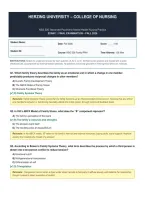
HERZING UNIVERSITY – COLLEGE OF NURSING
NSG 526: Advanced Psychiatric Mental Health Nursing Practice
EXAM 1 / FINAL EXAMINATION – FALL 2026
Student Name:
Date: Fall 2026 Score: ____ / 100
___________________________
Student ID:
Course: NSG 526 Family/PMH Time Allowed: 120 Mins
_____________________________
INSTRUCTIONS: Select the single best answer for each question (A, B, C, or D). Verified correct answers are marked with a green
checkmark [✔], accompanied by evidence-based rationales. All questions are strictly grounded in Herzing NSG 526 exam materials.
Q1. Which family theory describes the family as an emotional unit in which a change in one member
predictably produces reciprocal changes in other members?
A) Duvall’s Family Development Theory
B) The ABCX Model of Family Stress
C) Structural-Functional Theory
[✔] D) Family Systems Theory
Rationale: Family Systems Theory posits that the family functions as an interconnected emotional unit, meaning that any shift in
one member’s behavior or functioning inevitably affects the entire system through reciprocal feedback loops.
Q2. In Hill’s ABCX Model of Family Stress, what does the “B” component represent?
A) The family’s perception of the event
[✔] B) The family’s resources and strengths
C) The stressor event itself
D) The resulting crisis or disequilibrium
Rationale: In the ABCX model, “B” refers to the family’s internal and external resources (coping skills, social support, financial
assets) that mediate the impact of a stressor.
Q3. According to Bowen’s Family Systems Theory, what term describes the process by which a third person is
drawn into a two-person conflict to reduce tension?
A) Emotional cutoff
B) Multigenerational transmission
C) Differentiation of self
[✔] D) Triangulation
Rationale: Triangulation occurs when a dyad under stress recruits a third party to diffuse anxiety and stabilize the relationship,
though it prevents direct resolution of conflict.
, Q4. Which stage of Duvall’s Family Life Cycle involves establishing a new family unit and developing autonomy
from the family of origin?
A) Family with adolescents
[✔] B) Married couple without children
C) Childbearing family
D) Family with school-age children
Rationale: Stage I (married couple without children) focuses on forming a new family system, setting boundaries, and
establishing autonomy from families of origin.
Q5. In the Calgary Family Assessment Model (CFAM), which category includes family composition, gender, and
sexual orientation?
[✔] A) Internal structure
B) Expressive functioning
C) External structure
D) Instrumental functioning
Rationale: Internal structure in CFAM refers to household composition, gender, rank order, and sexual orientation of family
members.
Q6. A nurse asks a family, “Who outside the household helps you when you need support?” This question
assesses which CFAM component?
A) Internal structure
B) Developmental stage
[✔] C) External structure
D) Instrumental functioning
Rationale: External structure addresses the family’s connections to extended family, community systems, and external
resources.
Q7. According to Duvall’s Family Development Theory, what is the primary developmental task of families with
adolescents?
A) Adjusting to retirement
[✔] B) Balancing freedom with responsibility
C) Adjusting to new parenting roles
D) Reorganizing the family for launching children
Rationale: Families with adolescents must negotiate increasing autonomy and independence for teenagers while maintaining
appropriate structure and boundaries.


