
EXPOSURE FLUOROSCOPY EXPECTED QUESTIONS
WITH VERIFIED ANSWERS
Question 1.
what does ABS stand for?
ANSWER
automatic brightness stabilization
Question 2.
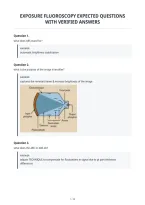
what is the purpose of the image intensifier?
ANSWER
captures the remnant beam & increase brightness of the image
Question 3.
what does the ABC or ABS do?
ANSWER
adjusts TECHNIQUE to compensate for fluctuations in signal due to pt part thickness
differences
,Question 4.
what makes up the image intensifier?
ANSWER
1. input phosphor
2. photocathode
3. electrostatic focusing lenses
4. accelerating anode
5. output phosphor
Question 5.
what converts light photons into electrons?
ANSWER
photocathode
Question 6.
what makes up the fluoroscopic chain?
ANSWER
1. monitor
2. CCD or CMOS
3. image intensifier
4. xray table
5. xray tube
, Question 7.
what is the result of using collimation in fluoro?
ANSWER
reduces scatter & better for pt dose
Question 8.
what is signal sensing?
ANSWER
most common way to measure adequacy of the signal flowing through the fluoro unit
Question 9.
what is the purpose of the electrostatic focusing lenses?
ANSWER
focuses electrons from the input side toward the output (opposite charges attract)
Question 10.
when was fluoro discovered?
ANSWER
1896
Question 11.
What is fluoroscopy?
ANSWER
dynamic real-time imaging of anatomical structures in motion
Question 12.
What is dark adaptation?
ANSWER
eyes adjust to the dark


