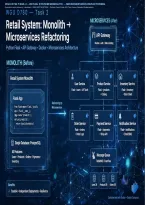
WGU D780 TASK 2 – RETAIL SYSTEM MONOLITH → MICROSERVICES REFACTORING
Questions and Answers | Updated – 2026/2027 EDITION – Python Flask Code API Test Cases Detailed Explanations
,TABLE OF CONTENTS / EXAM BLUEPRINT
Section 1: 1. Monolith Architecture – Retail System Flask Monolith
Section 2: 2. Microservices Architecture – Decomposition Strategy
Section 3: 3. User, Product, Inventory Services – Flask Implementation
Section 4: 4. Order, Payment, Notification Services – Stripe API Email/SMS
Section 5: 5. API Gateway – Routes, Auth, Rate Limiting
Section 6: 6. Message Queue – RabbitMQ Event Bus & Databases
Section 7: 7. Python Flask Code – Refactoring & Clean Code
Section 8: 8. API Test Cases – Unit & Integration Testing
Section 9: 9. Task 2 Integration – Monolith to Microservices Refactoring
,EXAM BLUEPRINT & INSTRUCTIONS
About This Exam:
• 200 original with complete retail system monolith-to-microservices exemplar – 100% different – fixed factory – new image cover that go
• Covers both tracks: Monolith Flask App Single DB and Microservices API Gateway User Product Inventory Order Payment Notification
• Aligned to WGU D780 Software Architecture and Design Task 2 Complete Retail System Monolith-to-Microservices Refactoring Exemp
• Reflects Task 2 format – MONOLITH Before Retail System Monolith Flask App Single Database PostgreSQL All Features Users Produ
Instructions:
1. Pace yourself: 200Q complete exemplar Python Flask code API test cases
2. Read last line first: monolith microservices retail system Flask API Gateway Docker
3. Monolith Before: Retail System Monolith Flask App from flask import Flask app Flask name @app.route products get_products return
4. Microservices After: API Gateway Routes Auth Rate Limiting User Service Flask /users JWT Auth Product Service /products Catalog I
5. Refactoring Benefits: Scalable Independent Deployments Resilience Containerized with Docker Docker Compose Clean Code Inherita
6. Testing & Documentation: Python Flask code app route jsonify API test cases unit integration pytest detailed explanations tested code
, SECTION ONE: QUESTIONS 1-200
Choose the single best answer. Correct answers and rationales follow each item.
1. Monolith Architecture – Retail System Flask Monolith
Question 1. Which API for Inventory Service Flask /inventory stock check correctly
yields API test cases unit integration pytest with Flask code test cases per Task 2
exemplar? WGU D780 Software Architecture and Design Task 2 Complete Retail System
Monolith to Microservices Refactoring Exemplar with Python Flask Code API Test Cases
and Detailed Explanations 2026/2027 Updated.
A. Ignore Inventory Service Flask /inventory stock check: assume Docker not needed –
incorrect Task 2 exemplar.
B. Miscalculate Inventory Service Flask /inventory stock check as product service no
catalog – Task 2 error.
C. Inventory Service Flask /inventory stock check: inventory → testing. Complete
exemplar Q1: inventory implements API test cases unit integration pytest via monolith to
microservices refactoring with Python Flask code API test cases detailed explanations
for D780 Task 2.
D. Confuse Inventory Service Flask /inventory stock check with API test cases unit
integration pytest: keep monolith all features in one Flask app single DB – not
refactored.
CORRECT ANSWER: C. Inventory Service Flask /inventory stock check: inventory →
testing. Complete exemplar Q1: inventory implements API test cases unit integration
pytest via monolith to microservices refactoring with Python Flask code API test cases
detailed explanations for D780 Task 2.
RATIONALE: Inventory: inventory → testing. Monolith→microservices refactoring Flask API
Gateway Docker. Others keep monolith. Per D780 Task 2 retail system exemplar.
Question 2. Which statement about Scalable independent deployments resilience shows
need for correction re Monolith Before Flask App single database PostgreSQL all
features users products orders payments inventory in D780 Task 2 retail system? WGU
D780 Software Architecture and Design Task 2 Complete Retail System Monolith to
Microservices Refactoring Exemplar with Python Flask Code API Test Cases and
Detailed Explanations 2026/2027 Updated.
A. Ignore Scalable independent deployments resilience: assume API Gateway not needed –
incorrect Task 2 exemplar.
B. Confuse Scalable independent deployments resilience with Monolith Before Flask App
single database PostgreSQL all features users products orders payments inventory: keep
monolith all features in one Flask app single DB – not refactored.
C. Miscalculate Scalable independent deployments resilience as microservices single DB
still – Task 2 error.
D. Scalable independent deployments resilience: benefits microservices → monolith.
Complete exemplar Q2: benefits microservices implements Monolith Before Flask App single
database PostgreSQL all features users products orders payments inventory via monolith
to microservices refactoring with Python Flask code API test cases detailed explanations
for D780 Task 2.
CORRECT ANSWER: D. Scalable independent deployments resilience: benefits microservices
→ monolith. Complete exemplar Q2: benefits microservices implements Monolith Before
Flask App single database PostgreSQL all features users products orders payments
inventory via monolith to microservices refactoring with Python Flask code API test
cases detailed explanations for D780 Task 2.
RATIONALE: Scalable: benefits microservices → monolith. Monolith→microservices refactoring
Flask API Gateway Docker. Others keep monolith. Per D780 Task 2 retail system exemplar.