
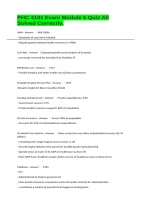
PHC 4101 Exam Module 5 Quiz All
Solved Correctly.
AMA - Answer - Mid 1800s
- Standards of care were initiated
- Argued against national health insurance in 1900s
Civil War - Answer Catalyzed growth and evolution of hospitals
- previously reserved for mentally ill or destitute ill
Hill-Burton Act - Answer - 1947
- Funded hospital and other health care facility construction
Prepaid Hospital Service Plan - Answer - 1929
-Became model for Blue Cross Blue Shield
Funding and Structure - Answer - Private expenditures: 54%
- Government sources: 47%
- Private/public insurance supports 84% of population
Private Insurance - Answer - Covers 58% of population
- Accounts for 33% of total healthcare expenditures
US Health Care System - Answer - More costly than any other industrialized country ($3.35
trillion)
- Constitutes the single largest service vector in US
- Second largest industry only passed by durable goods/manufacturing
- Spends twice as much of its GDP on healthcare as does UK
- Does NOT have: healthier people, better access to healthcare, less medical errors
Medicare - Answer - 1965
- 65+
- Administered by federal government
- Uses private insurance companies across US under contract for administration
-> contribute a portion of payroll tax throughout working lives
, Medicare Parts - Answer A - Ambulance
B - Physician and out patient
C - Managed care
D - Drugs
Medicare Issues - Answer - High-cost sharing equipments
- A: deductibles
- B: monthly premiums
- D: cost-sharing/copays
- Gaps in benefits
- Limited long-term care
- No hearing aids, glasses, or dental
Medicare Stats - Answer - Covers 13% of population - 55 million (46 million elderly, 9 million
<65 with disabilities
- Accounts for 20% of total healthcare expenditures
- 14% of federal budget
Medicaid - Answer - 1965
- For the poor, children, pregnant, elderly, and PWD
- Administered by the states
- Funded jointly by states and federal government
- Today: focus is on welfare population
single parents w/ dependent children, individuals who are aged, blind, or disabled
Medicaid Stats - Answer - Covers 12% of population - 69 mill
- Accounts for 14% of total healthcare expenditures
- 8% of federal budget
- $574.2 bill in 2017
Affordable Care Act - Answer - Signed into law in 2010
- Emphasizing and providing no cost preventative care
- Reduced cost of pharmaceuticals for seniors


