
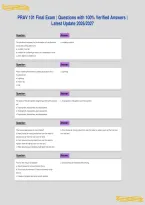
PRAV 101 Final Exam | Questions with 100% Verified Answers |
Latest Update 2026/2027
The conditions necessary for the formation of cumulonimbus a. unstable, moist air.
clouds are a lifting action and
Question:
a. unstable, moist air. Answer:
The conditions necessary for the formation of cumulonimbus a. unstable, moist air.
b. unstable air containing an excess of condensation nuclei.
clouds are a lifting action and
The
c. conditions
either stable ornecessary
unstablefor
airthe formation of cumulonimbus a. unstable, moist air.
a. unstable, moist air.
The conditions
clouds necessary
are a lifting for the formation of cumulonimbus
action and a. unstable, moist air.
b. unstable air containing an excess of condensation nuclei.
clouds are amoist
a. unstable, liftingair.
action and
The
Which
c. conditions
eitherweather
stable ornecessary
unstablefor
phenomenon airthe formation
is always of cumulonimbus
associated with a a. Lightning.
a. unstable, moist air.
a.
b. unstable, moist
unstable air air.
containing an excess of condensation nuclei.
clouds are
thunderstorm?a lifting action and
b. unstable
c. either air containing
stable or unstableanairexcess of condensation nuclei.
a. Lightning.
a. unstable, moist air.
Which
c. eitherweather
stable orphenomenon
unstable airis always associated with a a. Lightning.
b. Heavy
b. unstable air containing an excess of condensation nuclei.
rain.
thunderstorm?
Which
c.
c. either
Hail. weather
stable orphenomenon
unstable airis always associated with a a. Lightning.
Question:
a. Lightning. Answer:
Which weather phenomenon is always associated with a
thunderstorm? a. Lightning.
b. Heavy rain.
thunderstorm?
a. Lightning.
Which
c. Hail. weather phenomenon is always associated with a a. Lightning.
a.
b. Lightning.
Heavy rain.
thunderstorm?
b. Heavy rain.
c. Hail.
a. Lightning.
c. Hail.
b. Heavy rain.
c. Hail.
Question: Answer:
The layers of the atmosphere, beginning at the earth's surface, c. Troposphere, stratosphere, and mesosphere.
are:
a. Troposphere, mesosphere, and stratosphere.
The layers of the atmosphere, beginning at the earth's surface, c. Troposphere, stratosphere, and mesosphere.
b. Stratosphere, mesosphere, and troposphere.
are:
The
c. layers of thestratosphere,
Troposphere, atmosphere, and beginning at the earth's surface,
mesosphere. c. Troposphere, stratosphere, and mesosphere.
a. Troposphere, mesosphere, and stratosphere.
The
are: layers of the atmosphere, beginning at the earth's surface, c. Troposphere, stratosphere, and mesosphere.
b. Stratosphere, mesosphere, and troposphere.
are:
a. Troposphere, mesosphere, and stratosphere.
The
What
c. layers of sea
causes
Troposphere,thestratosphere,
atmosphere,
breezes to move beginning
and inland?at the earth's surface,
mesosphere. c. Troposphere, stratosphere, and mesosphere.
b. Cool, dense air moving inland from over the water to replace warm air that has risen
Question:
a.
b. Troposphere,
Stratosphere, mesosphere,
mesosphere, and and stratosphere.
troposphere. Answer:
are:
a. Warm, dense air moving inland from over the water to over the land.
b. Stratosphere, stratosphere,
c. Troposphere, mesosphere, and troposphere.
mesosphere.
a. Troposphere,
replace cool air mesosphere,
that has risenand overstratosphere.
the land.
What
c. causes seastratosphere,
Troposphere, breezes to move inland?
and mesosphere. b. Cool, dense air moving inland from over the water to replace warm air that has risen
b. Cool,
b. Stratosphere,
dense air mesosphere,
moving inland andfromtroposphere.
over the water to
a. Warm, dense air moving inland from over the water to over the land.
What causes
warmsea
c. Troposphere,
replace breezes to move
airstratosphere,
that has risen andover inland?
mesosphere.
the land. b. Cool, dense air moving inland from over the water to replace warm air that has risen
replace cool air that has risen over the land.
What
c. causes
a. Warm,
Water denseseaair
absorbing breezes
moving toinland
moveheat
and radiating inland?
from over the
faster thanwater to
the land. b. Cool,
over the dense
land. air moving inland from over the water to replace warm air that has risen
b. Cool, dense air moving inland from over the water to
a. Warm,cool
replace denseairair
thatmoving inland
has risen overfrom
the over
land. the water to over the land.
What causes
replace warmseaair breezes to move
that has risen overinland?
the land. b. Cool, dense air moving inland from over the water to replace warm air that has risen
replace
b. Cool, cool
dense airair
that has risen
moving inland over
from theover
land.the water to
a. Warm,
Frost
c. dense
on absorbing
Water air moving
the wing ofand inland
an airplane:
radiating heatfromfaster
over the
thanwater to
the land. over
a. the land.
Should always be removed before flying.
b. Cool, warm
replace denseair airthat
moving inland
has risen from
over over
the the water to
land.
replace
a. Shouldcool air that
always has risen before
be removed over theflying.
land.
replace
c. Waterwarm air that
absorbing has
and risen over
radiating heat the land.than the land.
faster
b. Cool,
b. Shoulddense
only beair moving
removedinland from
if it has an over the water
extremely roughto
Frost
c. on absorbing
Water the wing ofand an airplane:
radiating heat faster than the land. a. Should always be removed before flying.
Question:
replace
texture. warm air that has risen over the land. Answer:
a. Should always be removed before flying.
Frost
c.
c. on absorbing
Water
Causes the
nowing
problemofand
andue
airplane:
radiating heat faster
to its smooth than the land.
surface. a. Should always be removed before flying.
b. Should only be removed if it has an extremely rough
Frost on the
a. Should wingbe
always of removed
an airplane: before flying. a. Should always be removed before flying.
texture.
a.
b. Should always
only bebe removed
removed if itbefore
has anflying.
extremely rough
Frost
c. on the
Causes nowing
problemof andue
airplane:
to its smooth surface. a. Should always be removed before flying.
b. Should only be removed if it has an extremely rough
texture.
a. Should always be removed before flying.
texture.
c. Causes no problem due to its smooth surface.
b. Should only be removed if it has an extremely rough
c. Causes no problem due to its smooth surface.
texture.
c. Causes no problem due to its smooth surface.
,Question: Answer:
AIRMETs are advisories of significant weather phenomena but b. all pilots.
of lower intensities than SIGMETS and are intended for
dissemination to
AIRMETs are advisories of significant weather phenomena but b. all pilots.
a. only IFR pilots.
of lower intensities than SIGMETS and are intended for
b. all pilots.
dissemination to
AIRMETs
c. only VFR arepilots.
advisories of significant weather phenomena but b. all pilots.
a. only IFR pilots.
of lower intensities than SIGMETS and are intended for
b. all pilots.
dissemination to
AIRMETs
What
c. onlyisVFR arepilots.
wake advisories
turbulence? of significant weather phenomena but b. all pilots.
a. The counter rotating vortices off the wingtips of an airplane generating lift.
Question:
a. only IFR pilots. Answer:
ofThe
a. lower intensities
counter thanvortices
rotating SIGMETS offand
theare intended
wingtips for
of an airplane
b. all pilots.
dissemination
generating to
lift.
AIRMETs
What
c. onlyisVFR are
wake advisories
turbulence?
pilots. of significant weather phenomena but b. all pilots.
a. The counter rotating vortices off the wingtips of an airplane generating lift.
a. The
b. onlyairIFRtrailing
pilots.behind an aircraft due to its prop wash in
of lower
a. The intensities
counter thanvortices
rotating SIGMETS offand
theare intended
wingtips for
of an airplane
b. all pilots.
flight.
dissemination
generating lift.to
WhatonlyisVFR
c. The
c. wake turbulence?
pilots. a. The counter rotating vortices off the wingtips of an airplane generating lift.
a. onlyair
b. The IFRtrailing
air pilots.behind
trailing
an aircraft due to its prop wash while
behind an aircraft due to its prop wash in
a. The
onall counter
the ground. rotating vortices off the wingtips of an airplane
b.
flight.pilots.
generating lift.
What
c.
c. onlyisair
The wake
VFR turbulence?
pilots.
trailing behind an aircraft due to its prop wash while a. The counter rotating vortices off the wingtips of an airplane generating lift.
b. The air trailing behind an aircraft due to its prop wash in
a. The
What
on counter
thefeature
ground. isrotating
normally vortices off the
associated wingtips
with of an airplane
the cumulus stage of b. Continuous updraft.
flight.
generating
a thunderstorm? lift.
What
c. Theisairwake turbulence?
trailing behind an aircraft due to its prop wash while a. The counter rotating vortices off the wingtips of an airplane generating lift.
b. The
a. air trailing
Frequent behind an aircraft due to its prop wash in
lightning.
a.
What
on The
the counter
feature
ground. isrotating
normally vortices off the
associated wingtips
with of an airplane
the cumulus stage of b. Continuous updraft.
Question:
flight.
b. Continuous updraft. Answer:
generating
a thunderstorm? lift.
c. The
c. Roll air trailing behind an aircraft due to its prop wash while
cloud.
b.
a. The air
Frequent trailing behind an aircraft due to its prop wash in
lightning.
What
on thefeature
ground. is normally associated with the cumulus stage of b. Continuous updraft.
flight.
b. Continuous updraft.
a thunderstorm?
c.
c. The
WhatRollisair trailing
meant
cloud. bybehind
the terman 'dewpoint'?
aircraft due to its prop wash while a. The temperature to which air must be cooled to become saturated.
a. Frequent lightning.
What
on
a. The feature
thetemperature
ground. is normally
to which air must with
associated the cumulus
be cooled stage of
to become b. Continuous updraft.
b. Continuous updraft.
a thunderstorm?
saturated.
What
c. Rolliscloud.
meant by the term 'dewpoint'? a. The temperature to which air must be cooled to become saturated.
a. The
b. Frequent lightning.
temperature at which dew willwith
always
What feature
a. The temperature is normally associated
to which the form.
air must be cooled cumulus stage of
to become b. Continuous updraft.
b. Continuous
c.thunderstorm? updraft.
The temperature at which condensation and evaporation are
a
saturated.
What
c. Rolliscloud.
equal. meant by the term 'dewpoint'? a. The temperature to which air must be cooled to become saturated.
Question:
a.
b. Frequent
The lightning.
temperature at which dew will always form. Answer:
a. The temperature to which air must be cooled to become
b. Continuous
c. The temperature updraft.
at which condensation and evaporation are
saturated.
What
c.
A Rolliscloud.
weather
equal. meant by the
briefing term
that 'dewpoint'?
is provided when the information a. The
b. temperature
an outlook to which air must be cooled to become saturated.
briefing.
b. The temperature at which dew will always form.
a. The temperature to which
requested is 6 or more hours in advance air must be cooled to become
of the proposed
c. The temperature at which condensation and evaporation are
saturated.
departure timeby is
What
A weather
equal. is meantbriefingthe term
that 'dewpoint'?
is provided when the information a.
b. The temperature
an outlook to which air must be cooled to become saturated.
briefing.
b. The
a. a temperature
prognostic at which dew will always form.
briefing.
a. The temperature
requested is 6 or more to which
hoursairin must be cooled
advance to become
of the proposed
c. The
b. temperature
an outlook at which condensation and evaporation are
briefing.
saturated.
departure time is
A weather
equal.
c. forecast briefing
briefing.that is provided when the information b. an outlook briefing.
b.
a. The temperature
a prognostic at which dew will always form.
briefing.
requested is 6 or more hours in advance of the proposed
c.
b. The temperature
an outlook at which condensation and evaporation are
briefing.
departure time is
A weather
equal.
Thunderstorms
c. forecast briefingmay
briefing. that is provided when the information
contain: b. Turbulence,
c. an outlook briefing.
icing, hailstones, and lightning.
Question:
a. a prognostic briefing. Answer:
requested
a. Turbulence is 6andor more
icing hours
only. in advance of the proposed
b. an outlook briefing.
departure
b. weather
Turbulence time is
and lightning only. when the information
A forecast briefing
Thunderstorms
c. maythat
briefing. is provided
contain: b. an outlook briefing.
c. Turbulence, icing, hailstones, and lightning.
a. Turbulence,
c. a prognosticicing, briefing.
hailstones, and lightning.
requested
a. Turbulence is 6andor more
icing hours
only. in advance of the proposed
b. an outlook briefing.
departure
b. Turbulence timeand is lightning only.
Thunderstorms
c. forecast briefing. may contain: c. Turbulence, icing, hailstones, and lightning.
a. a prognostic briefing.
c. Turbulence, icing, hailstones, and lightning.
a. Turbulence and icing only.
b. an outlook briefing.
b. Turbulence and lightning only.
Thunderstorms
c. forecast briefing. may contain: c. Turbulence, icing, hailstones, and lightning.
c. Turbulence, icing, hailstones, and lightning.
a. Turbulence and icing only.
b. Turbulence and lightning only.
Thunderstorms may contain: c. Turbulence, icing, hailstones, and lightning.
c. Turbulence, icing, hailstones, and lightning.
a. Turbulence and icing only.
b. Turbulence and lightning only.
c. Turbulence, icing, hailstones, and lightning.
, requested is 6 or more hours in advance of the proposed
departure time is
a. a prognostic briefing.
b. an outlook briefing.
c. forecast briefing.
Question: Answer:
Thunderstorms may contain: c. Turbulence, icing, hailstones, and lightning.
a. Turbulence and icing only.
What types of fog depend upon wind in order to exist? a. Advection fog and upslope fog.
b. Turbulence and lightning only.
a. Advection fog and upslope fog.
c. Turbulence, icing, hailstones, and lightning.
b. Steam fog and ground fog.
What types of fog depend upon wind in order to exist? a. Advection fog and upslope fog.
c. Radiation fog and ice fog.
a. Advection fog and upslope fog.
Question:
b. Steam fog and ground fog. Answer:
What types of fog depend upon wind in order to exist? a. Advection fog and upslope fog.
c. Radiation fog and ice fog.
a. Advection fog and upslope fog.
What types of fog depend upon wind in order to exist? a. Advection fog and upslope fog.
b. Steam fog and ground fog.
What types offog
a. Advection fogand
depend upon
upslope wind in order to exist?
fog. a. Advection fog and upslope fog.
c. Radiation fog and ice fog.
a.
b. Advection
Steam fog fog
and and upslope
ground fog. fog.
b. Steam fogfog
c. Radiation andand
ground fog.
ice fog.
c. Radiation fog and ice fog.
Question: Answer:
The information in a METAR is: a. Sequential following a prescribed format.
a. Sequential following a prescribed format.
b. Follows no specific format.
The information in a METAR is: a. Sequential following a prescribed format.
c. Depends on the amount of data presented.
a. Sequential following a prescribed format.
b. Follows no specific format.
The information in a METAR is: a. Sequential following a prescribed format.
Thunderstorms
c. Depends on the reach their greatest
amount intensity during the
of data presented. b. mature stage.
Question:
a. Sequential following a prescribed format. Answer:
The
a. information
downdraft in a METAR is:
stage. a. Sequential following a prescribed format.
b. Follows no specific format.
The
b. information
a. Sequential
mature in a METAR
following
stage. is:
a prescribed format. a. Sequential following a prescribed format.
Thunderstorms
c. Depends on the reach their greatest
amount intensity during the
of data presented. b. mature stage.
a.
b. Sequential
c. Follows no
cumulus following a prescribed format.
specific format.
stage.
a. downdraft stage.
b. Follows no
c. Depends onspecific format.
the amount of data presented.
b. mature stage.
Thunderstorms
c. Depends on the reach their greatest
amount intensity during the
of data presented. b. mature stage.
While flyingstage.
c. cumulus over mountainous terrain you see clouds with a. An unstable air mass over the mountains.
a. downdraft stage.
Thunderstorms
extensive verticalreach their greatest
development. Whatintensity during
does this the
indicate? b. mature stage.
b. mature stage.
Thunderstorms
a. An
a. downdraft
unstablestage. reach
air masstheir
overgreatest intensity during the
the mountains. b. mature stage.
While
c. flyingstage.
cumulus over mountainous terrain you see clouds with a. An unstable air mass over the mountains.
Question:
a.
b.
b. downdraft
mature
Dry stage.
air. stage. Answer:
extensive vertical development. What does this indicate?
b.
c. mature
cumulus stage.
stage.
c. You are in a stable air mass.
a. An unstable air mass over the mountains.
While
c. flyingstage.
cumulus over mountainous terrain you see clouds with a. An unstable air mass over the mountains.
b. Dry air.
extensive vertical development. What does this indicate?
While
You flying
Aviation
c. in over
areRoutine mountainous
Weather
a stable terrain
reports
air mass. you see
(METARs) clouds with
contain: a. An
b. unstable
Wind, air precipitation,
visibility, mass over thecloud
mountains.
coverage, temperature, and altimeter setting.
a. An unstable air mass over the mountains.
While flying over mountainous terrain you see clouds
a. Wind, visibility, precipitation, and temperatureindicate?
extensive vertical development. What does this only. with a. An unstable air mass over the mountains.
b. Dry air.
extensive
a. An vertical
unstable air development.
mass over the What does
mountains. this indicate?
b. Wind, visibility, precipitation, cloud coverage, temperature,
Aviation
c. You areRoutine Weather
in a stable reports (METARs) contain:
air mass. b. Wind, visibility, precipitation, cloud coverage, temperature, and altimeter setting.
a.
b. An
andDry unstable
air.
altimeter air mass over the mountains.
setting.
a. Wind, visibility, precipitation, and temperature only.
b.
c. Dry are
c. You
Wind,air.visibility,
in a stable
andair mass.
precipitation only.
b. Wind, visibility, precipitation, cloud coverage, temperature,
Aviation
c. You are Routine
in a Weather
stable air reports (METARs) contain:
mass. b. Wind, visibility, precipitation, cloud coverage, temperature, and altimeter setting.
Question:
and altimeter setting. Answer:
a. Wind, visibility, precipitation, and temperature only.
Aviation Routine Weather
c. Wind, visibility, reports (METARs)
and precipitation only. contain: b. Wind, visibility, precipitation, cloud coverage, temperature, and altimeter setting.
b. Wind, visibility, precipitation, cloud coverage, temperature,
Aviation Routine Weather reports (METARs) contain:
a. Wind, visibility, precipitation, and temperature only. b. Wind, visibility, precipitation, cloud coverage, temperature, and altimeter setting.
and altimeter setting.
a.
b. Wind, visibility, precipitation, and cloudtemperature only.
coverage, temperature,
c. Wind, visibility, and precipitation only.
b.
andWind, visibility,
altimeter precipitation, cloud coverage, temperature,
setting.
and altimeter
c. Wind, setting.
visibility, and precipitation only.
c. Wind, visibility, and precipitation only.


