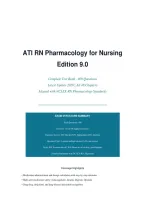
ATI RN Pharmacology for Nursing
Edition 9.0
Complete Test Bank - 400 Questions
Latest Update 2026 | All 48 Chapters
Aligned with NCLEX-RN Pharmacology Standards
EXAM STRUCTURE SUMMARY
Total Questions: 400
Sections: 13 (all 48 chapters covered)
Cognitive Levels: 30% Recall | 50% Application | 20% Analysis
Question Type: 4-option multiple choice (A-D), one correct
Style: 80% Scenario-based | 20% Direct recall of drug classifications
Detailed Rationales with NCLEX-RN Alignment
Coverage Highlights
• Medication administration and dosage calculation with step-by-step rationales
• High-alert medication safety (Anticoagulants, Insulin, Digoxin, Opioids)
• Drug-drug, drug-food, and drug-disease interaction recognition
,ATI RN Pharmacology for Nursing Edition 9.0 | Complete Test Bank (400 Questions) | Latest Update 2026
• Comparison of similar drug classes (ACE vs. ARB, Heparin vs. Warfarin, SSRI vs. SNRI, SABA vs. LABA)
• Therapeutic drug monitoring and lab value correlation
• Lifespan and special population prescribing (Beers Criteria, pregnancy, pediatric)
• NCLEX-RN clinical judgment and prioritization formats
ATI Review Module Content Mastery Series
Aligned with current FDA safety communications and medication standards
Prepared for nursing education and NCLEX-RN preparation
Z.ai - ATI RN Pharmacology Test Bank 2026 Page 2
,ATI RN Pharmacology for Nursing Edition 9.0 | Complete Test Bank (400 Questions) | Latest Update 2026
Section 1: Pharmacologic Foundations and Principles (Q1-Q40)
Ch. 1-5: Drug Regulation, Pharmacokinetics, Pharmacodynamics, Drug Interactions, & Prescriptive
Considerations (Q1-Q40)
Q1: A nurse is teaching a client about drug regulation in the United States. Which of the following federal laws
established the requirement for drugs to be proven safe before marketing?
A. Harrison Narcotic Act of 1914
B. Pure Food and Drug Act of 1906
C. Federal Food, Drug, and Cosmetic Act of 1938 [CORRECT]
D. Kefauver-Harris Amendment of 1962
Correct Answer: C
Rationale:
The Federal Food, Drug, and Cosmetic Act of 1938 was passed after the sulfanilamide elixir disaster and required
drugs to be proven SAFE before marketing. The Pure Food and Drug Act of 1906 (option B) prohibited
adulterated/misbranded drugs but did not require safety testing. The Kefauver-Harris Amendment of 1962 (option D)
added the requirement for PROVEN EFFICACY in addition to safety, after the thalidomide tragedy. The Harrison Act
(option A) regulated narcotics.
Q2: A nurse is reviewing drug classifications. Which of the following is TRUE regarding Schedule II controlled
substances?
A. They have a low abuse potential and are accepted for medical use.
B. They have a high abuse potential and accepted medical use; prescriptions cannot be refilled without a
new written prescription. [CORRECT]
C. They have a high abuse potential with NO accepted medical use.
D. They have the lowest abuse potential of all controlled substances.
Correct Answer: B
Rationale:
Schedule II drugs (e.g., morphine, oxycodone, fentanyl, methylphenidate, amphetamines, methadone) have HIGH
abuse potential with accepted medical use. They require a written or electronic prescription (no refills allowed without
a new prescription), and the prescription must be presented or e-prescribed per DEA requirements. Schedule I (option
C, e.g., heroin, LSD) has NO accepted medical use. Schedule III-V (option A and D) have progressively lower abuse
potential.
Q3: A nurse is teaching a client about pharmacokinetics. The client asks what 'first-pass effect' means. The
nurse's BEST response is that the first-pass effect:
A. Occurs when the drug is filtered by the kidneys before reaching the bloodstream.
B. Refers to the metabolism of a drug by the liver after oral absorption, which reduces the amount of
active drug reaching systemic circulation. [CORRECT]
C. Occurs when the drug binds to plasma proteins and is unavailable.
D. Refers to the drug being absorbed across the blood-brain barrier.
Correct Answer: B
Z.ai - ATI RN Pharmacology Test Bank 2026 Page 3
, ATI RN Pharmacology for Nursing Edition 9.0 | Complete Test Bank (400 Questions) | Latest Update 2026
Rationale:
The first-pass effect (first-pass metabolism) is the metabolism of a drug by the liver (and gut wall) after oral absorption,
before reaching systemic circulation. This significantly reduces the bioavailability of many oral drugs (e.g., morphine,
propranolol, nitroglycerin). Sublingual, IV, IM, and rectal routes bypass or partially bypass the first-pass effect. The
nurse should explain why oral doses of some drugs are higher than parenteral doses.
Q4: A client is prescribed a medication that is highly protein-bound. The nurse should monitor closely when
another highly protein-bound drug is added because:
A. The drugs will combine to form a toxic compound.
B. Displacement from protein-binding sites can increase free (active) drug levels, potentially causing
toxicity. [CORRECT]
C. The drugs will be eliminated too rapidly.
D. The drugs will compete for hepatic metabolism only.
Correct Answer: B
Rationale:
Highly protein-bound drugs (e.g., warfarin, phenytoin, valproate, sulfonamides, diazepam) bind to plasma proteins
(mainly albumin). When two protein-bound drugs are given together, they compete for binding sites, displacing one
another and increasing the free (active) fraction of the displaced drug. This can lead to toxicity. Hypoalbuminemia
(e.g., liver disease, nephrotic syndrome, malnutrition) also increases free drug levels.
Q5: A nurse is caring for a client with hepatic impairment. The nurse should understand that this client may
require dosage adjustments because the liver is the primary site for:
A. Drug absorption only.
B. Drug metabolism and biotransformation. [CORRECT]
C. Drug excretion only.
D. Drug distribution only.
Correct Answer: B
Rationale:
The liver is the primary organ for drug metabolism (biotransformation), primarily through the cytochrome P450
enzyme system. Hepatic impairment reduces metabolism, leading to drug accumulation and toxicity risk. Dosage
adjustments or longer dosing intervals are often required for hepatically cleared drugs (e.g., diazepam, morphine,
phenytoin). The kidneys are for excretion (option C); the GI tract for absorption (option A); and distribution depends
on blood flow, protein binding, and tissue affinity (option D).
Q6: A nurse is teaching a client about pharmacodynamics. The nurse should explain that pharmacodynamics
refers to:
A. What the body does to the drug.
B. What the drug does to the body, including receptor interactions and therapeutic effects. [CORRECT]
C. The metabolism of the drug.
D. The excretion of the drug.
Correct Answer: B
Rationale:
Pharmacodynamics is 'what the drug does to the body,' including receptor binding, signal transduction, and
therapeutic/toxic effects. Pharmacokinetics (option A) is 'what the body does to the drug' (ADME: absorption,
distribution, metabolism, excretion). Understanding pharmacodynamics helps predict drug effects, interactions, and
adverse effects based on mechanism of action.
Z.ai - ATI RN Pharmacology Test Bank 2026 Page 4