
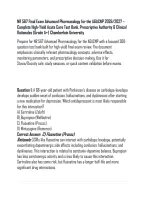
NR 567 Final Exam Advanced Pharmacology for the AGACNP 2026/2027 –
Complete High-Yield Acute Care Test Bank, Prescriptive Authority & Clinical
Rationales (Grade A+) Chamberlain University
Prepare for NR 567 Advanced Pharmacology for the AGACNP with a focused 300-
question test bank built for high-yield final exam review. The document
emphasizes clinically relevant pharmacology concepts, adverse effects,
monitoring parameters, and prescriptive decision-making. Use it for
Stuvia/Docsity sale, study sessions, or quick content validation before exams.
Question 1: A 68-year-old patient with Parkinson's disease on carbidopa-levodopa
develops sudden onset of confusion, hallucinations, and dyskinesias after starting
a new medication for depression. Which antidepressant is most likely responsible
for this interaction?
A) Sertraline (Zoloft)
B) Bupropion (Wellbutrin)
C) Fluoxetine (Prozac)
D) Mirtazapine (Remeron)
Correct Answer: C) Fluoxetine (Prozac)
Rationale: SSRIs like fluoxetine can interact with carbidopa-levodopa, potentially
exacerbating dopaminergic side effects including confusion, hallucinations, and
dyskinesias. This interaction is related to serotonin-dopamine balance. Bupropion
has less serotonergic activity and is less likely to cause this interaction.
Sertraline also has some risk, but fluoxetine has a longer half-life and more
significant drug interactions.
,Question 2: A patient with refractory generalized tonic-clonic seizures is started
on valproic acid (Depakote). Which laboratory parameter requires the most
frequent monitoring?
A) Serum creatinine
B) Liver function tests (AST, ALT)
C) Serum potassium
D) Complete blood count
Correct Answer: B) Liver function tests (AST, ALT)
Rationale: Valproic acid is associated with hepatotoxicity, and liver function tests
should be monitored frequently, especially during the first six months of therapy.
Serum creatinine and potassium are not the primary parameters affected,
although pancreatitis and thrombocytopenia are also possible adverse effects.
Question 3: A 35-year-old female with long-standing anxiety treated with
diazepam (Valium) triples her daily dose due to increased stress. She is found
lethargic and obtunded. Which agent should be administered?
A) Naloxone (Narcan)
B) Flumazenil (Romazicon)
C) Activated charcoal
D) Thiamine
Correct Answer: B) Flumazenil (Romazicon)
Rationale: Flumazenil is a competitive benzodiazepine antagonist at the GABA-A
receptor. It reverses the sedative effects of benzodiazepine overdose. However,
caution is needed as it may precipitate seizures in benzodiazepine-dependent
patients. Naloxone is used for opioid overdose, not benzodiazepines.
,Question 4: Which medication should be given to patients presenting to the ED
with altered mental status, seizures, or both, if concern for Wernicke-Korsakoff
syndrome exists?
A) Folate (Folic acid)
B) Chlordiazepoxide (Librium)
C) Thiamine (Vitamin B1)
D) Lorazepam (Ativan)
Correct Answer: C) Thiamine (Vitamin B1)
Rationale: Thiamine is the essential treatment for Wernicke-Korsakoff syndrome,
which results from thiamine deficiency often associated with alcohol use disorder.
Thiamine should be administered before glucose to prevent precipitating acute
neurological symptoms. This is a critical intervention in the emergency setting.
Question 5: Which antiseizure medication is preferred for a generalized seizure
disorder in a 25-year-old pregnant female?
A) Phenobarbital (Solfoton)
B) Valproate (Valproic acid)
C) Levetiracetam (Keppra)
D) Topiramate (Topamax)
Correct Answer: C) Levetiracetam (Keppra)
Rationale: Levetiracetam is preferred in pregnancy due to its lower teratogenic
risk profile. Valproate is associated with neural tube defects and increased risk of
autism spectrum disorder; phenobarbital and topiramate also carry higher risks.
This reflects current AGACNP practice guidelines for managing epilepsy in
pregnancy.
, Question 6: A patient with Parkinson's disease is prescribed pramipexole. What is
the mechanism of action of this medication?
A) Inhibits monoamine oxidase-B
B) Stimulates dopamine-2 and dopamine-3 receptors
C) Increases dopamine synthesis and release
D) Inhibits COMT enzyme
Correct Answer: B) Stimulates dopamine-2 and dopamine-3 receptors
Rationale: Pramipexole is a nonergot dopamine agonist that works by stimulating
dopamine-2 (D2) and dopamine-3 (D3) receptors. This helps compensate for the
dopamine deficiency seen in Parkinson's disease. MAO-B inhibitors, COMT
inhibitors, and dopamine precursors work through different mechanisms.
Question 7: A 72-year-old woman with congestive heart failure and chronic
kidney disease (eGFR = 28 mL/min) is admitted for dyspnea exacerbation and
started on a new antibiotic that is primarily renally eliminated. After two doses,
she complains of dizziness and confusion. Which of the following is the most likely
cause?
A) The antibiotic is not effective at the current dose
B) Drug accumulation due to reduced renal clearance
C) An allergic reaction to the antibiotic
D) The antibiotic is interacting with her heart failure medications
Correct Answer: B) Drug accumulation due to reduced renal clearance
Rationale: Drugs that are primarily renally eliminated can accumulate in patients
with chronic kidney disease, leading to toxicity. The dizziness and confusion are
likely signs of drug accumulation. Dose adjustment is required based on creatinine
clearance.


