
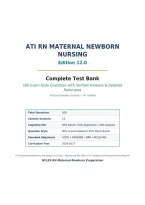
ATI RN MATERNAL NEWBORN
NURSING
Edition 12.0
Complete Test Bank
500 Exam-Style Questions with Verified Answers & Detailed
Rationales
All Core Domains Covered — A+ Graded
Total Questions 500
Content Sections 12
Cognitive Mix 30% Recall | 50% Application | 20% Analysis
Question Style 80% Scenario-Based | 20% Direct Recall
Standard Alignment ACOG • AWHONN • NRP • NCLEX-RN
Curriculum Year 2026-2027
ATI Maternal Newborn Nursing Edition 12.0 Style | Aligned with the Official ATI Textbook and Proctored Exam Blueprint
NCLEX-RN Maternal-Newborn Preparation
,ATI RN Maternal Newborn Nursing Edition 12.0 — Complete Test Bank 2026 ATI Curriculum Standards | A+ Graded
About This Test Bank
This comprehensive test bank contains 500 exam-style questions meticulously aligned with the
ATI RN Maternal Newborn Nursing Edition 12.0 textbook and the official ATI proctored
examination blueprint. Each question reflects the cognitive complexity and clinical judgment
expectations of current NCLEX-RN standards, with content calibrated to the 2026-2027 ATI
curriculum. The bank is organized into twelve core content sections spanning the entire
maternal-newborn continuum: from antepartum assessment through high-risk newborn care,
women's reproductive health, pharmacologic management, and integrated clinical judgment
scenarios.
Question design follows the ATI framework of 30% recall, 50% application, and 20% analysis
cognitive levels. Eighty percent of items are scenario-based, requiring the test-taker to apply
nursing judgment to authentic clinical situations; the remaining twenty percent assess
foundational recall and standard interpretation skills such as GTPAL calculation, EDD
determination, APGAR scoring, and electronic fetal monitoring tracing categorization. Distractors
are intentionally engineered to reflect common maternal-newborn pitfalls — misinterpreting fetal
heart rate tracings, confusing placenta previa with abruptio placentae, miscalculating GTPAL,
misidentifying the 4 T's of postpartum hemorrhage, and failing to recognize magnesium toxicity.
Each item includes a verified correct answer and a detailed rationale explaining both why the
correct option is right and why each distractor is wrong, with attention to physiologic basis,
assessment findings, prioritization rationale, and nursing intervention evidence. Questions are
sequenced by content area to facilitate focused review; users may also shuffle items for
comprehensive NCLEX-RN practice. This resource is intended for nursing students, registered
nurses preparing for the ATI proctored maternal-newborn exam, and NCLEX-RN candidates
seeking rigorous maternal-newborn preparation aligned with current ACOG, AWHONN, and NRP
clinical guidelines.
Section Breakdown
# Section Title Questions
1 Antepartum Nursing Care Q1-50
2 Antepartum Complications Q51-96
3 Intrapartum Nursing Care Q97-148
4 Intrapartum Complications and Operative Birth Q149-192
5 Postpartum Nursing Care Q193-240
6 Postpartum Complications Q241-282
7 Newborn Assessment and Transition Q283-328
8 High-Risk Newborn Care Q329-374
9 Reproductive and Women's Health Q375-412
10 Maternal-Newborn Medications Q413-444
Page 2 | NCLEX-RN Maternal-Newborn Preparation
,ATI RN Maternal Newborn Nursing Edition 12.0 — Complete Test Bank 2026 ATI Curriculum Standards | A+ Graded
11 Prioritization, Safety, Cultural Care, & Patient Education Q445-472
12 NCLEX-RN Integration and Clinical Judgment Q473-500
Page 3 | NCLEX-RN Maternal-Newborn Preparation
, ATI RN Maternal Newborn Nursing Edition 12.0 — Complete Test Bank 2026 ATI Curriculum Standards | A+ Graded
SECTION 1: ANTEPARTUM NURSING CARE
Prenatal Assessment, GTPAL, EDD Calculation, Nutrition, & Common Discomforts
Q1: A primigravida client at 12 weeks' gestation asks the nurse when her baby is
due. The client reports her last menstrual period (LMP) began on January 1. Using
Naegele's rule, what is the estimated date of delivery (EDD)?
A. October 1 of the same year
B. October 8 of the same year [CORRECT]
C. October 15 of the same year
D. November 1 of the same year
Correct Answer: B
Rationale: Naegele's rule calculates EDD by subtracting 3 months from the first day of the LMP, adding
7 days, and adding 1 year if needed. January 1 minus 3 months = October 1; add 7 days = October 8.
Option A omits the 7-day addition. Option C incorrectly adds 14 days. Option D subtracts only 2
months.
Q2: A nurse is calculating a client's GTPAL. The client reports: two term births at
39 and 40 weeks, one preterm birth at 34 weeks, one miscarriage at 10 weeks,
and three living children. She is currently pregnant. What is the correct GTPAL?
A. G5 T2 P1 A1 L3 [CORRECT]
B. G4 T2 P1 A1 L3
C. G5 T3 P1 A1 L3
D. G5 T2 P0 A2 L3
Correct Answer: A
Rationale: G (gravida) = 5 (current pregnancy + 2 term + 1 preterm + 1 miscarriage). T (term) = 2
(both ≥37 weeks). P (preterm) = 1 (the 34-week birth). A (abortion) = 1 (miscarriage before 20 weeks
counts as abortion in GTPAL). L (living) = 3. Option B undercounts the current pregnancy. Option C
misclassifies a preterm birth as term. Option D ignores the preterm birth and double-counts abortions.
Q3: A nurse is assessing a client at 8 weeks' gestation. Which finding should the
nurse identify as a presumptive sign of pregnancy?
A. Fetal heart rate detected by Doppler
B. Chadwick's sign on pelvic examination
C. Nausea and vomiting reported by the client [CORRECT]
D. Positive pregnancy test for hCG
Correct Answer: C
Rationale: Presumptive signs are subjective symptoms experienced by the client and include
amenorrhea, nausea/vomiting, fatigue, urinary frequency, and quickening. Chadwick's sign and a
positive pregnancy test are probable signs (objective but not definitive). Fetal heart rate detected by
Doppler is a positive (diagnostic) sign of pregnancy, as it can only originate from a fetus.
Page 4 | NCLEX-RN Maternal-Newborn Preparation


