
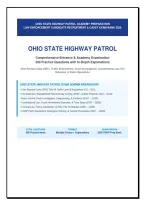
OHIO STATE HIGHWAY PATROL ACADEMY PREPARATION
LAW ENFORCEMENT CANDIDATE RECRUITMENT & CADET EXAM BANK 2026
OHIO STATE HIGHWAY PATROL
Comprehensive Entrance & Academy Examination
300 Practice Questions with In-Depth Explanations
Ohio Revised Code (ORC), Traffic Enforcement, Crash Investigation, Constitutional Law, OVI
Detection, & Patrol Operations
OHIO STATE HIGHWAY PATROL EXAM DOMAIN BREAKDOWN
• Ohio Revised Code (ORC) Title 45 Traffic Laws & Regulations (Q1 – Q50)
• OVI Detection, Standardized Field Sobriety Testing (SFST), & BAC Protocols (Q51 – Q100)
• Motor Vehicle Crash Investigation, Diagramming, & Evidence (Q101 – Q150)
• Constitutional Law, Fourth Amendment Searches, & Terry Stops (Q151 – Q200)
• Criminal Law, Felony Interdiction, & ORC Title 29 Statutes (Q201 – Q250)
• OSHP Patrol Operations, Emergency Driving, & Tactical Procedures (Q251 – Q300)
TOTAL QUESTIONS FORMAT EXAM VERSION
300 Practice Items Multiple Choice + Explanations 2026 OSHP Prep Bank
,OHIO STATE HIGHWAY PATROL COMPREHENSIVE EXAM
BANK (Q1 - Q300)
Question 1 [Q1] Under Ohio Revised Code Section 4511.21, what is the prima-facie speed limit
in an alley within a municipal corporation, unless otherwise posted?
(A) 15 miles per hour
(B) 20 miles per hour
(C) 25 miles per hour
(D) 10 miles per hour
CORRECT ANSWER: (A) 15 miles per hour
Legal / Operational Rationale: ORC 4511.21(B)(1)(a) establishes a prima-facie speed limit of 15 miles per
hour in any alley within a municipal corporation.
Question 2 [Q2] According to ORC 4511.19, what is the legal blood alcohol concentration
(BAC) limit per se for an adult driver operating a non-commercial motor vehicle in Ohio?
(A) 0.04%
(B) 0.10%
(C) 0.02%
(D) 0.08%
CORRECT ANSWER: (D) 0.08%
Legal / Operational Rationale: ORC 4511.19(A)(1)(b) establishes a per se statutory prohibition against
operating a motor vehicle with a BAC of 0.08% or higher for drivers aged 21 and older.
Question 3 [Q3] During the Horizontal Gaze Nystagmus (HGN) test, what is the maximum
number of clues that a Trooper can observe across both eyes?
(A) 8 clues
(B) 2 clues
(C) 6 clues
(D) 4 clues
CORRECT ANSWER: (C) 6 clues
Legal / Operational Rationale: The HGN test evaluates 3 clues per eye (lack of smooth pursuit, distinct and
sustained nystagmus at maximum deviation, onset of nystagmus prior to 45 degrees), totaling 6 maximum
clues.
Question 4 [Q4] Which NHTSA-validated Field Sobriety Test requires the subject to take 9
steps out along a straight line, turn in a prescribed manner, and take 9 steps back?
(A) Modified Romberg Balance test
(B) Walk-and-Turn (WAT) test
, (C) One-Leg Stand (OLS) test
(D) Horizontal Gaze Nystagmus (HGN)
CORRECT ANSWER: (B) Walk-and-Turn (WAT) test
Legal / Operational Rationale: The Walk-and-Turn test is a standardized divided-attention test where the
suspect takes 9 heel-to-toe steps along a line, turns, and returns taking 9 heel-to-toe steps.
Question 5 [Q5] When investigating a crash, an Trooper observes tire marks on the asphalt
caused by a locked, sliding wheel that leaves heavy rubber deposits. What type of tire mark is
this?
(A) Skid mark
(B) Yaw mark
(C) Scuff mark
(D) Print mark
CORRECT ANSWER: (A) Skid mark
Legal / Operational Rationale: A skid mark is produced by a tire that is locked and sliding, preventing
rotation. Yaw marks occur when a tire is slipping sidewards while still rotating.
Question 6 [Q6] In motor vehicle crash reconstruction, what critical piece of data is calculated
using the drag factor (coefficient of friction) and skid distance?
(A) Maximum acceleration rate
(B) Total impact force in foot-pounds
(C) Exact reaction time of the driver in milliseconds
(D) Minimum initial speed of the vehicle prior to braking
CORRECT ANSWER: (D) Minimum initial speed of the vehicle prior to braking
Legal / Operational Rationale: The skid speed formula (S = sqrt(30 * d * f)) uses the skid distance (d) and
coefficient of friction (f) to determine the minimum speed of the vehicle prior to braking.
Question 7 [Q7] Under the Fourth Amendment landmark ruling in Terry v. Ohio (1968), what
level of proof must a law enforcement officer possess to conduct a brief investigatory stop and
pat-down for weapons?
(A) Clear and convincing evidence
(B) Absolute certainty beyond a reasonable doubt
(C) Reasonable suspicion that criminal activity is afoot and the person is armed and dangerous
(D) Probable cause to arrest
CORRECT ANSWER: (C) Reasonable suspicion that criminal activity is afoot and the person is
armed and dangerous
Legal / Operational Rationale: Terry v. Ohio established that an officer may conduct a brief stop and frisk for
weapons based on reasonable suspicion that a person has committed/is committing a crime and is armed.
, Question 8 [Q8] During a lawful traffic stop, an Trooper notices a bag of cocaine sitting on the
passenger seat in clear view without moving any objects. Under what legal doctrine is the
seizure of this evidence justified?
(A) Inventory Search Exception
(B) Plain View Doctrine
(C) Exigent Circumstances
(D) Consent Search Exception
CORRECT ANSWER: (B) Plain View Doctrine
Legal / Operational Rationale: The Plain View Doctrine allows officers to seize evidence without a warrant if
they are lawfully present, the item is in open view, and its incriminating character is immediately apparent.
Question 9 [Q9] Under ORC 2921.31, obstructing official business occurs when a person,
without privilege to do so and with purpose to prevent or delay an official function, performs
which of the following?
(A) An affirmative overt act that hampers or impedes a public official in the performance of duties
(B) Refuses to answer casual background questions
(C) Remains completely silent during questioning
(D) Files a formal complaint against the officer
CORRECT ANSWER: (A) An affirmative overt act that hampers or impedes a public official in the
performance of duties
Legal / Operational Rationale: ORC 2921.31 requires an affirmative overt act that impedes or obstructs a
public official; mere silence or refusal to speak typically does not constitute obstruction.
Question 10 [Q10] What primary statutory authority grants the Ohio State Highway Patrol
primary jurisdiction over state highways and state-owned property under ORC 5503.02?
(A) Investigation of federal tax fraud
(B) Primary municipal code enforcement in townships
(C) Civil court judgments and eviction enforcement
(D) Enforcement of traffic laws, investigation of crashes, and preservation of peace on state roadways
and property
CORRECT ANSWER: (D) Enforcement of traffic laws, investigation of crashes, and preservation
of peace on state roadways and property
Legal / Operational Rationale: ORC 5503.02 specifies that the OSHP enforces laws relating to the
registration and operation of vehicles on state highways and preserves the peace on state property.
Question 11 [Q11 - OSHP Cadet Examination] Under Ohio Revised Code Section 4511.21,
what is the prima-facie speed limit in an alley within a municipal corporation, unless otherwise
posted? (Item #11)
(A) 25 miles per hour


