
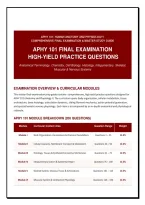
APHY 101: HUMAN ANATOMY AND PHYSIOLOGY I
COMPREHENSIVE FINAL EXAMINATION & MASTER STUDY GUIDE
APHY 101 FINAL EXAMINATION
HIGH-YIELD PRACTICE QUESTIONS
Anatomical Terminology, Chemistry, Cell Biology, Histology, Integumentary, Skeletal,
Muscular & Nervous Systems
EXAMINATION OVERVIEW & CURRICULAR MODULES
This master final examination prep guide contains comprehensive, high-yield practice questions designed for
APHY 101 (Anatomy and Physiology I). The curriculum spans body organization, cellular metabolism, tissue
architecture, bone histology, articulation dynamics, sliding filament mechanics, action potential generation,
and special/somatic sensory physiology. Each item is accompanied by an in-depth anatomical and physiological
rationale.
APHY 101 MODULE BREAKDOWN (200 QUESTIONS)
Module Curricular Content Area Question Range Weight
Module I Body Organization, Homeostasis & Chemical Foundations Questions 1 – 25 12.5%
Module II Cellular Anatomy, Membrane Transport & Metabolism Questions 26 – 50 12.5%
Module III Histology, Tissues & Epithelial/Connective Membranes Questions 51 – 75 12.5%
Module IV Integumentary System & Epidermal Repair Questions 76 – 100 12.5%
Module V Skeletal System, Osseous Tissue & Articulations Questions 101 – 125 12.5%
Module VI Muscular System & Contraction Physiology Questions 126 – 150 12.5%
, Module VII Nervous System, Action Potentials & Synapses Questions 151 – 175 12.5%
Module VIII Central/Peripheral Nervous System & Sensory Organs Questions 176 – 200 12.5%
STUDY & EXAMINATION INSTRUCTIONS:
1. Select the single best answer (A–D) for each anatomical or physiological question.
2. Detailed rationales are provided immediately following each question block in crimson callout boxes.
3. Focus on understanding physiological mechanisms (e.g., negative feedback, cross-bridge cycling, resting membrane
potential) rather than memorizing isolated terms.
,MODULE I: BODY ORGANIZATION, HOMEOSTASIS & CHEMICAL
FOUNDATIONS
Question 1. Which of the following anatomical terms best describes the relationship of the wrist (carpus) to the
elbow (cubitus)?
A) Proximal
B) Distal
C) Medial
D) Superior
CORRECT ANSWER: B
PHYSIOLOGICAL RATIONALE & ANATOMICAL CORRELATE: The wrist is distal to the elbow because it is located farther
from the point of attachment (the shoulder trunk) along the upper limb.
Question 2. In a negative feedback control loop maintaining human body temperature, what role is played by
the hypothalamus when core body temperature rises above 37°C?
A) Stimulus
B) Receptor
C) Control Center
D) Effector
CORRECT ANSWER: C
PHYSIOLOGICAL RATIONALE & ANATOMICAL CORRELATE: The hypothalamus functions as the integration/control
center. It compares incoming sensory data from thermoreceptors against the set point and sends output signals to effectors (sweat
glands, cutaneous blood vessels).
Question 3. Which organelle or cellular process relies directly on hydrogen bonding between water molecules to
maintain blood plasma liquid fluidity and thermal stability?
A) High heat capacity and high heat of vaporization of water
B) Nonpolar hydrophobic interactions of triglycerides
C) Ionic dissociation of sodium chloride crystals
D) Covalent peptide bond formation
CORRECT ANSWER: A
PHYSIOLOGICAL RATIONALE & ANATOMICAL CORRELATE: Hydrogen bonding gives water a high heat capacity and
high heat of vaporization, enabling blood plasma to absorb large amounts of heat with minimal temperature change.
, Question 4. Which of the following anatomical terms best describes the relationship of the wrist (carpus) to the
elbow (cubitus)? (Clinical & Applied Scenario 2)
A) Proximal
B) Distal
C) Medial
D) Superior
CORRECT ANSWER: B
PHYSIOLOGICAL RATIONALE & ANATOMICAL CORRELATE: The wrist is distal to the elbow because it is located farther
from the point of attachment (the shoulder trunk) along the upper limb.
Question 5. In a negative feedback control loop maintaining human body temperature, what role is played by
the hypothalamus when core body temperature rises above 37°C? (Clinical & Applied Scenario 2)
A) Stimulus
B) Receptor
C) Control Center
D) Effector
CORRECT ANSWER: C
PHYSIOLOGICAL RATIONALE & ANATOMICAL CORRELATE: The hypothalamus functions as the integration/control
center. It compares incoming sensory data from thermoreceptors against the set point and sends output signals to effectors (sweat
glands, cutaneous blood vessels).
Question 6. Which organelle or cellular process relies directly on hydrogen bonding between water molecules to
maintain blood plasma liquid fluidity and thermal stability? (Clinical & Applied Scenario 2)
A) High heat capacity and high heat of vaporization of water
B) Nonpolar hydrophobic interactions of triglycerides
C) Ionic dissociation of sodium chloride crystals
D) Covalent peptide bond formation
CORRECT ANSWER: A
PHYSIOLOGICAL RATIONALE & ANATOMICAL CORRELATE: Hydrogen bonding gives water a high heat capacity and
high heat of vaporization, enabling blood plasma to absorb large amounts of heat with minimal temperature change.


