
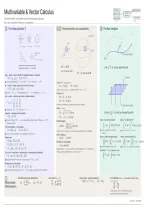
Multivariable & Vector Calculus
② operators ∇ ③ conservative
⑦ three
④⑤ parametrize
theorems
physics uses
The math toolkit and where each tool shows up in physics ⑥ four integrals
page 1 page 2
left to right: ingredients → theorems → consequences
② The three operators ∇ ④⑤ Parametrization and coordinates ⑥ The four integrals
ρ sin ϕ dθ
r dθ F
∇ ⋅ F > 0 source ∇ ⋅ F < 0 sink ∇ × F vortex
dr
ρ dϕ
paddle wheel
turns θ dr along the path
→ ∇ × F is not zero
start
No whirlpool, still curl: faster on one side
Sign: counterclockwise = +z^ (right hand)
dA = r dr dθ Line: ∫C F ⋅ dr, add up along the path
arc side grows with r
dV = ρ2 sin ϕ dρ dϕ dθ
grad — scalar → vector, direction of steepest increase, ⊥ level sets
∇f = ⟨fx , fy , fz ⟩,
Du^ f = ∇f ⋅ u
^
^ normal
n
Force from potential F = −∇U · field E = −∇ϕ · heat flow q = −k∇T
Curve r(t) = ⟨x(t), y(t), z(t)⟩
div — vector → scalar, source (>0) or sink (<0) density ds = ∣r ′ (t)∣ dt, dr = r ′ (t) dt
∇ ⋅ F = ∂x F1 + ∂y F2 + ∂z F3
circle (a cos bt, a sin bt), b = number of turns · line r = a + tb
Gauss ∇ ⋅ E = ρ/ε0 · incompressible flow ∇ ⋅ v = 0 · continuity ∂t ρ + ∇ ⋅ J = 0
Surface r(u, v)
curl — vector → vector, local rotation, circulation density dS = (ru × rv ) du dv
^i ^j k^
dS = ∣ru × rv ∣ du dv
∇ × F = ∂x ∂y ∂z
normal sets orientation, closed surfaces point outward
F1 F2 F3
F pierces the patch
Graph z = f (x, y)
Faraday ∇ × E = −∂t B · vorticity ω = ∇ × v
Laplacian — divergence of the gradient dS = 1 + fx2 + fy2 dx dy
Surface: ∬S F ⋅ dS , add up through the patch
2
∇ f = ∇ ⋅ ∇f dS = ⟨−fx , −fy , 1⟩dx dy
Laplace / Poisson ∇2 ϕ = −ρ/ε0 (electrostatics, steady heat) · diffusion ∂t c = D∇2 c Scalar · line (no dot product) Vector · line (dot with dr)
Multiple integrals
b
(transport, fluids) b
dx dy dz =
∂(x, y, z)
du dv dw ∫ f ds = ∫ f (r(t)) ∣r ′ (t)∣ dt ∫ F ⋅ dr = ∫ F (r(t)) ⋅ r ′ (t) dt
Two zero identities — the backbone
∂(u, v, w)
C a C a
∇ × (∇f ) = 0, ∇ ⋅ (∇ × F ) = 0 outer limits are constants; inner limits may depend on outer variables mass / charge of a wire with work W · emf E = ∮ E ⋅ dr
has curl ⇒ not a gradient · has divergence ⇒ not a curl density f
Polar / cylindrical
Product rules Scalar · surface (no dot product) Vector · surface (dot with dS )
r dr dθ r dr dθ dz
∇(f g) = f ∇g + g∇f Spherical (ϕ = polar angle) ∬ f dS = ∬ f ∣ru × rv ∣ du dv
∬ F ⋅ dS = ∬ F ⋅ (ru × rv ) du dv
∇ ⋅ (f F ) = f ∇ ⋅ F + ∇f ⋅ F 2
ρ sin ϕ dρ dϕ dθ
S D S D
surface charge / mass, area flux: ΦE , ΦB , mass flow, heat flow
∇ × (f F ) = f ∇ × F + ∇f × F
solid angle dΩ = sin ϕ dϕ dθ · sphere surface element ρ2 dΩ · convention: ρ
2D flux of F = ⟨M , N ⟩ across a curve
Curl of curl — every field = irrotational part + solenoidal part (Helmholtz) radius, ϕ polar angle from the z axis, θ azimuth
∇ × (∇ × F ) = ∇(∇ ⋅ F ) − ∇2 F ∮ F ⋅n
^ ds = ∮ M dy − N dx
C C
Apply to Maxwell in vacuum → wave equation ∇2 E = μ0 ε0 ∂t2 E
Divergence of a cross product
∇ ⋅ (A × B ) = B ⋅ (∇ × A) − A ⋅ (∇ × B )
Poynting theorem: energy flow S = E × H , energy conservation of the EM field
① Total differential / linear approximation Chain rule for xi = xi (t)
Tangent plane · Lagrange multipliers Exact differential: P dx + Q dy is exact ⇔ some f has
∂f ∂f dxi ∇f (P ) ⋅ (r − P ) = 0, ∇f = λ∇g
df = ∑
df P = fx , Q = fy
Multivariable dx i , Δf ≈ ∇f ⋅ Δr =∑
∂xi ∂xi dt ∂P ∂Q
dt =
differentiation
i
i
∂y ∂x
same test as curl = 0 in ③: exactness and
conservativeness are one concept
page 1 of 2 · ingredients


