
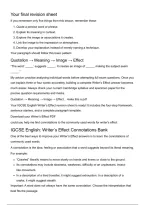
Your final revision sheet
If you remember only five things from this lesson, remember these:
1. Quote a precise word or phrase.
2. Explain its meaning in context.
3. Explore the image or associations it creates.
4. Link the image to the impression or atmosphere.
5. Develop your explanation instead of merely naming a technique.
Your paragraph should follow this basic pattern:
Quotation → Meaning → Image → Effect
“The word ‘_____’ suggests _____. It creates an image of _____, making the subject seem
_____.”
My advice: practise analysing individual words before attempting full exam questions. Once you
can explain three or four words accurately, building a complete Writer’s Effect answer becomes
much easier. Always check your current Cambridge syllabus and specimen paper for the
precise question requirements and marks.
Quotation → Meaning → Image → Effect .. make this a pdf
Your IGCSE English Writer’s Effect revision sheet is ready! It includes the four-step framework,
sentence starters, and a complete paragraph template.
Download your Writer’s Effect PDF
could you help me find connotations to the commonly used words for writer's effect
IGCSE English: Writer’s Effect Connotations Bank
One of the best ways to improve your Writer’s Effect answers is to learn the connotations of
commonly used words.
A connotation is the idea, feeling or association that a word suggests beyond its literal meaning.
For example:
“Crawled” literally means to move slowly on hands and knees or close to the ground.
Its connotations may include slowness, weakness, difficulty or an unpleasant, insect-
like movement.
In a description of a tired traveller, it might suggest exhaustion. In a description of a
snake, it might suggest stealth.
Important: A word does not always have the same connotation. Choose the interpretation that
best fits the passage.
,Here is your revision bank, organised by the types of descriptions you are likely to meet in
IGCSE First Language English.
1. Movement and action verbs
These are especially useful in descriptions of people, animals, journeys and dangerous
situations.
Word Possible
connotati
ons
Crawled Slowness,
weakness
, difficulty,
vulnerabili
ty
Crept Secrecy,
caution,
stealth,
fear
Stumbled Instability,
exhaustio
n,
confusion,
clumsines
s
Staggered Weakness
,
disorientat
ion,
difficulty
moving
Lunged Suddenne
ss,
, aggressio
n, force,
urgency
Pounced Speed,
precision,
aggressio
n,
predatory
behaviour
Charged Force,
determina
tion,
aggressio
n,
momentu
m
Rushed Urgency,
haste,
panic,
lack of
control
Dashed Speed,
urgency,
excitemen
t,
eagerness
Sprinted Great
speed,
effort,
desperatio
n or
determina
tion
, Dragged Reluctanc
e,
heaviness
,
exhaustio
n,
difficulty
Slithered Smooth
movement
, stealth,
slipperine
ss;
sometime
s menace
Swayed Gentle
movement
,
instability,
uncertaint
y
Drifted Aimlessne
ss,
passivity,
effortless
movement
Floated Lightness,
grace,
effortlessn
ess,
dreamines
s
Plunged Sudden
descent,


