
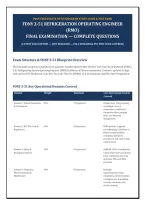
FDNY CERTIFICATE OF FITNESS EXAM STUDY GUIDE & TEST BANK
FDNY Z-51 REFRIGERATION OPERATING ENGINEER
(RMO)
FINAL EXAMINATION — COMPLETE QUESTIONS
[LATEST 2026 EDITION — JUST RELEASED — FULL DOMAINS & NYC FIRE CODE COVERED]
Exam Structure & FDNY Z-51 Blueprint Overview
This test bank comprises comprehensive questions modeled directly after the New York City Fire Department (FDNY)
Z-51 Refrigerating System Operating Engineer (RMO) Certificate of Fitness examination. Content is updated to align
with current NYC Mechanical Code, NYC Fire Code Title 29, ASHRAE 15 & 34 standards, and EPA Title VI regulations.
FDNY Z-51 Key Operational Domains Covered
Domain Weight Questions Core Operational Content
Covered
Domain 1: System Operations 30% 75 Questions Compressors (reciprocating,
& Components centrifugal, screw),
evaporators, condensers,
expansion valves, purging
units, and lubricant
management.
Domain 2: NYC Fire Code & 25% 63 Questions FDNY permits, Logbook
Regulations recordkeeping, Certificate of
Fitness responsibilities,
emergency shutdown
procedures, and rupture disk
requirements.
Domain 3: Safety & 25% 62 Questions ASHRAE 15/34 classification,
Emergency Systems safety relief valves, machinery
room ventilation, toxic leak
detection, PPE, and SCBA
protocols.
Domain 4: Chemistry, 20% 50 Questions Enthalpy,
Thermodynamics & superheat/subcooling
Maintenance calculations, brine chemistry,
cooling towers, leak testing,
recovery standards, and
electrical safety.
,SECTION 1
Question 1 [Domain 2: NYC Fire Code & Regulations]
According to the FDNY Fire Code and NYC regulations, how often must the Refrigerating System Operating Engineer (RMO)
perform logged inspections of an operational Group A1 industrial refrigeration plant exceeding 50 horsepower?
A. Once every 24 hours during normal business operations
B. At least once per shift while the system is in operation
C. Weekly, provided an automatic monitoring system is active
D. Monthly, before submitting the facility safety audit
Correct Answer: Option B. At least once per shift while the system is in operation
FDNY / ASHRAE Rationale: NYC Fire Code requires that an RMO holding a valid Certificate of Fitness perform entries in the
official refrigeration logbook at least once per shift while the system is operating.
Question 2 [Domain 3: Safety & Emergency Systems]
When dual safety relief valves are installed with a three-way manifold valve in a commercial refrigeration system, what is
the mandatory position of the three-way valve during normal plant operation?
A. Fully open to both safety relief valves simultaneously
B. Fully closed to isolate pressure surges from the atmosphere
C. Backseated or frontseated to ensure one relief valve is fully active while isolating the second for service
D. Mid-seated to split relief capacity 50/50 between both valves
Correct Answer: Option C. Backseated or frontseated to ensure one relief valve is fully active while isolating the second
for service
FDNY / ASHRAE Rationale: ASHRAE 15 and FDNY Code mandate that a 3-way relief manifold valve must never isolate both
relief valves at once. It must seat so one valve is in full service while the other remains isolated for safe testing or replacement.
Question 3 [Domain 1: System Operations & Components]
In a reciprocating compression refrigeration cycle operating with R-717 (Ammonia), what physical property causes oil to
collect at the bottom of the receiver or evaporator?
A. Ammonia and mineral oil are highly miscible and form a dense emulsion
B. Mineral oil is heavier than liquid ammonia and immiscible with it
C. Ammonia vaporizes oil, causing it to condense at low pressures
D. Oil remains suspended at the surface of liquid ammonia due to surface tension
Correct Answer: Option B. Mineral oil is heavier than liquid ammonia and immiscible with it
FDNY / ASHRAE Rationale: Ammonia (R-717) and standard refrigeration mineral oil are immiscible. Mineral oil has a higher
specific gravity than liquid ammonia, causing it to settle at the lowest points of vessels where it must be safely drained.
Question 4 [Domain 4: Chemistry, Thermodynamics & Maintenance]
A refrigeration technician measures a suction line pressure corresponding to a saturation temperature of 40°F and an actual
suction line temperature of 52°F. What is the calculated superheat?
A. 12°F Superheat
B. 92°F Superheat
C. 8°F Subcooling
D. 48°F Superheat
Correct Answer: Option A. 12°F Superheat
FDNY / ASHRAE Rationale: Superheat is calculated as Actual Line Temperature minus Saturation Temperature (52°F - 40°F =
12°F). Superheat ensures no liquid refrigerant enters the compressor suction port.
,Question 5 [Domain 1: System Operations & Components]
Which of the following operational symptoms most accurately indicates the presence of non-condensable gases (such as air)
inside a water-cooled condenser?
A. Abnormally low suction pressure and low motor amp draw
B. Abnormally high head pressure accompanied by higher condensing temperatures
C. High suction superheat and low discharge line temperature
D. Rapid fluctuation in expansion valve superheat hunt
Correct Answer: Option B. Abnormally high head pressure accompanied by higher condensing temperatures
FDNY / ASHRAE Rationale: Non-condensable gases collect in the top of the condenser, reducing the available heat transfer
surface area and increasing total pressure according to Dalton's Law of Partial Pressures, leading to abnormally high head
pressure.
Question 6 [Domain 3: Safety & Emergency Systems]
According to ASHRAE Standard 34, how is R-123 categorized regarding safety, toxicity, and flammability?
A. Class A1 (Higher Toxicity, No Flammability)
B. Class B1 (Higher Toxicity, No Flammability)
C. Class A2L (Lower Toxicity, Lower Flammability)
D. Class B2 (Higher Toxicity, Lower Flammability)
Correct Answer: Option B. Class B1 (Higher Toxicity, No Flammability)
FDNY / ASHRAE Rationale: R-123 is classified as B1 under ASHRAE 34 (B = higher toxicity, 1 = no flame propagation at
standard test conditions). It requires dedicated machinery room safety sensors.
Question 7 [Domain 2: NYC Fire Code & Regulations]
Where must the remote emergency shutdown switch (FDNY Emergency Refrigeration Control Box) be located for a large
machinery room containing Class B2/B1 refrigerants?
A. Inside the main compressor room directly next to the control panel
B. Outside the machinery room, immediately adjacent to the principal exit door
C. In the building manager's office on the main lobby floor
D. Attached to the cooling tower structure on the building roof
Correct Answer: Option B. Outside the machinery room, immediately adjacent to the principal exit door
FDNY / ASHRAE Rationale: NYC Fire Code requires emergency shutdown controls and ventilation override switches to be
located outside the machinery room, near the main entrance door, so first responders or RMOs can shut down the plant safely
during an emergency.
Question 8 [Domain 4: Chemistry, Thermodynamics & Maintenance]
When operating a secondary glycol or calcium chloride brine cooling loop, what condition occurs if the brine solution
concentration drops below its eutectic point?
A. The freezing point of the brine solution begins to increase, raising the risk of freeze-up in the chiller tubes
B. The brine solution becomes highly acidic and strips copper plating
C. The specific heat capacity drops to zero, stopping heat transfer
D. Refrigerant vaporizes into the brine pump casing
Correct Answer: Option A. The freezing point of the brine solution begins to increase, raising the risk of freeze-up in the
chiller tubes
FDNY / ASHRAE Rationale: The eutectic point represents the maximum freezing point depression concentration. Deviating
below or above this specific concentration raises the freezing point of the solution, potentially freezing chiller tubes.
Question 9 [Domain 2: NYC Fire Code & Regulations]
According to the FDNY Fire Code and NYC regulations, how often must the Refrigerating System Operating Engineer (RMO)
perform logged inspections of an operational Group A1 industrial refrigeration plant exceeding 50 horsepower?
, A. Once every 24 hours during normal business operations
B. At least once per shift while the system is in operation
C. Weekly, provided an automatic monitoring system is active
D. Monthly, before submitting the facility safety audit
Correct Answer: Option B. At least once per shift while the system is in operation
FDNY / ASHRAE Rationale: NYC Fire Code requires that an RMO holding a valid Certificate of Fitness perform entries in the
official refrigeration logbook at least once per shift while the system is operating.
Question 10 [Domain 3: Safety & Emergency Systems]
When dual safety relief valves are installed with a three-way manifold valve in a commercial refrigeration system, what is
the mandatory position of the three-way valve during normal plant operation?
A. Fully open to both safety relief valves simultaneously
B. Fully closed to isolate pressure surges from the atmosphere
C. Backseated or frontseated to ensure one relief valve is fully active while isolating the second for service
D. Mid-seated to split relief capacity 50/50 between both valves
Correct Answer: Option C. Backseated or frontseated to ensure one relief valve is fully active while isolating the second
for service
FDNY / ASHRAE Rationale: ASHRAE 15 and FDNY Code mandate that a 3-way relief manifold valve must never isolate both
relief valves at once. It must seat so one valve is in full service while the other remains isolated for safe testing or replacement.
Question 11 [Domain 1: System Operations & Components]
In a reciprocating compression refrigeration cycle operating with R-717 (Ammonia), what physical property causes oil to
collect at the bottom of the receiver or evaporator?
A. Ammonia and mineral oil are highly miscible and form a dense emulsion
B. Mineral oil is heavier than liquid ammonia and immiscible with it
C. Ammonia vaporizes oil, causing it to condense at low pressures
D. Oil remains suspended at the surface of liquid ammonia due to surface tension
Correct Answer: Option B. Mineral oil is heavier than liquid ammonia and immiscible with it
FDNY / ASHRAE Rationale: Ammonia (R-717) and standard refrigeration mineral oil are immiscible. Mineral oil has a higher
specific gravity than liquid ammonia, causing it to settle at the lowest points of vessels where it must be safely drained.
Question 12 [Domain 4: Chemistry, Thermodynamics & Maintenance]
A refrigeration technician measures a suction line pressure corresponding to a saturation temperature of 40°F and an actual
suction line temperature of 52°F. What is the calculated superheat?
A. 12°F Superheat
B. 92°F Superheat
C. 8°F Subcooling
D. 48°F Superheat
Correct Answer: Option A. 12°F Superheat
FDNY / ASHRAE Rationale: Superheat is calculated as Actual Line Temperature minus Saturation Temperature (52°F - 40°F =
12°F). Superheat ensures no liquid refrigerant enters the compressor suction port.
Question 13 [Domain 1: System Operations & Components]
Which of the following operational symptoms most accurately indicates the presence of non-condensable gases (such as air)
inside a water-cooled condenser?
A. Abnormally low suction pressure and low motor amp draw
B. Abnormally high head pressure accompanied by higher condensing temperatures
C. High suction superheat and low discharge line temperature
D. Rapid fluctuation in expansion valve superheat hunt


