
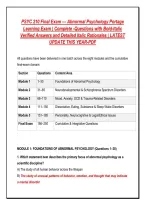
PSYC 210 Final Exam — Abnormal Psychology Portage
Learning Exam | Complete -Questions with Bold-Italic
Verified Answers and Detailed Italic Rationales | LATEST
UPDATE THIS YEAR-PDF
All questions have been delivered in one batch across the eight modules and the cumulative
final-exam domain:
Section Questions Content Area
Module 1 1–30 Foundations of Abnormal Psychology
Module 2 31–65 Neurodevelopmental & Schizophrenia Spectrum Disorders
Module 3 66–110 Mood, Anxiety, OCD & Trauma-Related Disorders
Module 4 111–150 Dissociative, Eating, Substance & Sleep-Wake Disorders
Module 5 151–185 Personality, Neurocognitive & Legal/Ethical Issues
Final Exam 186–250 Cumulative & Integrative Questions
.
MODULE 1: FOUNDATIONS OF ABNORMAL PSYCHOLOGY (Questions 1–30)
1. Which statement best describes the primary focus of abnormal psychology as a
scientific discipline?
A) The study of all human behavior across the lifespan
B) The study of unusual patterns of behavior, emotion, and thought that may indicate
a mental disorder
,C) The study of brain anatomy and neurochemistry only
D) The study of social norms and cultural expectations only
Abnormal psychology studies atypical behavior, emotional distress, and maladaptive
functioning, distinguishing it from general psychology and from purely biological or
sociological approaches.
2. Which of the following is NOT one of the “four D’s” commonly used to define
abnormality in psychopathology?
A) Deviance
B) Distress
C) Dysfunction
D) Duration
The four D’s are Deviance, Distress, Dysfunction, and Danger; duration is a relevant clinical
consideration but is not part of the standard four-D framework.
3. A behavior is considered “deviant” in abnormal psychology when it does which of
the following?
A) Causes personal suffering and emotional pain
B) Differs significantly from what is considered normal or acceptable in a given
culture
C) Interferes with a person’s ability to function in daily roles
D) Poses a risk of harm to the self or others
Deviance refers to statistical or cultural departure from what is considered normal or
acceptable within a specific cultural context.
4. According to the biopsychosocial model, mental disorders are caused by which of
the following?
A) Biological factors only
B) Psychological factors only
,C) Social factors only
D) An interaction of biological, psychological, and social factors
The biopsychosocial model integrates genetics, brain chemistry, psychological processes,
and social environment in explaining mental disorders.
5. The medical model of abnormal behavior assumes which of the following about
mental disorders?
A) Mental disorders are learned behaviors acquired through conditioning
B) Mental disorders are caused by unconscious conflicts from childhood
C) Mental disorders are diseases with biological causes that can be diagnosed and
treated
D) Mental disorders are the result of societal oppression and labeling
The medical model views mental illness similarly to physical illness, emphasizing biological
etiology, diagnosis, and treatment.
6. Which historical figure is best known for advocating moral treatment of the
mentally ill, including removing chains and providing humane conditions?
A) Sigmund Freud
B) Philippe Pinel
C) Emil Kraepelin
D) John Watson
Philippe Pinel was a French physician who pioneered moral treatment, advocating dignity
and humane care for individuals with mental illness.
7. Which psychological perspective emphasizes that abnormal behavior is learned
through classical conditioning, operant conditioning, and observational learning?
A) Biological
B) Psychodynamic
C) Behavioral
, D) Humanistic
The behavioral model (Pavlov, Skinner, Bandura) focuses on how abnormal behaviors are
acquired and maintained through learning processes.
8. According to the psychodynamic model, the root of abnormal behavior lies
primarily in which of the following?
A) Irrational thoughts and cognitive distortions
B) Unconscious conflicts and unresolved childhood experiences
C) Chemical imbalances in the brain
D) Dysfunctional family communication patterns
Freudian psychodynamic theory posits that mental disorders arise from unconscious
conflicts, often stemming from early childhood experiences and defense mechanisms.
9. A 24-year-old graduate student reports weeks of intense worry about failing
comprehensive exams, with persistent distress that interferes with sleep and
concentration despite appearing high-functioning to others. Which component of
abnormality is most clearly illustrated?
A) Dysfunction in occupational performance alone
B) Distress that is subjectively experienced even when external functioning appears
intact
C) Deviance from cultural norms of academic success
D) Danger to self demonstrated by explicit suicidal planning
The scenario highlights internal distress that persists despite external perceptions of
competence; distress can be present independently of observable impairment.
10. The progression from early asylums’ moral treatment to modern biopsychosocial
formulation best illustrates which historical shift in perspective?
A) From purely biological reductionism to exclusive reliance on psychoanalytic interpretation
B) From moral and environmental considerations toward an integrative multi-level


