
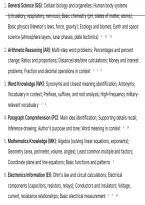
1. General Science (GS): Cellular biology and organelles; Human body systems
(circulatory, respiratory, nervous); Basic chemistry (pH, states of matter, atoms);
Basic physics (Newton's laws, force, gravity); Ecology and biomes; Earth and space
science (atmosphere layers, lunar phases, plate tectonics) 4 12 13
2. Arithmetic Reasoning (AR): Multi-step word problems; Percentages and percent
change; Ratios and proportions; Distance/rate/time calculations; Money and interest
problems; Fraction and decimal operations in context 3 5 9
3. Word Knowledge (WK): Synonyms and closest meaning identification; Antonyms;
Vocabulary in context; Prefixes, suffixes, and root analysis; High-frequency military-
relevant vocabulary 3 6
4. Paragraph Comprehension (PC): Main idea identification; Supporting details recall;
Inference drawing; Author's purpose and tone; Word meaning in context 6 14
5. Mathematics Knowledge (MK): Algebra (solving linear equations, exponents);
Geometry (area, perimeter, volume, angles); Least common multiple and factors;
Coordinate plane and line equations; Basic functions and patterns 2
6. Electronics Information (EI): Ohm's law and circuit calculations; Electrical
components (capacitors, resistors, relays); Conductors and insulators; Voltage,
current, resistance relationships; Basic electrical measurement 3 7 14
, 7. Auto & Shop Information (AS): Internal combustion engine fundamentals; Automotive
systems (cooling, lubrication, ignition); Hand tools and power tools identification;
Building materials and fasteners; Shop safety practices 11 14
8. Mechanical Comprehension (MC): Simple machines (levers, pulleys, gears, inclined
planes); Mechanical advantage calculations; Torque and rotational force; Fluid
dynamics basics; Friction and force transmission 3 14
9. Assembling Objects (AO): Spatial reasoning and mental rotation; Shape assembly
and puzzle completion; Visual manipulation of 2D and 3D objects; Identifying
connected points and patterns 11 14
10. Test-Taking Strategy & Verification: PICAT verification process understanding; Time
management across subtests; Question analysis and elimination techniques; AFQT
scoring awareness 6 14
ASVAB PICAT Verification Test
,1. Which statement most accurately describes an important principle of cellular
biology regarding the function of the mitochondrion in eukaryotic cells?
A. The mitochondrion stores genetic material and controls all cellular activities through
gene expression regulation.
B. The mitochondrion generates ATP through aerobic cellular respiration to power
cellular processes.
C. The mitochondrion modifies and packages proteins received from the rough
endoplasmic reticulum for secretion.
D. The mitochondrion contains digestive enzymes that break down cellular waste and
foreign invaders.
Correct Answer: B
Rationale: Mitochondria are the primary sites of aerobic cellular respiration and ATP
production in eukaryotic cells. The nucleus stores genetic material, the Golgi apparatus
packages proteins, and lysosomes contain digestive enzymes . 7 13
, 2. A net force of 24 newtons is applied to an object that starts from rest and
accelerates to a velocity of 16 meters per second in 4 seconds. What is the mass of
the object?
A. 4 kilograms
B. 6 kilograms
C. 8 kilograms
D. 12 kilograms
Correct Answer: B
Rationale: Acceleration = change in velocity / time = 16 m/s ÷ 4 s = 4 m/s². Using
Newton's second law, F = ma: 24 N = m × 4 m/s², so m = 6 kg . 4
3. Which word is closest in meaning to the vocabulary term DILIGENT as it would be
used in a professional or military context?
A. Careless


