
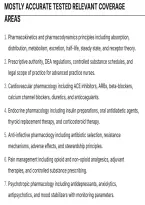
MOSTLY ACCURATE TESTED RELEVANT COVERAGE
AREAS
1. Pharmacokinetics and pharmacodynamics principles including absorption,
distribution, metabolism, excretion, half-life, steady state, and receptor theory.
2. Prescriptive authority, DEA regulations, controlled substance schedules, and
legal scope of practice for advanced practice nurses.
3. Cardiovascular pharmacology including ACE inhibitors, ARBs, beta-blockers,
calcium channel blockers, diuretics, and anticoagulants.
4. Endocrine pharmacology including insulin preparations, oral antidiabetic agents,
thyroid replacement therapy, and corticosteroid therapy.
5. Anti-infective pharmacology including antibiotic selection, resistance
mechanisms, adverse effects, and stewardship principles.
6. Pain management including opioid and non-opioid analgesics, adjuvant
therapies, and controlled substance prescribing.
7. Psychotropic pharmacology including antidepressants, anxiolytics,
antipsychotics, and mood stabilizers with monitoring parameters.
, 8. Geriatric pharmacology including Beers Criteria, polypharmacy, age-related
pharmacokinetic changes, and deprescribing.
9. Drug interactions including CYP450 enzyme inducers and inhibitors, food-drug
interactions, and polypharmacy risk assessment.
10. Special populations including pregnancy, lactation, pediatrics, hepatic
impairment, and renal impairment dosing considerations.
NUR 5351 ADVANCED PHARMACOLOGY MIDTERM
EXAM
250 MULTIPLE-CHOICE QUESTIONS WITH ANSWERS AND
RATIONALES
,1. A primary care nurse practitioner is reviewing the pharmacokinetic properties
of a newly prescribed medication and needs to identify which phase involves the
movement of the drug from the administration site into systemic circulation.
☐ A. Distribution
☐ B. Metabolism
☐ C. Absorption
☐ D. Excretion
Answer: C
Rationale: Absorption is the pharmacokinetic phase that describes the movement
of a drug from its site of administration into the bloodstream. Distribution involves
transport to tissues, metabolism involves biotransformation, and excretion involves
elimination.
2. A patient asks the nurse practitioner why a brand-name medication was
prescribed instead of a generic equivalent, and the NP explains that different
, formulations may vary in which pharmacokinetic parameter that affects clinical
response.
☐ A. Therapeutic index
☐ B. Bioavailability
☐ C. Receptor affinity
☐ D. Protein binding
Answer: B
Rationale: Different formulations of the same drug may have varying degrees of
bioavailability, meaning the amount of active drug that reaches systemic circulation
may differ. This is particularly important for drugs with narrow therapeutic ranges
. 5
3. A nurse practitioner is prescribing a medication that undergoes extensive first-
pass metabolism and wants to select a route of administration that bypasses this
effect to achieve predictable systemic levels.


