
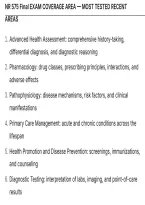
NR 575 Final EXAM COVERAGE AREA — MOST TESTED RECENT
AREAS
1. Advanced Health Assessment: comprehensive history-taking,
differential diagnosis, and diagnostic reasoning
2. Pharmacology: drug classes, prescribing principles, interactions, and
adverse effects
3. Pathophysiology: disease mechanisms, risk factors, and clinical
manifestations
4. Primary Care Management: acute and chronic conditions across the
lifespan
5. Health Promotion and Disease Prevention: screenings, immunizations,
and counseling
6. Diagnostic Testing: interpretation of labs, imaging, and point-of-care
results
, 7. Clinical Guidelines: evidence-based practice and standards of care
8. Patient Education and Counseling: self-management and behavior
change
9. Care Coordination and Referral: interprofessional collaboration and
follow-up
10. Documentation, Ethics, and Legal Issues: scope of practice and
informed consent
NR 575 Final EXAM QUESTIONBOOK WITH ANSWERS AND
RATIONALES
1. A 58-year-old man presents with exertional chest pressure relieved
by rest. Which finding most strongly suggests stable angina?
A. Pain lasting 45 minutes
B. Pain reproduced by palpation
C. Pain relieved within 5 minutes of rest
, D. Pain associated with fever
Answer: C
Rationale: Stable angina is classically relieved by rest or nitroglycerin
within minutes and is predictable with exertion.
2. Which laboratory value is most important to monitor in a patient
started on warfarin for atrial fibrillation?
A. Platelet count
B. INR
C. Serum sodium
D. Hemoglobin A1c
Answer: B
Rationale: Warfarin therapy requires INR monitoring to ensure
therapeutic anticoagulation and prevent bleeding.
3. A 45-year-old woman has fatigue, weight gain, and cold intolerance.
Which diagnosis is most likely?
, A. Hyperthyroidism
B. Hypothyroidism
C. Diabetes mellitus
D. Anemia
Answer: B
Rationale: Fatigue, weight gain, and cold intolerance are classic
symptoms of hypothyroidism.
4. Which medication class is first-line for a patient with newly diagnosed
uncomplicated hypertension?
A. Alpha-blockers
B. Thiazide diuretics
C. Loop diuretics
D. Central alpha-agonists
Answer: B
Rationale: Thiazide diuretics are first-line therapy for uncomplicated
hypertension per guidelines.


