
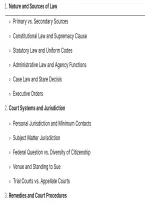
1. Nature and Sources of Law
Primary vs. Secondary Sources
Constitutional Law and Supremacy Clause
Statutory Law and Uniform Codes
Administrative Law and Agency Functions
Case Law and Stare Decisis
Executive Orders
2. Court Systems and Jurisdiction
Personal Jurisdiction and Minimum Contacts
Subject Matter Jurisdiction
Federal Question vs. Diversity of Citizenship
Venue and Standing to Sue
Trial Courts vs. Appellate Courts
3. Remedies and Court Procedures
, Remedies at Law (Damages)
Remedies in Equity (Specific Performance, Injunction, Rescission)
Civil vs. Criminal Law
Substantive vs. Procedural Law
4. Intentional Torts
Assault and Battery
Intent Requirement
Defamation (Libel and Slander)
Actual Malice Standard
Right of Privacy
Trespass to Land and Personal Property
Conversion
5. Business Ethics and Corporate Legal Strategy
Avoidance, Compliance, Prevention, Value, Transformation
, Duty-Based Ethics
Outcome-Based Ethics
BLAW 341 Exam 1- Maull
1. Which of the following is a primary source of law that establishes binding
legal rules?
A. A legal encyclopedia summarizing contract law
B. A state statute enacted by the legislature
C. A law review article analyzing tort reform
D. A legal treatise written by a professor
Answer: B
Rationale: Primary sources establish law, including constitutions, statutes,
administrative rules, and court decisions. Legal encyclopedias and treatises
are secondary sources that only summarize or interpret the law . 2 8
, 2. Which document is considered the supreme law of the United States and
prevails over conflicting state laws?
A. The Uniform Commercial Code adopted by all states
B. The United States Constitution
C. The Federal Register published daily
D. The Restatement of Contracts
Answer: B
Rationale: The U.S. Constitution is the supreme law of the land under the
Supremacy Clause. Any federal, state, or local law that conflicts with it
cannot be enforced . 2 6
3. When a court decides a case involving a constitutional issue, what is the
proper role of the judiciary?
A. To create new constitutional provisions as needed
B. To interpret and apply the law to specific facts
C. To amend the Constitution through judicial decree
D. To defer entirely to the legislative branch


