
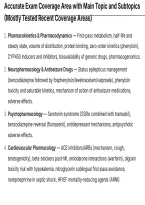
Accurate Exam Coverage Area with Main Topic and Subtopics
(Mostly Tested Recent Coverage Areas)
1. Pharmacokinetics & Pharmacodynamics — First-pass metabolism, half-life and
steady state, volume of distribution, protein binding, zero-order kinetics (phenytoin),
CYP450 inducers and inhibitors, bioavailability of generic drugs, pharmacogenomics.
2. Neuropharmacology & Antiseizure Drugs — Status epilepticus management
(benzodiazepine followed by fosphenytoin/levetiracetam/valproate), phenytoin
toxicity and saturable kinetics, mechanism of action of antiseizure medications,
adverse effects.
3. Psychopharmacology — Serotonin syndrome (SSRIs combined with tramadol),
benzodiazepine reversal (flumazenil), antidepressant mechanisms, antipsychotic
adverse effects.
4. Cardiovascular Pharmacology — ACE inhibitors/ARBs (mechanism, cough,
teratogenicity), beta-blockers post-MI, amiodarone interactions (warfarin), digoxin
toxicity risk with hypokalemia, nitroglycerin sublingual first-pass avoidance,
norepinephrine in septic shock, HFrEF mortality-reducing agents (ARNI).
,5. Anticoagulants, Antiplatelets & Thrombolytics — Heparin mechanism and reversal
(protamine), warfarin interactions and INR elevation, DOAC renal dosing, clopidogrel
CYP2C19 interaction with omeprazole, alteplase indications and contraindications,
P2Y12 inhibitors.
6. Endocrine Pharmacology — Prednisone-induced hyperglycemia (insulin resistance
and gluconeogenesis), insulin onset times (lispro fastest), DKA management with IV
insulin infusion, thyroid pharmacology, corticosteroid adverse effects.
7. Infectious Disease & Antimicrobial Stewardship — Vancomycin red man syndrome
and nephrotoxicity, fluoroquinolone tendon rupture risk, MRSA bacteremia treatment,
aminoglycoside ototoxicity potentiated by loop diuretics, amphotericin B
nephrotoxicity, azole antifungal absorption and interactions.
8. Pain Management & Opioids — Morphine active metabolite accumulation in CKD,
opioid + benzodiazepine additive sedation, naloxone reversal, tramadol serotonergic
effects, Beers criteria in older adults.
9. Renal & Electrolyte Pharmacology — Renal dosing of LMWH and DOACs, loop
diuretic mechanism (NKCC2 inhibition in thick ascending limb), hyperkalemia
emergency management (insulin/glucose, albuterol, calcium gluconate), drug
accumulation in renal impairment.
,10. Emergency & Critical Care Pharmacology — Vasopressors (norepinephrine alpha-1
effect), antidotes (N-acetylcysteine for acetaminophen, flumazenil for
benzodiazepines, protamine for heparin, vitamin K for warfarin), septic shock
corticosteroid use, acute pulmonary edema management.
NR 567 Final Exam Advanced Pharmacology for the
AGACNP
250 Detailed Multiple-Choice Questions with Answers and
Rationales
1. A 68-year-old man with stable angina asks why his nitroglycerin tablets must
dissolve under the tongue rather than be swallowed. Which pharmacokinetic principle
best explains this route selection?
A. Sublingual absorption enters the systemic circulation directly and avoids extensive
hepatic first-pass metabolism, preserving bioavailability
, B. Sublingual administration prevents ionization of the drug by gastric acid, which
would otherwise destroy the active compound
C. Sublingual absorption completely bypasses plasma protein binding, allowing 100%
of the dose to reach vascular smooth muscle
D. The sublingual route eliminates the need for enterohepatic recirculation, which
inactivates orally administered nitrates
Answer: A
Rationale: Nitroglycerin undergoes extensive first-pass metabolism by hepatic organic
nitrate reductases, leaving oral bioavailability below 10%. Sublingual absorption drains
through the superior vena cava directly into systemic circulation, bypassing the portal
vein and hepatic metabolism. Option B misattributes the primary issue to gastric acid
ionization. Protein binding still occurs after systemic uptake (C). Enterohepatic
recirculation is not the governing factor (D) .


