
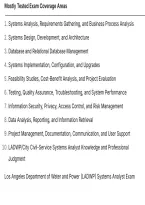
Mostly Tested Exam Coverage Areas
1. Systems Analysis, Requirements Gathering, and Business Process Analysis
2. Systems Design, Development, and Architecture
3. Database and Relational Database Management
4. Systems Implementation, Configuration, and Upgrades
5. Feasibility Studies, Cost-Benefit Analysis, and Project Evaluation
6. Testing, Quality Assurance, Troubleshooting, and System Performance
7. Information Security, Privacy, Access Control, and Risk Management
8. Data Analysis, Reporting, and Information Retrieval
9. Project Management, Documentation, Communication, and User Support
10. LADWP/City Civil-Service Systems Analyst Knowledge and Professional
Judgment
Los Angeles Department of Water and Power (LADWP) Systems Analyst Exam
,1. A systems analyst is gathering requirements for a new utility customer
information system. Which approach is most effective for identifying
differences between what users currently need and what the existing system
provides?
A) Increase server capacity
B) Replace the database immediately
C) Perform a gap analysis
D) Develop the user interface first
C) Perform a gap analysis
A gap analysis compares the current state with the desired future state and
identifies missing capabilities, process deficiencies, and functional requirements.
Increasing server capacity may address performance but does not identify
requirements gaps. Replacing the database before understanding the problem is
premature, while designing the interface first can result in building functionality
that does not satisfy actual business needs. 2 8
,2. Which requirement is the best example of a functional requirement for a
utility work-management application?
A) The system shall allow supervisors to assign work orders to field crews
B) The application shall have 99.9 percent availability
C) The application shall encrypt sensitive data
D) The system shall respond within two seconds
A) The system shall allow supervisors to assign work orders to field crews
A functional requirement describes what the system must do. Allowing
supervisors to assign work orders is a specific system function. Availability,
encryption, and response time describe qualities or constraints on how the
system performs and are therefore nonfunctional requirements. 2 8
3. A stakeholder says, "The system needs to be user-friendly." What should the
systems analyst do first?
A) Interpret user-friendly as a response time of less than one second
B) Remove the statement because it cannot be tested
, C) Convert it directly into a database requirement
D) Ask clarifying questions and define measurable usability criteria
D) Ask clarifying questions and define measurable usability criteria
"User-friendly" is subjective and cannot be adequately tested without
clarification. The analyst should determine what users mean, such as intuitive
navigation, limited training requirements, accessibility, consistent terminology, or
a specified task-completion rate. Measurable acceptance criteria can then be
created. 2 6
4. A business owner requests a new dashboard but cannot explain which
decisions it will support. What is the best response from the systems analyst?
A) Build the dashboard immediately using every available metric
B) Ask the database administrator to choose the metrics
C) Work with the business owner to identify key decisions and associated
metrics
D) Recommend purchasing a commercial dashboard product


