
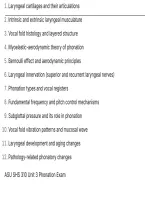
1. Laryngeal cartilages and their articulations
2. Intrinsic and extrinsic laryngeal musculature
3. Vocal fold histology and layered structure
4. Myoelastic-aerodynamic theory of phonation
5. Bernoulli effect and aerodynamic principles
6. Laryngeal innervation (superior and recurrent laryngeal nerves)
7. Phonation types and vocal registers
8. Fundamental frequency and pitch control mechanisms
9. Subglottal pressure and its role in phonation
10. Vocal fold vibration patterns and mucosal wave
11. Laryngeal development and aging changes
12. Pathology-related phonatory changes
ASU SHS 310 Unit 3 Phonation Exam
,1. Which of the following laryngeal cartilages is the only unpaired cartilage that
articulates with the thyroid cartilage via a synovial joint?
A. Arytenoid cartilage
B. Cricoid cartilage
C. Corniculate cartilage
D. Cuneiform cartilage
The cricoid cartilage is the only unpaired cartilage that forms a synovial
articulation with the thyroid cartilage at the cricothyroid joint, allowing for
changes in vocal fold tension.
2. During phonation, which intrinsic laryngeal muscle is primarily responsible for
adducting the vocal folds to bring them together?
A. Posterior cricoarytenoid
B. Lateral cricoarytenoid
C. Cricothyroid
D. Thyroarytenoid
,The lateral cricoarytenoid muscle rotates the arytenoid cartilages medially,
adducting the vocal folds, which is essential for voice production.
3. Which layer of the vocal fold is primarily responsible for the viscoelastic
properties that allow for mucosal wave propagation during vibration?
A. Epithelium
B. Superficial lamina propria
C. Deep lamina propria
D. Vocalis muscle
The superficial lamina propria, also known as Reinke's space, provides the
pliability needed for the mucosal wave that is essential for normal vocal fold
vibration.
4. According to the myoelastic-aerodynamic theory, what is the primary driving
force that initiates vocal fold vibration?
A. Active muscular contraction of the vocal folds
B. Subglottal air pressure
, C. Bernoulli effect from supraglottal airflow
D. Elastic recoil of the cricothyroid joint
Subglottal air pressure builds up beneath the closed vocal folds and eventually
overcomes the resistance, pushing them apart to initiate vibration in the
myoelastic-aerodynamic cycle.
5. Which nerve provides motor innervation to the cricothyroid muscle, which is
responsible for increasing vocal fold tension and raising pitch?
A. Recurrent laryngeal nerve
B. Superior laryngeal nerve (external branch)
C. Superior laryngeal nerve (internal branch)
D. Glossopharyngeal nerve
The external branch of the superior laryngeal nerve innervates the cricothyroid
muscle, which tenses the vocal folds and is critical for pitch elevation.
6. What is the primary function of the posterior cricoarytenoid muscle during the
phonatory cycle?


