
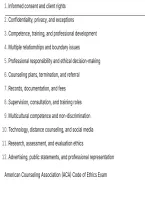
1. Informed consent and client rights
2. Confidentiality, privacy, and exceptions
3. Competence, training, and professional development
4. Multiple relationships and boundary issues
5. Professional responsibility and ethical decision-making
6. Counseling plans, termination, and referral
7. Records, documentation, and fees
8. Supervision, consultation, and training roles
9. Multicultural competence and non-discrimination
10. Technology, distance counseling, and social media
11. Research, assessment, and evaluation ethics
12. Advertising, public statements, and professional representation
American Counseling Association (ACA) Code of Ethics Exam
,1. A counselor who is unsure whether a dual relationship with a client is ethically
permissible should first take which of the following actions?
A. Enter the relationship and document it later
B. Consult the ACA Code of Ethics and seek supervision
C. Ask the client to sign a waiver
D. Ignore the issue if no harm is apparent
Answer: B
Rationale: The ACA Code of Ethics emphasizes consultation, supervision, and
ethical decision-making when potential multiple relationships arise, rather
than proceeding without careful review.
2. When a client discloses intentions to seriously harm an identifiable other
person, the counselor's most appropriate initial ethical consideration is
whether to do which of the following?
A. Maintain absolute confidentiality as requested
B. Warn the identifiable victim and take protective action as permitted by law
C. Terminate the counseling relationship immediately
D. Report the client to a professional association
, Answer: B
Rationale: The ACA Code of Ethics permits and often requires breaking
confidentiality to protect identifiable third parties from serious and foreseeable
harm, consistent with legal requirements.
3. A counselor in private practice discovers that a client's insurance company is
requesting more detailed clinical information than is necessary for
reimbursement. The counselor should do which of the following?
A. Provide all records without limitation
B. Disclose only the minimum information necessary with client authorization
C. Refuse to communicate with the insurer entirely
D. Ask the client to handle all insurance communication
Answer: B
Rationale: The ACA Code of Ethics calls for disclosing only information
necessary for the purpose and obtaining client authorization before releasing
confidential information.
4. Which of the following best describes the ACA Code of Ethics position on
informed consent at the outset of the counseling relationship?
, A. It is optional when the client seems cooperative
B. It should be obtained only after several sessions
C. It should be part of the initial session and documented appropriately
D. It is unnecessary for brief counseling
Answer: C
Rationale: Informed consent is an ongoing process that should begin at the
outset of services and be documented, covering rights, responsibilities, and
limits of confidentiality.
5. A counselor who lacks competence in a specialized area but agrees to see a
client anyway is most clearly at risk of violating which ethical principle?
A. Fidelity
B. Competence
C. Veracity
D. Justice
Answer: B
Rationale: The ACA Code of Ethics requires counselors to practice only within


