Pyc 3701 Assignment 1
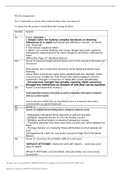
PYC3701 Assignment 1 The (*) represents an answer that I could not find or that I am unsure of. () means that the answer is mostly likely after viewing all others. Question s Answers Q1 Answer 3)Heuristics Simple rules for making complex decisions or drawing inferences in a rapid and seemingly effortless manner – to avoid info. Overload The reduce cognitive effort Affect: our current feelings and mood. People have diff. cognitive frameworks (expectations) for same situation, therefore understand them differently. Page 37 (Textbook Baron) Q2* Answer 1) Conscious thought has strict limits in terms of the amount of information we can process. Participants who made their decisions while being prevented from thinking about them consciously were more satisfied with the decision made (unconscious conditions) than those who could engage in careful, systematic thought (conscious) or those who chose immediately. - Unconscious thought has greater capacity while conscious thought has limitations on amount of info that can be handled. Q3 Answer 1) mood dependency memory mood dependent memory (fact that we tend to remember information consistent with our current moods) mood congruence effects (we are more likely to store or remember information consistent with our current mood) and Q4* Answer 1 Q5 Answer 3) lasting internal lasting causes, temporary external causes - Depressed individuals show opposite of self-serving bias - Attribute negative events to internal lasting causes - Attribute positive events to external temporary causes - Therefore perceive that they have little control over what happens to them - Therapy focuses on changing these attributions so that people can start taking personal credit for successful outcome Page 90-91(Textbook Baron) Q6 Answer 2) a)consc
Document information
- Uploaded on
- September 9, 2021
- Number of pages
- 5
- Written in
- 2021/2022
- Type
- Exam (elaborations)
- Contains
- Questions & answers