
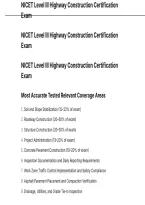
NICET Level III Highway Construction Certification
Exam
NICET Level III Highway Construction Certification
Exam
NICET Level III Highway Construction Certification
Exam
Most Accurate Tested Relevant Coverage Areas
1. Soil and Slope Stabilization (12–22% of exam)
2. Roadway Construction (20–30% of exam)
3. Structure Construction (20–30% of exam)
4. Project Administration (13–23% of exam)
5. Concrete Pavement Construction (10–20% of exam)
6. Inspection Documentation and Daily Reporting Requirements
7. Work Zone Traffic Control Implementation and Safety Compliance
8. Asphalt Pavement Placement and Compaction Verification
9. Drainage, Utilities, and Grade Tie-In Inspection
,10. Contract Administration, Change Orders, and Noncompliance Resolution
NICET Level III Highway Construction Certification
Exam
1. During inspection of a mechanically stabilized earth wall, which condition
most likely indicates a potential failure of the reinforcement connection and
requires immediate documentation?
A. Minor surface staining on the concrete facing panels
B. Visible movement or separation at the panel-to-strip connection
C. Uniform settlement of the wall footing within tolerance
D. Slight color variation in the granular backfill material
Correct Answer: B
Explained Notes:
A: Surface staining is cosmetic and typically does not indicate structural
distress unless accompanied by cracking or displacement.
B: Separation or movement at the connection directly affects load transfer and
is a critical deficiency requiring immediate reporting and possible stop-work.
C: Uniform settlement within design tolerance is expected and does not indicate
failure.
, D: Color variation in backfill is unrelated to reinforcement connection
performance.
2. When inspecting a drilled shaft excavation, the inspector observes that the
bottom of the hole contains loose debris and standing water. What is the most
appropriate immediate action?
A. Allow the contractor to proceed with concrete placement to save time
B. Require the contractor to clean the shaft bottom and remove water before
placing concrete
C. Document the condition and continue inspecting other shafts
D. Approve the shaft because the debris will be encapsulated by concrete
Correct Answer: B
Explained Notes:
A: Placing concrete over debris and water creates voids, weakens the shaft,
and violates typical specification requirements.
B: Shaft bottoms must be clean and dry (or properly slurry-displaced) before
concrete placement to ensure structural integrity and bond.
C: Documentation alone does not address the nonconformance; corrective
action is required.
, D: Encapsulation does not remedy the loss of bearing capacity and integrity
caused by debris and water.
3. A contractor requests approval to add water to a concrete truck at the project
site to improve workability. The inspector observes the specified water-cement
ratio has already been achieved at batching. What is the correct response?
A. Allow the addition because workability is a field concern
B. Deny the addition because it alters the approved water-cement ratio
C. Permit a small amount if the contractor signs a waiver
D. Approve it if the concrete temperature is below 90°F
Correct Answer: B
Explained Notes:
A: Workability does not override the approved mix design; unauthorized water
addition is a specification violation.
B: Adding water after batching increases the water-cement ratio, reducing
strength and durability, and is prohibited without authorization.
C: A contractor waiver does not authorize noncompliant work.
D: Temperature is unrelated to the water-cement ratio requirement.
Exam
NICET Level III Highway Construction Certification
Exam
NICET Level III Highway Construction Certification
Exam
Most Accurate Tested Relevant Coverage Areas
1. Soil and Slope Stabilization (12–22% of exam)
2. Roadway Construction (20–30% of exam)
3. Structure Construction (20–30% of exam)
4. Project Administration (13–23% of exam)
5. Concrete Pavement Construction (10–20% of exam)
6. Inspection Documentation and Daily Reporting Requirements
7. Work Zone Traffic Control Implementation and Safety Compliance
8. Asphalt Pavement Placement and Compaction Verification
9. Drainage, Utilities, and Grade Tie-In Inspection
,10. Contract Administration, Change Orders, and Noncompliance Resolution
NICET Level III Highway Construction Certification
Exam
1. During inspection of a mechanically stabilized earth wall, which condition
most likely indicates a potential failure of the reinforcement connection and
requires immediate documentation?
A. Minor surface staining on the concrete facing panels
B. Visible movement or separation at the panel-to-strip connection
C. Uniform settlement of the wall footing within tolerance
D. Slight color variation in the granular backfill material
Correct Answer: B
Explained Notes:
A: Surface staining is cosmetic and typically does not indicate structural
distress unless accompanied by cracking or displacement.
B: Separation or movement at the connection directly affects load transfer and
is a critical deficiency requiring immediate reporting and possible stop-work.
C: Uniform settlement within design tolerance is expected and does not indicate
failure.
, D: Color variation in backfill is unrelated to reinforcement connection
performance.
2. When inspecting a drilled shaft excavation, the inspector observes that the
bottom of the hole contains loose debris and standing water. What is the most
appropriate immediate action?
A. Allow the contractor to proceed with concrete placement to save time
B. Require the contractor to clean the shaft bottom and remove water before
placing concrete
C. Document the condition and continue inspecting other shafts
D. Approve the shaft because the debris will be encapsulated by concrete
Correct Answer: B
Explained Notes:
A: Placing concrete over debris and water creates voids, weakens the shaft,
and violates typical specification requirements.
B: Shaft bottoms must be clean and dry (or properly slurry-displaced) before
concrete placement to ensure structural integrity and bond.
C: Documentation alone does not address the nonconformance; corrective
action is required.
, D: Encapsulation does not remedy the loss of bearing capacity and integrity
caused by debris and water.
3. A contractor requests approval to add water to a concrete truck at the project
site to improve workability. The inspector observes the specified water-cement
ratio has already been achieved at batching. What is the correct response?
A. Allow the addition because workability is a field concern
B. Deny the addition because it alters the approved water-cement ratio
C. Permit a small amount if the contractor signs a waiver
D. Approve it if the concrete temperature is below 90°F
Correct Answer: B
Explained Notes:
A: Workability does not override the approved mix design; unauthorized water
addition is a specification violation.
B: Adding water after batching increases the water-cement ratio, reducing
strength and durability, and is prohibited without authorization.
C: A contractor waiver does not authorize noncompliant work.
D: Temperature is unrelated to the water-cement ratio requirement.


