
INMUNOLOGÍA
CLASE 4 — INMUNIDAD INNATA By Bianca P
OBJETIVO
Entender la secuencia completa: barreras →reconocimiento de PAMP/DAMP →PRR →señalización intracelular
→inflamación/defensa antivírica →fagocitosis/complemento/NK →conexión con inmunidad adaptativa.
1. GENERALIDADES DE LA INMUNIDAD INNATA
La inmunidad innata es la primera respuesta frente a muchos microorganismos. Su función es impedir,
controlar o eliminar la infección antes de que la inmunidad adaptativa alcance su máxima eficacia.
La presentación señala que eliminar mecanismos innatos aumenta mucho la susceptibilidad a infecciones
incluso cuando la inmunidad adaptativa está intacta. Por eso la inmunidad innata no es una simple “sala de
espera” de la adaptativa: es un sistema de defensa completo.
Los microorganismos también pueden desarrollar mecanismos para resistir estas defensas. Esas estrategias de
evasión contribuyen a la virulencia, porque favorecen supervivencia, multiplicación o diseminación.
La inmunidad innata también responde a moléculas del propio organismo que aparecen cuando las células
están estresadas, dañadas o muertas. Así, además de controlar infecciones, participa en eliminación de células
dañadas y reparación tisular.
IDEA CLAVE
La inmunidad innata tiene dos grandes programas frente a microbios: inflamación y defensa antivírica
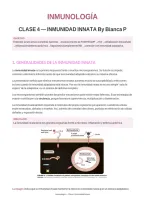
La imagen indica que la inmunidad innata mantiene la infección controlada hasta que se activa la adaptativa
Inmunología — Clase 4 | Inmunidad innata
,2. INMUNIDAD INNATA VS ADAPTATIVA
Característica Innata Adaptativa
Velocidad Rápida/inmediata Días en una primera exposición
Inmunología — Clase 4 | Inmunidad innata
, Reconocimiento Patrones conservados Millones de estructuras mediante
receptores clonales
Memoria Poca o ninguna memoria clásica Memoria potente
Respuesta principal Inflamación y defensa antivírica Anticuerpos y respuestas T
Receptores PRR BCR y TCR
Función Control inicial y eliminación Respuesta especializada y
memoria
La inmunidad adaptativa es más lenta al comienzo porque los linfocitos específicos son escasos y deben
activarse, proliferar y diferenciarse. Sin embargo, una segunda exposición produce una respuesta más rápida y
eficaz gracias a la memoria.
La inmunidad innata estimula y orienta la respuesta adaptativa. Las células dendríticas son especialmente
importantes porque detectan microbios, producen señales y presentan antígenos a linfocitos T.
2.1 Inflamación
La inflamación lleva leucocitos circulantes y proteínas plasmáticas al lugar de infección. Allí son activados para
destruir y eliminar el agente causal.
2.2 Defensa antivírica
La defensa antivírica induce cambios celulares que dificultan la replicación viral y favorecen la eliminación de las
células infectadas. Los interferones tipo I y las células NK son elementos centrales.
2.3 Barreras
• Piel y epitelios de los tubos digestivo y respiratorio.
• Mecanismos físicos, químicos y microbiológicos.
• Si el microorganismo supera la barrera, encuentra células y proteínas innatas capaces de detectarlo.
Inmunología — Clase 4 | Inmunidad innata


