
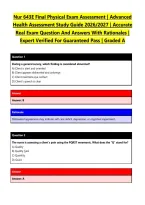
Nur 643E Final Physical Exam Assessment | Advanced
Health Assessment Study Guide 2026/2027 | Accurate
Real Exam Question And Answers With Rationales |
Expert Verified For Guaranteed Pass | Graded A
Question 1
During a general survey, which finding is considered abnormal?
A) Client is alert and oriented
B) Client appears disheveled and unkempt
C) Client maintains eye contact
D) Client’s speech is clear
Answer
Answer: B
Rationale
Disheveled appearance may indicate self-care deficit, depression, or cognitive impairment.
Question 2
The nurse is assessing a client’s pain using the PQRST mnemonic. What does the “Q” stand for?
A) Quality
B) Quality (yes)
C) Quantity
D) Quick
Answer
Answer: A
,Rationale
PQRST: Provocation, Quality, Region/Radiation, Severity, Timing. Q = Quality of pain.
Question 3
Which technique is correct for measuring blood pressure?
A) Place cuff over clothing
B) Place cuff 2.5 cm above the antecubital fossa
C) Deflate cuff rapidly
D) Use a cuff that covers 40% of arm circumference
Answer
Answer: B
Rationale
Correct placement ensures accurate measurement. Cuff should cover 80% of arm circumference.
Question 4
A nurse notes a client has a body mass index (BMI) of 32. This is classified as:
A) Normal weight
B) Overweight
C) Obese
D) Underweight
Answer
Answer: C
Rationale
BMI 30–34.9 is class I obesity. Normal is 18.5–24.9; overweight is 25–29.9.
2
,Question 5
When assessing skin turgor, which area is most reliable in an older adult?
A) Forearm
B) Over the sternum
C) Dorsum of hand
D) Abdomen
Answer
Answer: B
Rationale
Skin turgor is best assessed over the sternum in older adults; hand/forearm less reliable due to sun
damage.
Question 6
A nurse observes a flat, non-palpable, brown macule on the client’s back. This is most likely:
A) Melanoma
B) Benign nevus (mole)
C) Actinic keratosis
D) Basal cell carcinoma
Answer
Answer: B
Rationale
Benign nevi are flat or raised, uniform in color, and have regular borders.
Question 7
3
, The ABCDE rule for melanoma includes all of the following EXCEPT:
A) Asymmetry
B) Border irregularity
C) Color uniformity
D) Diameter >6 mm
Answer
Answer: C
Rationale
Melanoma often has color variation; uniform color is reassuring for benign lesions.
Question 8
When palpating the thyroid, the nurse asks the client to:
A) Hold breath
B) Swallow
C) Turn head to the side
D) Open mouth wide
Answer
Answer: B
Rationale
Swallowing causes the thyroid to rise, making it easier to palpate.
Question 9
A nurse auscultates a bruit over the carotid artery. This finding suggests:
A) Normal finding
B) Turbulent blood flow (stenosis)
C) Venous hum
4


