BSC 2085 | ANATOMY & PHYSIOLOGY I | PRACTICE EXAM BANK Original Study Resource
COLLEGE ANATOMY & PHYSIOLOGY | PRACTICE BANK
BSC 2085
Anatomy and Physiology I
Comprehensive Practice Exam Bank
220+ Original Questions with Detailed Rationales
Introduction • Chemistry • Cells • Tissues • Integumentary • Skeletal • Muscular • Nervous
DISCLAIMER – ORIGINAL educational practice resource for BSC 2085 themes. NOT an official college or publisher exam and NOT
proprietary licensed content. Scope: reinforce Anatomy & Physiology I knowledge and practices. Not official advice.
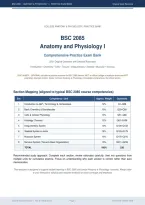
Section Mapping (aligned to typical BSC 2085 course competencies)
Sec Competency / Unit Approx. Weight Questions
1 Introduction to A&P;, Terminology & Homeostasis 12% Q1–Q28
2 Basic Chemistry & Biomolecules 10% Q29–Q50
3 Cells & Cellular Physiology 13% Q51–Q80
4 Histology (Tissues) 12% Q81–Q108
5 Integumentary System 10% Q109–Q132
6 Skeletal System & Joints 18% Q133–Q175
7 Muscular System 15% Q176–Q210
8 Nervous System (Tissue & Basic Organization) 10% Q211–Q235
TOTAL 100% 235
Recommended study approach: Complete each section, review rationales carefully, then mix questions from
multiple units for cumulative practice. Focus on understanding why each answer is correct rather than pure
memorization.
This resource is designed to support student learning in BSC 2085 and similar Anatomy & Physiology I courses. Always refer
to your instructor’s syllabus and required textbook for exact coverage and emphasis.
Original Study Resource | Not an official exam Page 1 Generated October 2026
,BSC 2085 | ANATOMY & PHYSIOLOGY I | PRACTICE EXAM BANK Original Study Resource
Section 1: Introduction to A&P;, Terminology & Homeostasis
Q1. Which of the following best describes the anatomical position?
A. Lying face down with arms at the sides
B. Standing upright, feet parallel, arms at sides with palms facing forward
C. Standing upright, feet together, arms crossed
D. Sitting with legs extended and palms facing backward
Answer: B
Rationale: The anatomical position is the standard reference position: body erect, feet slightly apart and parallel, arms
hanging at the sides with palms facing anteriorly (forward). This allows consistent use of directional terms.
Q2. The term 'proximal' is used to describe a structure that is:
A. Farther from the point of attachment of a limb
B. Closer to the midline of the body
C. Closer to the point of attachment of a limb to the trunk
D. Toward the head or upper part of a structure
Answer: C
Rationale: Proximal means closer to the origin or point of attachment of a limb to the body trunk. Distal is the opposite
(farther from the attachment). Medial refers to closer to the midline; superior/cranial refers to toward the head.
Q3. Which plane divides the body into equal right and left halves?
A. Coronal (frontal) plane
B. Transverse (horizontal) plane
C. Midsagittal (median) plane
D. Parasagittal plane
Answer: C
Rationale: The midsagittal (median) plane divides the body into equal right and left halves. A parasagittal plane is parallel
to the midsagittal but unequal. The coronal/frontal plane divides into anterior and posterior; the transverse plane divides
into superior and inferior.
Q4. Homeostasis is best defined as:
A. The process of cell division
B. Maintenance of a stable internal environment despite external changes
C. The breakdown of complex molecules
D. The production of energy within mitochondria
Answer: B
Rationale: Homeostasis is the body’s ability to maintain relatively stable internal conditions (e.g., temperature, pH, blood
glucose) even when the external environment changes. It is a foundational concept in physiology.
Q5. In a negative feedback loop, the response of the effector:
A. Amplifies the original stimulus
B. Reduces or opposes the original stimulus
C. Has no effect on the stimulus
D. Always involves the endocrine system only
Answer: B
Rationale: Negative feedback mechanisms reduce or reverse the effect of the original stimulus, helping return the variable
to its set point. Most homeostatic controls (body temperature, blood pressure, blood glucose) are negative feedback.
Positive feedback amplifies the stimulus (e.g., childbirth, blood clotting).
Original Study Resource | Not an official exam Page 2 Generated October 2026
,BSC 2085 | ANATOMY & PHYSIOLOGY I | PRACTICE EXAM BANK Original Study Resource
Q6. Which of the following is an example of positive feedback?
A. Regulation of body temperature by sweating
B. Control of blood glucose by insulin
C. Blood clotting cascade
D. Regulation of blood pressure by baroreceptors
Answer: C
Rationale: Blood clotting is a classic positive feedback example: once a clot begins to form, chemicals released accelerate
further clotting until the vessel is sealed. Childbirth (oxytocin) is another classic example. Temperature, glucose, and blood
pressure regulation are negative feedback.
Q7. The dorsal body cavity contains the:
A. Heart and lungs
B. Stomach and intestines
C. Brain and spinal cord
D. Liver and spleen
Answer: C
Rationale: The dorsal body cavity includes the cranial cavity (brain) and vertebral (spinal) cavity (spinal cord). The ventral
body cavity contains the thoracic cavity (heart, lungs) and abdominopelvic cavity (digestive organs, etc.).
Q8. Which regional term refers to the posterior surface of the knee?
A. Popliteal
B. Patellar
C. Femoral
D. Crural
Answer: A
Rationale: Popliteal refers to the posterior aspect of the knee. Patellar is the anterior knee (kneecap area), femoral is the
thigh, and crural is the leg (between knee and ankle).
Q9. The serous membrane that covers the surface of the lungs is the:
A. Parietal peritoneum
B. Visceral pleura
C. Parietal pericardium
D. Visceral peritoneum
Answer: B
Rationale: Visceral pleura covers the external surface of the lungs. Parietal pleura lines the thoracic wall. Pericardium
relates to the heart; peritoneum relates to the abdominopelvic cavity.
Q10. Which of the following is NOT a necessary life function?
A. Maintaining boundaries
B. Movement
C. Photosynthesis
D. Responsiveness
Answer: C
Rationale: Necessary life functions for humans include maintaining boundaries, movement, responsiveness, digestion,
metabolism, excretion, reproduction, and growth. Photosynthesis is a process used by plants and some other organisms,
not humans.
Original Study Resource | Not an official exam Page 3 Generated October 2026
, BSC 2085 | ANATOMY & PHYSIOLOGY I | PRACTICE EXAM BANK Original Study Resource
Q11. The most abundant chemical substance in the body is:
A. Protein
B. Water
C. Carbohydrate
D. Lipid
Answer: B
Rationale: Water makes up approximately 60–70% of body weight and is the most abundant chemical substance. It is
essential for virtually all physiological processes.
Q12. Which directional term means 'toward the midline of the body'?
A. Lateral
B. Medial
C. Distal
D. Superficial
Answer: B
Rationale: Medial means toward the midline. Lateral means away from the midline. Distal means farther from the point of
attachment; superficial means toward the body surface.
Q13. The abdominopelvic cavity is divided into how many quadrants?
A. Two
B. Four
C. Six
D. Nine
Answer: B
Rationale: Clinically, the abdominopelvic cavity is commonly divided into four quadrants (right upper, left upper, right lower,
left lower) by one horizontal and one vertical line through the umbilicus. It can also be divided into nine regions for more
detail.
Q14. A structure that is 'deep' is:
A. Closer to the body surface
B. Farther from the body surface
C. Closer to the head
D. On the same side of the body
Answer: B
Rationale: Deep means away from the body surface; more internal. Superficial is the opposite (toward or at the body
surface).
Q15. Which of the following organs is located primarily in the right upper quadrant?
A. Appendix
B. Spleen
C. Liver
D. Sigmoid colon
Answer: C
Rationale: The majority of the liver is located in the right upper quadrant (RUQ). The appendix is typically in the right lower
quadrant, the spleen in the left upper quadrant, and the sigmoid colon in the left lower quadrant.
Q16. The process by which the body detects a change and responds to it is called:
Original Study Resource | Not an official exam Page 4 Generated October 2026