
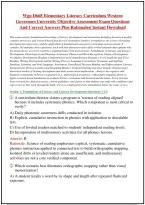
Wgu D668 Elementary Literacy Curriculum Western
Governors University Objective Assessment Exam Questions
And Correct Answers Plus Rationales| Instant Download
This exam assesses foundational knowledge of literacy development and instruction, including theoretical models,
cognitive processes, and research-based practices for elementary learners. It emphasizes the science of reading,
developmental trajectories, and the application of foundational concepts to curriculum and assessment. It
contains 145 multiple-choice questions, each with four distractors and a fully worked rationale that explains why
the keyed answer is correct. Content is organized into 12 focused sections: Foundations of Literacy and Literacy
Development, Phonological and Phonemic Awareness, Phonics and Word Recognition, Fluency Development,
Vocabulary Development, Reading Comprehension and Comprehension Strategies, Text Complexity and Close
Reading, Writing Development and the Writing Process, Language Conventions, Grammar, and Spelling,
Speaking, Listening, and Oral Language, Assessment, Data-Based Decision Making, and Differentiation, Literacy
Instruction for Diverse Learners and Struggling Readers. Targeted learning outcomes include: Explain major
theoretical models of reading development and their instructional implications.; Analyze the cognitive and
linguistic components of literacy acquisition (e.g., phonological awareness, orthographic mapping, fluency).;
Apply research-based foundations to evaluate literacy curriculum and instructional decisions.. Every item has
been reviewed for clinical accuracy, current guidelines, and clarity so that students can study with confidence and
self-correct as they work through the bank. Use it as a high-yield review immediately before the exam, or as a
Section 1: Foundations of Literacy and Literacy Development (Questions 1-13)
1 A curriculum director claims a program is 'science of reading aligned'
because it includes systematic phonics. Which component is most critical to
verify?
A) Daily phonemic awareness drills conducted in isolation.
B) Explicit, cumulative instruction in phonics with application to decodable
text.
C) Use of leveled readers matched to students' independent reading levels.
D) Incorporation of multisensory activities for all phonics lessons.
Answer: B
Rationale: Science of reading emphasizes explicit, systematic, cumulative
phonics instruction applied in connected text to build orthographic mapping.
Isolated drills or leveled readers alone are insufficient, and multisensory
activities are not a core verified component.
2 Which scenario best illustrates orthographic mapping rather than visual
memorization?
A) A student recalls a word by its shape and length after repeated flashcard
exposure.
,B) A student sounds out an unfamiliar word by blending phonemes and then
reads it effortlessly later.
C) A student uses picture cues to guess a word in a predictable text.
D) A student writes a word repeatedly to commit it to memory.
Answer: B
Rationale: Orthographic mapping is the process of forming connections
between phonemes and graphemes for automatic word recognition. Blending
phonemes and later reading effortlessly reflects mapping; visual memorization,
picture cues, and rote writing do not.
3 A second-grade team debates the timing of phonological awareness
instruction. Which principle is best supported by reading research?
A) Phonological awareness should be taught only until basic rhyme and
syllable skills are mastered.
B) Phonemic awareness instruction is most effective when integrated with
letter-sound instruction.
C) Phonological awareness training should be delayed until students have
strong vocabulary.
D) Phonological awareness is a prerequisite that must be fully mastered
before any print exposure.
Answer: B
Rationale: Research shows that phonemic awareness instruction is most
effective when combined with grapheme-phoneme correspondence, enhancing
both skills. It should not be delayed, limited to early levels, or isolated from
print.
4 Which statement accurately reflects the Simple View of Reading (SVR) and
its implications for assessment?
A) Reading comprehension is the product of decoding and linguistic
comprehension; both must be assessed.
B) Reading comprehension is primarily determined by vocabulary
knowledge, regardless of decoding.
C) Decoding is the sole predictor of reading comprehension in early grades.
D) Linguistic comprehension becomes irrelevant once decoding is automatic.
Answer: A
Rationale: The SVR posits that reading comprehension is the product of
,decoding and linguistic comprehension, so both components must be
evaluated. Other options incorrectly isolate one factor or dismiss the other.
5 A student reads accurately but slowly and without expression. Which
component of reading fluency is most likely deficient?
A) Automaticity
B) Prosody
C) Accuracy
D) Phonemic awareness
Answer: B
Rationale: Prosody refers to reading with appropriate expression, phrasing, and
intonation. Accuracy is intact, and automaticity may be affected, but lack of
expression specifically indicates prosody weakness.
6 Which instructional approach best supports the development of vocabulary
depth rather than breadth?
A) Providing a list of 20 new words with definitions to memorize weekly.
B) Engaging students in semantic mapping and discussion of word
relationships.
C) Using flashcards with pictures and words for rapid recall.
D) Assigning independent reading of grade-level texts without follow-up.
Answer: B
Rationale: Vocabulary depth involves understanding word relationships,
nuances, and multiple meanings, fostered by semantic mapping and discussion.
Memorization, flashcards, and unstructured reading primarily target breadth or
superficial exposure.
7 According to automatic information processing theory (LaBerge &
Samuels), what happens when decoding requires excessive cognitive
resources?
A) Comprehension improves due to heightened attention.
B) Working memory is freed for higher-level comprehension.
C) Comprehension suffers because resources are diverted from meaning
construction.
D) Fluency develops more rapidly through increased effort.
Answer: C
, Rationale: Automaticity theory holds that non-automatic decoding consumes
working memory, leaving fewer resources for comprehension. Thus,
comprehension suffers; other options contradict this principle.
8 A school uses a Tier 1 curriculum that includes explicit phonemic awareness
and phonics. Which MTSS/RtI principle should guide Tier 2 support?
A) Tier 2 should repeat Tier 1 instruction at a slower pace for all students.
B) Tier 2 should provide targeted, evidence-based intervention for students
not responding to Tier 1.
C) Tier 2 should focus solely on vocabulary enrichment to compensate for
phonics.
D) Tier 2 should replace Tier 1 instruction for struggling readers.
Answer: B
Rationale: MTSS/RtI frameworks require Tier 2 to deliver targeted,
evidence-based interventions for students identified as not making adequate
progress in Tier 1. It supplements, not replaces, Tier 1 and is not merely slower
repetition.
9 Which finding from the National Reading Panel (2000) most directly informs
foundational literacy curriculum?
A) Independent silent reading is the strongest predictor of reading
achievement.
B) Systematic phonics instruction improves word recognition and spelling,
especially in early grades.
C) Whole-language approaches outperform code-based approaches in all
outcomes.
D) Phonemic awareness training is ineffective without extensive vocabulary
instruction.
Answer: B
Rationale: The NRP meta-analysis found systematic phonics instruction
significantly improves word reading and spelling in early grades. It did not find
silent reading or whole language superior, nor that phonemic awareness
requires vocabulary instruction.
10 A curriculum emphasizes teaching letter names before letter sounds. Which
critique aligns with research on early literacy foundations?


