
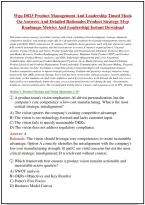
Wgu D823 Product Management And Leadership Timed Mock
Oa Answers And Detailed Rationales Product Strategy Mvp
Roadmaps Metrics And Leadership| Instant Download
This exam assesses mastery of product strategy and vision, including vision development, strategic alignment,
competitive analysis, and strategic trade-offs. It is designed for graduate-level product management courses and
aligns with WGU D823 competencies. It contains 147 multiple-choice questions, each with four distractors and a
fully worked rationale that explains why the keyed answer is correct. Content is organized into 11 focused
sections: Product Strategy and Vision, Product Leadership and Organizational Alignment, Customer Discovery
and Market Research, Product Roadmapping and Prioritization, Minimum Viable Product (MVP) and Product
Development, Product Metrics, Analytics, and KPIs, Stakeholder Management and Cross-Functional
Collaboration, Agile and Lean Product Management Practices, Go-to-Market Strategy and Launch Planning,
Product Lifecycle and Portfolio Management, Team Leadership, Communication, and Decision-Making. Targeted
learning outcomes include: Formulate a compelling product vision that aligns with organizational strategy;
Conduct competitive analysis to inform strategic positioning; Evaluate and prioritize strategic initiatives using
frameworks like OKRs and Lean Startup. Every item has been reviewed for clinical accuracy, current guidelines,
and clarity so that students can study with confidence and self-correct as they work through the bank. Use it as a
high-yield review immediately before the exam, or as a structured practice tool during the unit - the rationales
double as concise teaching notes. The recommended writing time is 2 hours, with a passing score of 80%. Aligned
Section 1: Product Strategy and Vision (Questions 1-14)
1 A product team's vision emphasizes AI-driven personalization, but the
company's core competency is low-cost manufacturing. What is the most
critical strategic misalignment?
A) The vision ignores the company's existing competitive advantage.
B) The vision is too technology-focused and lacks customer input.
C) The vision fails to specify measurable OKRs.
D) The vision does not address regulatory compliance.
Answer: A
Rationale: The vision should leverage core competencies to create sustainable
advantage. Option A correctly identifies the misalignment with the company's
low-cost manufacturing strength. B and C are valid concerns but not the most
critical strategic misalignment; D is irrelevant without context.
2 Which framework best ensures a product vision remains actionable and
measurable across quarters?
A) SWOT analysis
B) OKRs (Objectives and Key Results)
C) Porter's Five Forces
D) Business Model Canvas
,Answer: B
Rationale: OKRs translate vision into measurable objectives and key results,
enabling quarterly tracking. SWOT and Five Forces are analytical tools, not
execution frameworks. Business Model Canvas describes business logic but
lacks the cadence for quarterly measurement.
3 In a mature market, a product vision focused on radical innovation is likely
to fail because:
A) Customers resist change regardless of value.
B) The vision does not align with market demand for incremental
improvements.
C) Radical innovation always requires more funding.
D) Mature markets have no room for differentiation.
Answer: B
Rationale: In mature markets, customer needs are often well-served, so a vision
of radical innovation may not resonate. Option B captures this misalignment. A
is an overgeneralization; C is not universally true; D is false as differentiation
is possible.
4 A startup's vision is 'to make healthcare accessible to all.' Which competitive
analysis tool best tests this vision's viability?
A) SWOT analysis
B) PESTLE analysis
C) Porter's Five Forces
D) Value Chain Analysis
Answer: C
Rationale: Porter's Five Forces assesses industry attractiveness and competitive
pressures, which is crucial for testing a vision's viability in healthcare. SWOT
and PESTLE are broader; Value Chain focuses on internal activities.
5 Which element is most essential for a product vision to drive strategic
decision-making?
A) Detailed feature list
B) Clear target customer and value proposition
C) Financial projections
D) Technology stack
,Answer: B
Rationale: A vision must clearly define the target customer and value
proposition to guide decisions. Feature lists, financials, and tech stack are
execution details, not the core of vision.
6 A product manager uses the 'Working Backwards' approach. What is the
primary artifact produced?
A) A press release and FAQ
B) A business case
C) A user story map
D) A Gantt chart
Answer: A
Rationale: Amazon's Working Backwards process starts with a mock press
release and FAQ to articulate the vision from the customer's perspective. Other
options are planning tools, not vision artifacts.
7 When crafting a vision, which of the following best ensures alignment with
corporate strategy?
A) Conducting a competitor analysis
B) Mapping the vision to strategic pillars
C) Setting OKRs immediately
D) Defining the MVP
Answer: B
Rationale: Mapping the vision to strategic pillars ensures it supports corporate
goals. Competitor analysis informs but doesn't ensure alignment; OKRs and
MVP come after vision.
8 A vision statement that is too broad is problematic primarily because:
A) It is difficult to communicate.
B) It fails to guide prioritization and trade-offs.
C) It requires more resources.
D) It alienates stakeholders.
Answer: B
Rationale: A broad vision lacks specificity, making it hard to prioritize features
and make trade-offs. Communication and resources are secondary; stakeholder
alienation is not the primary issue.
, 9 Which of the following best illustrates a product vision that is
customer-centric?
A) To be the leading provider of cloud services.
B) To empower small businesses to grow with intuitive financial tools.
C) To achieve 30% market share in five years.
D) To use AI to automate all manual processes.
Answer: B
Rationale: Option B focuses on the customer (small businesses) and the value
delivered (empowerment). A is company-centric; C is a goal; D is
technology-centric.
10 In the context of product strategy, a vision differs from a mission in that a
vision:
A) Describes the current state.
B) Defines the company's purpose.
C) Outlines the future state.
D) Lists core values.
Answer: C
Rationale: A vision outlines the future state the product aims to create, while a
mission defines the company's purpose and current focus. Options A and D
describe mission or values.
11 A product team's vision is 'to be the default workspace for remote teams.'
Which strategy best operationalizes this vision?
A) Defining a product strategy that prioritizes integration partnerships and
cross-platform sync to reduce friction for distributed teams.
B) Setting a quarterly OKR to increase monthly active users by 20% across
all segments.
C) Conducting a competitive analysis of top remote-work tools and
replicating their feature sets.
D) Launching a marketing campaign targeting remote workers with the
tagline 'Your team's default workspace.'
Answer: A
Rationale: A product strategy translates vision into choices about where to play
and how to win; prioritizing integrations and sync directly supports the 'default
workspace' vision by reducing friction for remote teams. B is a generic growth


