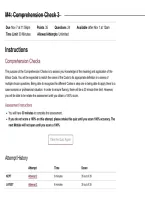
M4: Comprehension Check 3
Due Nov 7 at 11:59pm Points 35 Questions 24 Available after Nov 1 at 12am
Time Limit 30 Minutes Allowed Attempts Unlimited
Instructions
Comprehension Checks
The purpose of the Comprehension Checks is to assess your knowledge of the meaning and application of the
Ethics Code. You will be expected to match the name of the Code to its appropriate definition in a series of
multiple choice questions. Being able to recognize the different Codes is step one in being able to apply them to a
case scenario or professional situation. In order to ensure fluency, there will be a 30 minute time limit. However,
you will be able to be retake the assessment until you obtain a 100% score.
Assessment Instructions
You will have 30 minutes to complete this assessment.
If you do not score a 100% on this attempt, please retake this quiz until you score 100% accuracy. The
next Module will not open until you score a 100%.
Take the Quiz Again
Attempt History
Attempt Time Score
KEPT Attempt 2 8 minutes 35 out of 35
LATEST Attempt 2 8 minutes 35 out of 35
, Attempt Time Score
Attempt 1 24 minutes 30.62 out of 35
Correct answers are hidden.
Score for this attempt: 35 out of 35
Submitted Nov 7 at 3:48am
This attempt took 8 minutes.
Question 1 2..38 pts
Jose works as a BCBA for a national ABA agency. During his training, Jose worked with young
children with autism, all of whom were verbal and had primarily social skills or academic goals. His
clinical director (who is not a BCBA) has asked Jose to take on a new case working with an
adolescent with autism and intellectual disability, who is non verbal and is engaging in severe
aggression and challenging behaviors. With regard to Standard 3.03 Accepting Clients, what is
Jose’s best course of action?
Jose should request that the agency provide mentorship and support from another BCBA who has
competency in this area, or allow Jose to shadow that person in order to gain his competence.
Jose should go ahead and accept the client but make a note that he has told his clinical director that he
doesn’t feel he has the competency for this client.
, Jose should tell his clinical director that he cannot accept that client because he does not have the
competency to do so.
Jose should accept the client because he has training and experience with learners with autism.
Question 2 2..38 pts
Rhys is the only BCBA within a 150 mile radius of his small town. Many of the people who live in his
town work in jobs that do not provide health insurance, making it hard for some of his clients to afford
behavior analytic services. Which of the following would not be an appropriate option for Rhys to
consider, according to Standard 3.05 Financial Agreements?
Rhys could take on clients pro bono, as long as he can afford to provide the service.
Rhyse could barter for services as long as there is a service agreement in place.
Rhyse could charge for services on a sliding scale as long as that information was documented before
beginning services.
Rhys could provide behavior analytic services in exchange for some good or service that the client’s
family provides.
, Question 3 2..38 pts
Natalie has been providing consultation services to a local school district for the past year. Recently,
a new principal has asked her to include restraint and seclusion in her behavior intervention plans, as
he (the principal) has paid a lot of money to hire a company to conduct restraint and seclusion
training for his staff. This practice goes against Natalie’s professional and ethical recommendations
for her clients. Which would be her best course of action under Standard 3.08 Responsibility to the
Client with Third-Party Contracts for Services?
Natalie can discontinue her services effective immediately.
Natalie can explain her concerns and ethical responsibilities to the principal and if that does not resolve
the issue, then she can discontinue her services.
Natalie can explain her concerns and ethical responsibilities to the principal and if that does not resolve
the issue, then she can discontinue services after an appropriate transition.
Natalie can go ahead and write restraint and seclusion in some of the behavior plans for her clients whose
teachers are trained in the procedure.
Question 4 2..38 pts