
Clinical & Exam Quick-Reference Guide: Nursing &
CNA/PCT
Essential reference for RNs, LPNs, CNAs/PCTs, and clinical students preparing for NCLEX and board examinations.
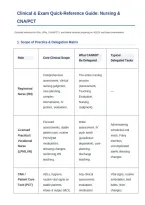
1. Scope of Practice & Delegation Matrix
What CANNOT Typical
Role Core Clinical Scope
Be Delegated Delegated Tasks
Comprehensive The entire nursing
assessment, clinical process
nursing judgment, (Assessment,
Registered
care planning, Teaching, —
Nurse (RN)
complex Evaluation,
interventions, IV Nursing
pushes, evaluation. Judgment).
Focused Initial
Administering
assessments, stable assessment, IV
Licensed scheduled oral
patient care, routine push meds
Practical / meds, Foley
PO/SQ/IM (jurisdiction
Vocational insertion,
medications, dependent), care
Nurse uncomplicated
dressing changes, planning,
(LPN/LVN) sterile dressing
reinforcing RN discharge
changes.
teaching. teaching.
CNA / ADLs, hygiene, Any clinical Vital signs, routine
Patient Care routine vital signs on assessment, ambulation, bed
Tech (PCT) stable patients, evaluation, baths, linen
intake & output (I&O), medication changes,
, administration, emptying
ambulation, reporting
invasive care, drainage bags,
observations.
tube feeding. recording meal %.
Delegation Golden Rule: The RN can delegate tasks, never nursing judgment, assessment, or evaluation. If a
patient is unstable or actively changing, delegation of vital signs or ambulation is inappropriate.
2. Vital Signs & Critical Lab Reference Values
Adult Vital Signs Reference Ranges
• Heart Rate (HR): 60–100 bpm (Bradycardia < 60, Tachycardia > 100)
• Respiratory Rate (RR): 12–20 breaths/min (Bradypnea < 12, Tachypnea > 20)
• Blood Pressure (BP): Normotensive systolic 90–120 mmHg, diastolic 60–80 mmHg
• Temperature: 36.5–37.5°C (97.7–99.5°F)
• Pulse Oximetry (SpO2): 95–100% on room air (Target 88–92% in severe COPD/hypercapnia)
Critical High-Yield Lab Values
Normal
Lab Test Critical High/Low Clinical Flags
Range
Cardiac rhythm: Peaked T waves, lethal
Potassium 3.5–5.0
dysrhythmias (> 5.0); muscle weakness, U waves (<
(K+) mEq/L
3.5).
Sodium 135–145 Neurological status: Confusion, seizures, altered
(Na+) mEq/L mental status, cerebral edema.
Neuromuscular excitability: Tetany,
Calcium 8.5–10.5
Trousseau/Chvostek signs (< 8.5); stones, groans (>
(Ca2+) mg/dL
10.5).


