

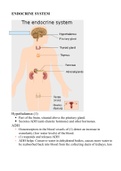
ENDOCRINE SYSTEM
Hypothalamus (1)
Part of the brain, situated above the pituitary gland.
Secretes ADH (anti-diuretic hormone) and other hormones.
ADH
Osmoreceptors in the blood vessels of (1) detect an increase in
osmolarity (low water levels) of the blood.
(1) responds and releases ADH
ADH helps: Conserve water in dehydrated bodies, causes more water to
be reabsorbed back into blood from the collecting ducts of kidneys, less
, water in urine.
Target organs : Nephrons of the kidneys
Pituitary Gland (2)
Chemical co-ordinator of most of the other endocrine glands.
Attached to (1)
Located at the base of the brain by a short stalk.
Hormones secreted
1. Thyroid stimulating hormone (TSH)
Stimulates (via blood) the thyroid gland to secrete its hormone, thyroxin.
Target organ: Thyroid (gland)
2. Follicle stimulating hormone (FSH)
In females: stimulates oogenesis in the ovary (formation of eggs, ova)
In males: stimulates spermatogenesis in the testes (formation of sperm)
3. Luteinizing hormone (LH)
Stimulates ovulation (release of an egg) from the ovary and the formation of the corpus
luteum (produces hormones itself)
4. Prolactin
Stimulates the production of milk in female mammory glands.
5. Adrenocorticotropic hormone (ACTH)
Stimulates adrenal cortex to secrete the hormones, cortisone and aldosterone.
6. Interstitial cell stimulating hormone (ICSH)
Stimulates testes to secrete testosterone
7. Growth Hormone (GH) or (STH) Somatrophic hormone
Promotes skeletal and muscular growth, stimulates the synthesis of proteins.
Target organs: skeleton, bone, muscle
Thyroid Gland (3)
Two lobes of the butterfly-shaped gland are found on either side of the
trachea just below the larynx (voice box) in the front of the neck.
Secretes thyroxin (iodine is essential to the production of thyroxin, a
goitre may develop if levels of iodine are low.
Hypothalamus (1)
Part of the brain, situated above the pituitary gland.
Secretes ADH (anti-diuretic hormone) and other hormones.
ADH
Osmoreceptors in the blood vessels of (1) detect an increase in
osmolarity (low water levels) of the blood.
(1) responds and releases ADH
ADH helps: Conserve water in dehydrated bodies, causes more water to
be reabsorbed back into blood from the collecting ducts of kidneys, less
, water in urine.
Target organs : Nephrons of the kidneys
Pituitary Gland (2)
Chemical co-ordinator of most of the other endocrine glands.
Attached to (1)
Located at the base of the brain by a short stalk.
Hormones secreted
1. Thyroid stimulating hormone (TSH)
Stimulates (via blood) the thyroid gland to secrete its hormone, thyroxin.
Target organ: Thyroid (gland)
2. Follicle stimulating hormone (FSH)
In females: stimulates oogenesis in the ovary (formation of eggs, ova)
In males: stimulates spermatogenesis in the testes (formation of sperm)
3. Luteinizing hormone (LH)
Stimulates ovulation (release of an egg) from the ovary and the formation of the corpus
luteum (produces hormones itself)
4. Prolactin
Stimulates the production of milk in female mammory glands.
5. Adrenocorticotropic hormone (ACTH)
Stimulates adrenal cortex to secrete the hormones, cortisone and aldosterone.
6. Interstitial cell stimulating hormone (ICSH)
Stimulates testes to secrete testosterone
7. Growth Hormone (GH) or (STH) Somatrophic hormone
Promotes skeletal and muscular growth, stimulates the synthesis of proteins.
Target organs: skeleton, bone, muscle
Thyroid Gland (3)
Two lobes of the butterfly-shaped gland are found on either side of the
trachea just below the larynx (voice box) in the front of the neck.
Secretes thyroxin (iodine is essential to the production of thyroxin, a
goitre may develop if levels of iodine are low.


