WGU D782 | HKN1 Task 1 | CloudCampusIQ
WESTERN GOVERNORS UNIVERSITY
D782 | NETWORK ARCHITECTURE AND CLOUD COMPUTING
HKN1 TASK 1
CLOUD SYSTEMS
CloudCampusIQ: cloud architecture, provider selection, and secure course-material storage
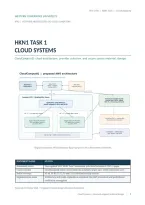
Original conceptual AWS architecture figure (proposal; not a deployment screenshot).
DOCUMENT BASIS STATUS
Assessment source User-supplied WGU HKN1 Task 1 assessment, print date December 4, 2025, 6 pages
Course scenario CloudCampusIQ online-course platform; scalability target: up to 10,000 concurrent users
Rubric coverage A1-A4, B1-B3, C1-C2, D, and E (11 individual scoring criteria)
Implementation status Architecture and model explanations completed; live AWS screenshots and performance
verification not supplied
Prepared 23 October 2026 • Original technical design and research synthesis
Cloud Systems • Research-aligned technical design | 1
, WGU D782 | HKN1 Task 1 | CloudCampusIQ
Document purpose, evidence boundaries, and scenario
This deliverable organizes CloudCampusIQ's proposed cloud solution against the exact A-E grading structure
visible in the supplied WGU performance assessment. It provides a coherent architectural design, decisions with
justifications, implementation specifications for secure storage, and a complete evidence-acquisition workflow. It
does not assert that cloud resources have already been created, that screenshots were captured, or that 10,000-
user capacity has been demonstrated.
1. Scenario facts provided by the assessment
Source-stated requirement Architectural interpretation
Online courses provided through a web A web application and application-delivery layer are needed.
application
Course materials stored securely Private object storage, authorized retrieval, encryption, and access-control
evidence are needed.
High availability and scalability Use more than one Availability Zone and scale-out-capable hosting.
Support up to 10,000 concurrent users Size from measured user activity; perform load tests before certifying the
target.
Security, monitoring and cost Define identity, network controls, telemetry, budgets, and retention policies.
management
Architecture diagram and stakeholder Provide a visual and explain each major service against the business needs.
rationale
2. Explicit design assumptions
AWS is an architectural selection for this solution, not a provider specified by WGU; the rubric permits AWS,
Azure, or Google Cloud.
The application is a conventional HTTPS web service with authenticated learner and instructor accounts. No
programming language, database engine, geographic region, or operating budget is supplied by the scenario.
Course files should not be publicly listed or fetched directly from an S3 URL. A login/authorization step
precedes temporary delivery of protected content.
“Up to 10,000 concurrent users” is a peak concurrency requirement, not evidence of 10,000 simultaneous
requests per second.
Cost values, instance sizes, scaling thresholds, and data retention durations remain configurable after
workload analysis and business approval.
A persistent database may be necessary for enrollment and progress, but this requirement is not explicit in
the supplied scenario; it is an optional follow-on component, not a prerequisite to A-C.
SCOPE BOUNDARY The stand-alone “D782 Case Study.docx” listed by the PDF was not provided. Only scenario
details printed on page 1 and requirements on pages 2-3 are treated as official case facts. Everything additional
is a reasoned AWS design choice.
3. Rubric-to-evidence traceability
Criterio
Where addressed Evidence type
n
A1 Figure 1, section A1 Original diagram; production reproduction in a
diagram tool
A2 Section A2 Provider/service inventory
Cloud Systems • Research-aligned technical design | 2