
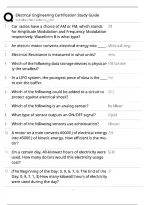
Electrical Engineering Certification Study Guide
There is no single “electrical engineering certification” in the abstract. The study guide you need depends entirely on which credential you are pursuing. The search results reflect several distinct pathways with different scopes, formats, and governing bodies. For U.S. engineering licensure (FE/PE): The Fundamentals of Engineering (FE) Electrical and Computer exam is the first step toward the PE license. It consists of 110 questions across 18 topic areas with a 5-hour 20-minute time limit. Study guides aligned with the NCEES blueprint typically cover Mathematics, Circuit Analysis, Linear Systems, Signal Processing, Electronics, Power Systems, Electromagnetics, Control Systems, Communications, Digital Systems, and Software Development. The PE Electrical & Computer Engineering exam follows as the professional-level credential, with study guides updated for the 2026–2027 NCEES specifications. For basic/fundamental electrical knowledge: Sanfoundry offers a free Basic Electrical Engineering Certification structured as 10 levels of 25 questions each, followed by a 50-question final exam with a 60-minute limit. An 80% or above earns a Certificate of Merit. This covers current, voltage, resistance, Ohm’s Law, Kirchhoff’s Laws, DC/AC circuit analysis, transformers, and measurement basics. For software-specific electrical design: The SOLIDWORKS CSWA-Electrical certification is a 50-question multiple-choice exam requiring 35 points to pass within 1 hour. It targets engineers working with SOLIDWORKS Electrical schematics and 3D wiring, covering electrical theory, schematics, and installation. For international/advanced practice: The UK-IET Chartered Engineer (CEng) and IEng technical assessments use a question bank of 1,500 MCQs covering advanced mathematics, network theory, control systems, electromagnetics, power systems, and digital electronics—though this resource provides answers only, not step-by-step solutions. For industry-specific credentials: SACA offers stackable certifications with Silver (theory-only, online multiple-choice) and Gold (theory + hands-on performance assessment) levels. Electrical-focused content includes AC/DC electrical systems, circuit analysis, and troubleshooting. The IEEE also offers a Distributed Energy Resources credentialing program focused on IEEE commissioning conformance. Most study guides emphasize practice questions, timed simulations, and familiarity with reference materials (such as the NCEES FE Reference Handbook) as core preparation strategies.
Document information
- Uploaded on
- October 22, 2026
- Number of pages
- 3
- Written in
- 2026/2027
- Type
- Exam (elaborations)
- Contains
- Questions & answers


