
EKG Certification Exam #1 (Third-Party Practice Question Set)
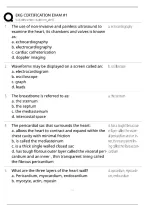
Official Exam Context: The most widely recognized EKG technician credential is the NHA Certified EKG Technician (CET) exam. According to the 2026 test plan, it consists of 100 scored items (plus 20 pretest items) with a 2-hour time limit. The content is divided into three domains: Safety, Compliance, and Coordinated Patient Care (34%), EKG Acquisition (40%), and EKG Analysis and Interpretation (26%) . Core knowledge includes cardiac anatomy and physiology, emergency recognition (syncope, chest pain), and CPR/BLS . Nature of "Exam #1" Materials: The document circulating on Docsity under the title "ACTUAL KAISER EKG CERTIFICATION EXAM 2026/2027" is a third-party recall question set, not an official Kaiser or NHA publication. It carries marketing language such as "100% correct" and "verified answers," and its accuracy cannot be guaranteed . Similar materials on Stuvia (e.g., "EKG Exam Review 2026 | Most Tested Questions & Verified Answers") follow the same pattern . Representative Content from Third-Party "Exam #1": History: William Einthoven developed the first EKG . Anatomy: The heart has 4 chambers; the upper chambers are the atria; the bicuspid valve is also called the mitral valve . Conduction: Electrical impulses reach the ventricles via the Purkinje fibers; another name for the SA node is the pacemaker . Measurements: One small box on EKG paper represents 0.04 sec and 1 mm; the normal PRI is 0.12 to 0.20 sec . Calculations: Stroke volume × heart rate = cardiac output . Electrolytes: Potassium, Calcium, and Sodium play important roles in cardiac conduction . Rhythm Interpretation (from related Stuvia sets): Atrial fibrillation presents with absent P waves and an irregularly irregular rhythm; first-degree AV block has a PR interval 0.20 sec with every P wave conducted .
Document information
- Uploaded on
- October 22, 2026
- Number of pages
- 6
- Written in
- 2026/2027
- Type
- Exam (elaborations)
- Contains
- Questions & answers


