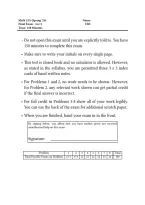
Math 33A (Spring ’26) Name: Put Your Name In This Space!
Final Exam - Lec 2 UID: Put Your Name In This Space!
Time: 150 Minutes
• Do not open this exam until you are explicitly told to. You have
150 minutes to complete this exam.
• Make sure to write your initials on every single page.
• This test is closed book and no calculator is allowed. However,
as stated in the syllabus, you are permitted three 3 x 5 index
cards of hand written notes.
• For Problems 1 and 2, no work needs to be shown. However,
for Problem 2, any relevant work shown can get partial credit
if the final answer is incorrect.
• For full credit in Problems 3-8 show all of your work legibly.
You can use the back of the exam for additional scratch paper.
• When you are finished, hand your exam in in the front.
By signing below, you affirm that you have neither given nor received
unauthorized help on this exam.
Signature:
Problem 1 2 3 4 5 6 7 8 Total
Total Possible Points on Problem: 12*1 4*4 12 12 12 12 12 12 100
,Blank Space Like Taylor Swift
2
, Put Your Initials Here: Initials Initials
Problem 1
Circle the correct answer. If you wish to change your answer and cross out a
circle, be sure it is abundantly clear what your final answer is.
1. The quadratic form 𝑞(𝑥, 𝑦) = 5𝑥2 + 4𝑥𝑦 + 5𝑦2 is indefinite.
# True # False
5 2
Answer: FALSE. The associated symmetric matrix is 𝐴 = ( ) which
2 5
has both eigenvalues > 0, so it is actually positive definite.
2. If 𝐴 is an invertible 𝑛 × 𝑛 matrix, the largest singular value of 𝐴−1 is the
reciprocal of the largest singular value of 𝐴.
# True # False
Answer: FALSE. The largest singular value of 𝐴−1 is the reciprocal of the
smallest singular value of 𝐴.
3. A 3 × 3 matrix always has at least one eigenvalue.
# True # False
Answer: TRUE. For a 3×3 matrix 𝑀, if we take det(𝑀 −𝜆𝐼), this is a cubic
polynomial in 𝜆 which has at least one real root. Hence, 𝑀 has at least one
eigenvalue.
4. For every 2 × 2 matrix 𝑀, the dimension of ker(𝑀 ) is different from the
dimension of im(𝑀 ).
# True # False
Answer: FALSE. There are 2 × 2 matrices which have dimension of ker(𝑀 )
1 0
and im(𝑀 ) both equal to 1. For example, 𝑀 = ( ).
0 0
5. Every symmetric matrix is diagonalizable.
# True # False
Answer: TRUE. Every symmetric matrix is orthogonally diagonalizable and
hence diagonalizable.
3