Fundamentals Basic Pharmacology Final Exam With Comprehensive
Study Guide
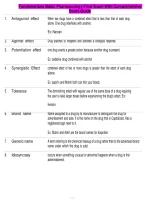
1. Antagonist effect When two drugs have a combined ettect that is less than that of each drug
alone. One drug interferes with another.
Ex: Narcan
2. Agonist effect Drug attaches to receptors and activates a biological response.
3. Potentiation effect one drug exerts a greater action because another drug is present.
Ex: sedative drug combined with alcohol
4. Synergistic Effect combined ettect of two or more drugs is greater than the ettect of each drug
alone.
Ex: aspirin and Motrin both can thin your blood.
5. Tolerance The diminishing ettect with regular use of the same dose of a drug requiring
the user to take larger doses before experiencing the drug's ettect. Ex:
heroin
6. Brand name Name assigned to a drug by its manufacturer to distinguish the drug for
advertisement and sale. It is the name on the drug that is Capitalized. Has a
registered sign next to it.
Ex: Motrin and Advil are the brand names for ibuprofen
7. Generic name A term referring to the chemical makeup of a drug rather than to the advertised brand
name under which the drug is sold.
8. Idiosyncrasy occurs when something unusual or abnormal happens when a drug is first
administered.
, Fundamentals Basic Pharmacology Final Exam With Comprehensive
Study Guide
Ex: When someone is taking a medication for anxiety but it makes them restless and
agitated instead.
9. signs and symp- Swelling, Flushing (red skin), itchy watering eyes, Warm tingling feeling in face,
toms of an allergic mouth, chest, feet, or hands, and Hives.
reaction
10. Allergy abnormal hypersensitivity acquired by exposure to an antigen
11. signs and symp- a patient has a severe life-threatening reaction that causes respiratory distress and
toms of anaphylac- cardiovascular collapse which can cause cyanosis of the skin has a QUICK
tic shock ONSET.
12. factors that affect a Age, pregnancy, lactation, body size, genetic factors, disease states, routes of
drugs action administration, environmental factors, psychological factors, and tolerance/re-
sistance.
13. Enteral route of ad- drug is administered directly into the gastrointestinal tract (GI) by the oral,
ministration sublingual, rectal, or nasogastric routes anything from your mouth to your
bottom.
14. parenteral route Bypasses the GI tract by using subcutaneous (subcut), intramuscular (IM), and
intravenous injection (IV).
15. percutaneous route Absorbed through the skin and mucous membranes by Inhalation, sublingual,
or topical routes.
16. lotions liquid water based soothing agent intended for external application to the skin.
17. ointments Semisolid oil-based preparation intended for external application to the skin or
mucous membranes that keep it on the skin longer.
18. creams semisolid preparations containing one or more drug substances dissolved or
dispersed in a suitable base. They are non-greasy and are removed with water.
Study Guide
1. Antagonist effect When two drugs have a combined ettect that is less than that of each drug
alone. One drug interferes with another.
Ex: Narcan
2. Agonist effect Drug attaches to receptors and activates a biological response.
3. Potentiation effect one drug exerts a greater action because another drug is present.
Ex: sedative drug combined with alcohol
4. Synergistic Effect combined ettect of two or more drugs is greater than the ettect of each drug
alone.
Ex: aspirin and Motrin both can thin your blood.
5. Tolerance The diminishing ettect with regular use of the same dose of a drug requiring
the user to take larger doses before experiencing the drug's ettect. Ex:
heroin
6. Brand name Name assigned to a drug by its manufacturer to distinguish the drug for
advertisement and sale. It is the name on the drug that is Capitalized. Has a
registered sign next to it.
Ex: Motrin and Advil are the brand names for ibuprofen
7. Generic name A term referring to the chemical makeup of a drug rather than to the advertised brand
name under which the drug is sold.
8. Idiosyncrasy occurs when something unusual or abnormal happens when a drug is first
administered.
, Fundamentals Basic Pharmacology Final Exam With Comprehensive
Study Guide
Ex: When someone is taking a medication for anxiety but it makes them restless and
agitated instead.
9. signs and symp- Swelling, Flushing (red skin), itchy watering eyes, Warm tingling feeling in face,
toms of an allergic mouth, chest, feet, or hands, and Hives.
reaction
10. Allergy abnormal hypersensitivity acquired by exposure to an antigen
11. signs and symp- a patient has a severe life-threatening reaction that causes respiratory distress and
toms of anaphylac- cardiovascular collapse which can cause cyanosis of the skin has a QUICK
tic shock ONSET.
12. factors that affect a Age, pregnancy, lactation, body size, genetic factors, disease states, routes of
drugs action administration, environmental factors, psychological factors, and tolerance/re-
sistance.
13. Enteral route of ad- drug is administered directly into the gastrointestinal tract (GI) by the oral,
ministration sublingual, rectal, or nasogastric routes anything from your mouth to your
bottom.
14. parenteral route Bypasses the GI tract by using subcutaneous (subcut), intramuscular (IM), and
intravenous injection (IV).
15. percutaneous route Absorbed through the skin and mucous membranes by Inhalation, sublingual,
or topical routes.
16. lotions liquid water based soothing agent intended for external application to the skin.
17. ointments Semisolid oil-based preparation intended for external application to the skin or
mucous membranes that keep it on the skin longer.
18. creams semisolid preparations containing one or more drug substances dissolved or
dispersed in a suitable base. They are non-greasy and are removed with water.