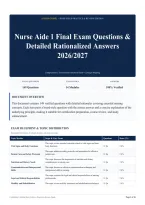
[STUDY GUIDE] • HIGH-YIELD PRACTICE & REVIEW EDITION
Nurse Aide 1 Final Exam Questions &
Detailed Rationalized Answers
2026/2027
Comprehensive Examination Question Bank • Concept Mapping
TOTAL QUESTIONS EXAM TOPICS ANSWERS
149 Questions 14 Modules 100% Verified
DOCUMENT OVERVIEW
This document contains 149 verified questions with detailed rationales covering essential nursing
concepts. Each item pairs a board-style question with the correct answer and a concise explanation of the
underlying principle, making it suitable for certification preparation, course review, and study
enhancement.
EXAM BLUEPRINT & TOPIC DISTRIBUTION
Systematic breakdown of subject domains and exam coverage.
Topic Module Scope & Core Focus Questions Share (%)
This topic covers essential concepts related to vital signs and basic
Vital Signs and Body Functions body functions. 11 Qs 7.4%
This topic addresses safety protocols and procedures for effective
Patient Care and Safety Protocols patient care. 11 Qs 7.4%
This topic discusses the importance of nutrition and dietary
Nutrition and Dietary Needs considerations in nursing care. 11 Qs 7.4%
Communication and Interpersonal This topic focuses on effective communication techniques and
Skills interpersonal skills in nursing. 11 Qs 7.4%
This topic explores the legal and ethical responsibilities of nursing
Legal and Ethical Responsibilities professionals. 11 Qs 7.4%
Mobility and Rehabilitation This topic covers mobility assistance and rehabilitation techniques. 11 Qs 7.4%
Confidential • Student Study Edition • Practice & Review Guide Page 1 of 36
,STUDENT STUDY & MASTERY EDITION PRACTICE & REVIEW GUIDE
This topic addresses infection control measures and prevention
Infection Control and Prevention strategies. 11 Qs 7.4%
Aging and Developmental This topic examines the aging process and its impact on health and
Considerations care. 11 Qs 7.4%
This topic focuses on maintaining skin integrity and managing
Skin Integrity and Wound Care wounds. 11 Qs 7.4%
This topic discusses the appropriate responses to emergencies and
Emergency Situations and First Aid first aid. 10 Qs 6.7%
Personal Care and Hygiene This topic covers personal care practices and hygiene maintenance. 10 Qs 6.7%
Psychosocial Aspects of Care This topic explores the psychosocial factors influencing patient care. 10 Qs 6.7%
Specimen Collection and Testing
Procedures This topic discusses procedures for specimen collection and testing. 10 Qs 6.7%
This topic examines the use of restraints and alternative methods for
Restraint Use and Alternatives managing behavior. 10 Qs 6.7%
Total Exam Coverage 14 Integrated Topic Modules 149 Qs 100.0%
TOPIC 1: VITAL SIGNS AND BODY FUNCTIONS
11 Questions • 7.4% of Exam • This topic covers essential concepts related to vital signs and basic body functions.
QUESTION 1
What is hypertension?
Answer: High blood pressure.
Rationale: Hypertension refers to a medical condition characterized by consistently elevated blood pressure readings, which can lead to
cardiovascular disease and other health complications. The term "high blood pressure" is the correct answer to the question "What is
hypertension?" because it accurately describes the fundamental physiological aspect of the condition, which is elevated blood pressure,
regardless of the specific terminology used to describe it.
QUESTION 2
What is tachycardia?
Answer: Fast heart rate.
Rationale: Tachycardia is a heart condition characterized by a rapid heart rate, typically above 100 beats per minute, which is caused
by an imbalance in the body's autonomic nervous system, leading to an increase in sympathetic tone and a decrease in parasympathetic
tone. This rapid heart rate is the defining feature of tachycardia, making "fast heart rate" the correct
answer because it accurately describes the primary manifestation of the condition.
Confidential • Student Study Edition • Practice & Review Guide Page 2 of 36
,STUDENT STUDY & MASTERY EDITION PRACTICE & REVIEW GUIDE
QUESTION 3
What do cells need to live and function?
Answer: Food, water, oxygen.
Rationale: Cells need food, water, and oxygen to live and function because these basic necessities provide the energy and building
blocks for cellular processes, such as metabolism, growth, and repair. Without these essential elements, cells would be unable to carry
out their normal functions, leading to dysfunction, damage, and ultimately, cell death.
QUESTION 4
Who decides how to style a resident's hair?
Answer: The resident.
Rationale: A resident is typically a person who lives in a particular place, such as a hotel, apartment complex, or senior living
community, and is often referred to as a resident. As a result, when it comes to styling their hair, it is the resident who makes the
decision, as they are the one who has personal control over their appearance and has the authority to choose how they want to style
their hair.
QUESTION 5
A resident wants a partial bath, what should you do?
Answer: Assist as needed.
Rationale: When a resident requests a partial bath, it means they require assistance with a specific aspect of the bathing process, such
as washing a particular area of their body, and not the entire bathing routine. Therefore, "Assist as needed" is the correct response, as it
acknowledges the resident's specific requirement and indicates that assistance will be provided only to the extent necessary, without
assuming a complete bathing session.
QUESTION 6
What do physical restraints do?
Answer: Restrict freedom of movement.
Rationale: Physical restraints, such as handcuffs or shackles, restrict an individual's freedom of movement by limiting their ability to
move or escape, thereby preventing them from leaving a specific area or interacting with their surroundings. By restricting movement,
physical restraints aim to maintain safety and control, often in situations where an individual may pose a risk to themselves or others.
Confidential • Student Study Edition • Practice & Review Guide Page 3 of 36
, STUDENT STUDY & MASTERY EDITION PRACTICE & REVIEW GUIDE
QUESTION 7
How should you hold linens while carrying then?
Answer: Away from your body and uniform.
QUESTION 8
When feeding somebody, what utensil should you use?
Answer: Spoon.
QUESTION 9
What site is used most often to take an adult pulse?
Answer: Radial.
QUESTION 10
What is a normal pulse rate for an adult?
Answer: 60-100 Beats per minute.
QUESTION 11
When removing tape, what direction do you pull the tape?
Answer: Toward the wound.
TOPIC 2: PATIENT CARE AND SAFETY PROTOCOLS
11 Questions • 7.4% of Exam • This topic addresses safety protocols and procedures for effective patient care.
Confidential • Student Study Edition • Practice & Review Guide Page 4 of 36