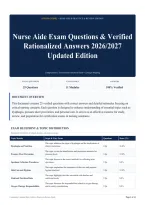
[STUDY GUIDE] • HIGH-YIELD PRACTICE & REVIEW EDITION
Nurse Aide Exam Questions & Verified
Rationalized Answers 2026/2027
Updated Edition
Comprehensive Examination Question Bank • Concept Mapping
TOTAL QUESTIONS EXAM TOPICS ANSWERS
25 Questions 11 Modules 100% Verified
DOCUMENT OVERVIEW
This document contains 25 verified questions with correct answers and detailed rationales focusing on
critical nursing concepts. Each question is designed to enhance understanding of essential topics such as
dysphagia, pressure ulcer prevention, and personal care. It serves as an effective resource for study,
review, and preparation for certification exams in nursing assistance.
EXAM BLUEPRINT & TOPIC DISTRIBUTION
Systematic breakdown of subject domains and exam coverage.
Topic Module Scope & Core Focus Questions Share (%)
This topic addresses the signs of dysphagia and the implications of
Dysphagia and Nutrition dietary restrictions. 4 Qs 16.0%
This topic covers the identification and prevention measures for
Pressure Ulcer Prevention pressure ulcers. 3 Qs 12.0%
This topic focuses on the correct methods for collecting urine
Specimen Collection Procedures specimens. 2 Qs 8.0%
This topic emphasizes the importance of skin care and personal
Skin Care and Hygiene hygiene practices. 3 Qs 12.0%
This topic highlights the risks associated with diarrhea and
Fluid and Nutrition Risks nutritional needs. 2 Qs 8.0%
This topic discusses the responsibilities related to oxygen therapy
Oxygen Therapy Responsibilities and its safety considerations. 2 Qs 8.0%
Confidential • Student Study Edition • Practice & Review Guide Page 1 of 14
, STUDENT STUDY & MASTERY EDITION PRACTICE & REVIEW GUIDE
This topic focuses on measures to prevent urinary tract infections
Urinary Health and proper care for catheterized residents. 2 Qs 8.0%
This topic covers the procedures for taking vital signs and handling
Vital Signs and Admissions admissions. 2 Qs 8.0%
This topic addresses measures for ensuring comfort and safety in
Comfort and Safety in Care resident care. 3 Qs 12.0%
This topic details the essential nutrients required for health and
Basic Nutritional Needs recovery. 1 Qs 4.0%
This topic evaluates how to assess skin integrity and recognize early
Assessment of Skin Integrity signs of damage. 1 Qs 4.0%
Total Exam Coverage 11 Integrated Topic Modules 25 Qs 100.0%
TOPIC 1: DYSPHAGIA AND NUTRITION
4 Questions • 16.0% of Exam • This topic addresses the signs of dysphagia and the implications of dietary restrictions.
QUESTION 1
The following are signs and symptoms of dysphagia except:
a. Food spills out of the person s mouth while eating
b. The person eats slowly, especially solid foods
c. The person frequently coughs or chokes before, during, or after swallowing
d. Appetite is increased
Answer: D. Appetite is increased.
Rationale: Dysphagia, a condition characterized by difficulty swallowing, is often accompanied by changes in eating habits, such as
eating slowly and coughing or choking due to food sticking in the throat. An increased appetite, however, is not a common symptom of
dysphagia, as individuals experiencing dysphagia often struggle to consume food due to the difficulty swallowing, leading to a decrease
in appetite rather than an increase.
Confidential • Student Study Edition • Practice & Review Guide Page 2 of 14