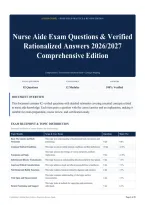
[STUDY GUIDE] • HIGH-YIELD PRACTICE & REVIEW EDITION
Nurse Aide Exam Questions & Verified
Rationalized Answers 2026/2027
Comprehensive Edition
Comprehensive Examination Question Bank • Concept Mapping
TOTAL QUESTIONS EXAM TOPICS ANSWERS
82 Questions 12 Modules 100% Verified
DOCUMENT OVERVIEW
This document contains 82 verified questions with detailed rationales covering essential concepts related
to nurse aide knowledge. Each item pairs a question with the correct answer and an explanation, making it
suitable for exam preparation, course review, and certification study.
EXAM BLUEPRINT & TOPIC DISTRIBUTION
Systematic breakdown of subject domains and exam coverage.
Topic Module Scope & Core Focus Questions Share (%)
Basic Movements and Body This topic tests understanding of fundamental body movements and
Mechanics positioning. 8 Qs 9.8%
Common Medical Conditions This topic covers prevalent medical conditions and their definitions. 10 Qs 12.2%
This topic assesses knowledge of various symptoms and their
Symptoms and Signs implications. 9 Qs 11.0%
Infection and Disease Transmission This topic focuses on understanding infections and how they spread. 6 Qs 7.3%
Legal and Ethical Considerations This topic addresses legal and ethical responsibilities in healthcare. 6 Qs 7.3%
Nutritional and Bodily Functions This topic explores functions related to digestion and nutrition. 6 Qs 7.3%
This topic evaluates understanding of vital signs and key
Vital Signs and Measurements measurements. 6 Qs 7.3%
This topic looks at methods for supporting and positioning
Patient Positioning and Support individuals. 5 Qs 6.1%
Confidential • Student Study Edition • Practice & Review Guide Page 1 of 25
,STUDENT STUDY & MASTERY EDITION PRACTICE & REVIEW GUIDE
Respiratory Conditions This topic covers conditions affecting the respiratory system. 5 Qs 6.1%
This topic focuses on mobility-related terms and rehabilitation
Mobility and Rehabilitation concepts. 5 Qs 6.1%
This topic assesses knowledge of urinary functions and related
Urinary Functions and Disorders disorders. 5 Qs 6.1%
Abbreviations and Medical This topic tests the understanding of common medical
Terminology abbreviations. 11 Qs 13.4%
Total Exam Coverage 12 Integrated Topic Modules 82 Qs 100.0%
TOPIC 1: BASIC MOVEMENTS AND BODY MECHANICS
8 Questions • 9.8% of Exam • This topic tests understanding of fundamental body movements and positioning.
QUESTION 1
Abduction
Answer: Movement away from the midline of the body.
Rationale: Abduction is a movement that occurs when a limb moves away from the midline of the body, which means it moves laterally
and away from the body's central axis. This movement is characterized by a displacement of the limb from its initial position, resulting in
a change in the distance between the limb and the body's midline.
QUESTION 2
Adduction
Answer: Movement toward the midline of the body.
Rationale: Adduction refers to the movement of a body part toward the midline of the body, which means bringing it closer to the
sagittal plane. This movement is in contrast to abduction, which is the movement away from the midline, and is characterized by the
convergence of two or more body parts toward the center of the body.
Confidential • Student Study Edition • Practice & Review Guide Page 2 of 25
, STUDENT STUDY & MASTERY EDITION PRACTICE & REVIEW GUIDE
QUESTION 3
Ambulate
Answer: To walk.
Rationale: The root "ambul-" in "ambulate" comes from the Latin word "ambulare", which means "to walk". This is why "to walk" is the
correct answer, as it is the most direct and literal translation of the Latin root, conveying the idea of moving one's feet to progress from
one place to another.
QUESTION 4
Extension
Answer: Straightening a body part.
Rationale: In anatomy, extension refers to the act of straightening or lengthening a body part, such as the elbow or spine, from a flexed
or bent position. This concept of straightening or extending a joint or limb is the foundation of the term extension, making "straightening
a body part" the correct answer to the question.
QUESTION 5
Fowlers Position
Answer: Semi sitting head raised at 45 - 60 degrees.
Rationale: The Fowlers position refers to a specific positioning of the head and neck during anesthesia, which is critical to ensure
proper airway management and prevent complications. By positioning the head at 45-60 degrees, with the patient semi-sitting and
raised, the anesthesia provider can create a stable and secure airway, allowing for effective ventilation and minimizing the risk of
airway obstruction or compromise.
QUESTION 6
Incontinence
Answer: Inability to control the bladder and/or bowels.
Rationale: Incontinence refers to the loss of voluntary control over one's bodily functions, specifically the bladder and/or bowels,
resulting in unintentional leakage or passage of urine or feces. This definition highlights the inability to control these functions as the
key characteristic of incontinence, making "inability to control the bladder and/or bowels" the correct answer.
Confidential • Student Study Edition • Practice & Review Guide Page 3 of 25