
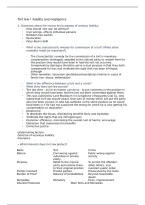
Tort law I liability and negligence
1. Questions about the nature and purposes of tortious liability:
◦ How should 'tort law' be defined?
⁃ Civil wrongs, affects individual persons
⁃ Between two parties
⁃ Restoration
⁃ Peter Burk's defn
◦ What is the characteristic remedy for commission of a tort? (What other
remedies might be important?)
- The characteristic remedy for the commission of a tort is monetary
compensation (damages) awarded to the injured party to restore them to
the position they would have been in had the tort not occurred.
Compensatory damages therefore serve a dual purpose in that they both
compensate for loss and vindicate the right that has been infringed,
although
- Other remedies: injunction (prohibitory/mandatory) (mainly in cases of
family law- abuse, defamation)
◦ What is the difference between a tort and a crime?
◦ What aims does tort law pursue?
⁃ Tort law aims - as far as money can do so - to put claimants in the position in
which they would have been had the tort not been committed against them.
⁃ This was outlined by Lord Blackburn in Livingstone v Rawyards Coal Co, who
stated that tort law should award 'that sum of money which will put the party
who has been injured, or who has suffered, in the same position as he would
have been in if he had not sustained the wrong for which he is now getting his
compensation or reparation'
⁃ Deterrence
⁃ To distribute the losses- distributing benefits fairly and equitably
⁃ Vindicate the rights that are infringed upon
⁃ Economic efficiency- minimising the overall cost of harms; encourage
behaviour that maximises the benefits
⁃ Corrective Justice
Undermining factors:
Doctrine of vicarious liability
Insurance
• What interests does tort law protect?
Basis Tort Crime
Nature Civil wrong against Public wrong against
individual or private society
entity
Purpose Relief to the injured To punish the offender,
party and restore them deter others, and
to their original position maintain public order.
Parties involved Private parties Prosecuted by the state
Burden of Proof Balance of probabilities Beyond reasonable
doubt
Remedies Monetary Fines, imprisonment
Interest Protected Main Torts and Remedies


