
&$!*#)(!*Phys_1401_Experiment_10_Spring_Elasticity.docx10/16/2026,
^!#&*^&^*#!(FG*T!^&*#*((*!#&()#_)#!*&$!*#)(!*##(*0Phys_1401_Experiment_10_Spring_Elasticity.docx.pdf*&!#%#&&!%%#^#^&^!#&*^&^*#!(FG*T!^&*#*((*!#&()#_)#!
Page 1 of 910/16/2026, 5:42:03 AM*&!#%#&&!%%#^#^&^!#&*^&^*#!(FG*T!^&*#*((*!#&()#_)#!*&$!*#)(!*Phys_1401_Experiment_10_Spring_Elasticity.docx10/16/202
5:42:03 AM*&!#%#&&!%%#^#^&^!#&*^&^*#!(FG*T!^&*#*((*!#&()#_)#!*&$!*#)(!*##(*0Phys_1401_Expe
Phys 1401 Experiment 10: Elasticity of a Spring
Objectives
When you have completed this assignment, you will be able to:
1. Determine the spring constant of a spring by measuring the elongation of the spring
for an applied force.
2. Determine the period of simple harmonic motion.
3. Use the period of simple harmonic motion to determine the spring constant of a
spring.
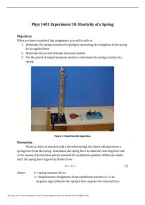
Figure 1: Experimental Apparatus
Discussion
When an object is attached with a stretched spring, the object will experience a
spring force from the spring. Sometimes the spring force is called the restoring force due
to the reason of its direction always towards the equilibrium position. Within the elastic
limit, the spring force is given by Hooke’s law:
F=−k ∙ x [1]
where: k = spring constant (N/m)
x = displacement (elongations) from equilibrium position (x = 0 m)
- (negative sign) indicates the spring’s force opposes the external force
This study source was downloaded by 1827175 from cliffsnotes.com on 01-08-2026 16:26:15 GMT -06:00
&$!*#)(!*Phys_1401_Experiment_10_Spring_Elasticity.docx10/16/2026,
^!#&*^&^*#!(FG*T!^&*#*((*!#&()#_)#!*&$!*#)(!*##(*0Phys_1401_Experiment_10_Spring_Elasticity.docx.pdf*&!#%#&&!%%#^#^&^!#&*^&^*#!(FG*T!^&*#*((*!#&()#_)#!
Page 1 of 910/16/2026, 5:42:03 AM*&!#%#&&!%%#^#^&^!#&*^&^*#!(FG*T!^&*#*((*!#&()#_)#!*&$!*#)(!*Phys_1401_Experiment_10_Spring_Elasticity.docx10/16/202
https://www.cliffsnotes.com//study-notes/16488225 5:42:03 AM*&!#%#&&!%%#^#^&^!#&*^&^*#!(FG*T!^&*#*((*!#&()#_)#!*&$!*#)(!*##(*0Phys_1401_Expe
,&$!*#)(!*Phys_1401_Experiment_10_Spring_Elasticity.docx10/16/2026,
^!#&*^&^*#!(FG*T!^&*#*((*!#&()#_)#!*&$!*#)(!*##(*0Phys_1401_Experiment_10_Spring_Elasticity.docx.pdf*&!#%#&&!%%#^#^&^!#&*^&^*#!(FG*T!^&*#*((*!#&()#_)#!
Page 2 of 910/16/2026, 5:42:03 AM*&!#%#&&!%%#^#^&^!#&*^&^*#!(FG*T!^&*#*((*!#&()#_)#!*&$!*#)(!*Phys_1401_Experiment_10_Spring_Elasticity.docx10/16/202
5:42:03 AM*&!#%#&&!%%#^#^&^!#&*^&^*#!(FG*T!^&*#*((*!#&()#_)#!*&$!*#)(!*##(*0Phys_1401_Expe
The spring constant, k, indicates the stiffness of the spring. The larger the value of k
is, the harder it is to stretch (or compress) the spring. Two methods will be used in this
laboratory to determine the value of the spring constant, k, of a spring.
METHOD 1: A spring is hung vertically, as shown in Figure 2, and a weight (with
mass, M) is attached to the lower end of the spring. The spring is stretched some distance,
L, from its initial (equilibrium) position. When the mass-spring system is at rest, the
upward spring force, FS, is the same as the downward weight, mg. Thus,
F S=k ∙ L=M ∙ g [2]
Re-arranging equation 2 above leads to
M ∙g
k= [3]
L
Figure 2: Stretched Spring
METHOD 2: If the object is pulled further down from its rest position by a value A,
and then released and allowed to move (as shown is Figure 2), the object will undergo
oscillatory motion, called simple harmonic motion. The spring constant, k, can be
determined by
2
4π ∙M
k= 2 [4]
T
where: k = spring constant (N/m)
M = mass (kg)
T = Time period of oscillation (sec.)
This study source was downloaded by 1827175 from cliffsnotes.com on 01-08-2026 16:26:15 GMT -06:00
&$!*#)(!*Phys_1401_Experiment_10_Spring_Elasticity.docx10/16/2026,
^!#&*^&^*#!(FG*T!^&*#*((*!#&()#_)#!*&$!*#)(!*##(*0Phys_1401_Experiment_10_Spring_Elasticity.docx.pdf*&!#%#&&!%%#^#^&^!#&*^&^*#!(FG*T!^&*#*((*!#&()#_)#!
Page 2 of 910/16/2026, 5:42:03 AM*&!#%#&&!%%#^#^&^!#&*^&^*#!(FG*T!^&*#*((*!#&()#_)#!*&$!*#)(!*Phys_1401_Experiment_10_Spring_Elasticity.docx10/16/202
https://www.cliffsnotes.com//study-notes/16488225 5:42:03 AM*&!#%#&&!%%#^#^&^!#&*^&^*#!(FG*T!^&*#*((*!#&()#_)#!*&$!*#)(!*##(*0Phys_1401_Expe
^!#&*^&^*#!(FG*T!^&*#*((*!#&()#_)#!*&$!*#)(!*##(*0Phys_1401_Experiment_10_Spring_Elasticity.docx.pdf*&!#%#&&!%%#^#^&^!#&*^&^*#!(FG*T!^&*#*((*!#&()#_)#!
Page 1 of 910/16/2026, 5:42:03 AM*&!#%#&&!%%#^#^&^!#&*^&^*#!(FG*T!^&*#*((*!#&()#_)#!*&$!*#)(!*Phys_1401_Experiment_10_Spring_Elasticity.docx10/16/202
5:42:03 AM*&!#%#&&!%%#^#^&^!#&*^&^*#!(FG*T!^&*#*((*!#&()#_)#!*&$!*#)(!*##(*0Phys_1401_Expe
Phys 1401 Experiment 10: Elasticity of a Spring
Objectives
When you have completed this assignment, you will be able to:
1. Determine the spring constant of a spring by measuring the elongation of the spring
for an applied force.
2. Determine the period of simple harmonic motion.
3. Use the period of simple harmonic motion to determine the spring constant of a
spring.
Figure 1: Experimental Apparatus
Discussion
When an object is attached with a stretched spring, the object will experience a
spring force from the spring. Sometimes the spring force is called the restoring force due
to the reason of its direction always towards the equilibrium position. Within the elastic
limit, the spring force is given by Hooke’s law:
F=−k ∙ x [1]
where: k = spring constant (N/m)
x = displacement (elongations) from equilibrium position (x = 0 m)
- (negative sign) indicates the spring’s force opposes the external force
This study source was downloaded by 1827175 from cliffsnotes.com on 01-08-2026 16:26:15 GMT -06:00
&$!*#)(!*Phys_1401_Experiment_10_Spring_Elasticity.docx10/16/2026,
^!#&*^&^*#!(FG*T!^&*#*((*!#&()#_)#!*&$!*#)(!*##(*0Phys_1401_Experiment_10_Spring_Elasticity.docx.pdf*&!#%#&&!%%#^#^&^!#&*^&^*#!(FG*T!^&*#*((*!#&()#_)#!
Page 1 of 910/16/2026, 5:42:03 AM*&!#%#&&!%%#^#^&^!#&*^&^*#!(FG*T!^&*#*((*!#&()#_)#!*&$!*#)(!*Phys_1401_Experiment_10_Spring_Elasticity.docx10/16/202
https://www.cliffsnotes.com//study-notes/16488225 5:42:03 AM*&!#%#&&!%%#^#^&^!#&*^&^*#!(FG*T!^&*#*((*!#&()#_)#!*&$!*#)(!*##(*0Phys_1401_Expe
,&$!*#)(!*Phys_1401_Experiment_10_Spring_Elasticity.docx10/16/2026,
^!#&*^&^*#!(FG*T!^&*#*((*!#&()#_)#!*&$!*#)(!*##(*0Phys_1401_Experiment_10_Spring_Elasticity.docx.pdf*&!#%#&&!%%#^#^&^!#&*^&^*#!(FG*T!^&*#*((*!#&()#_)#!
Page 2 of 910/16/2026, 5:42:03 AM*&!#%#&&!%%#^#^&^!#&*^&^*#!(FG*T!^&*#*((*!#&()#_)#!*&$!*#)(!*Phys_1401_Experiment_10_Spring_Elasticity.docx10/16/202
5:42:03 AM*&!#%#&&!%%#^#^&^!#&*^&^*#!(FG*T!^&*#*((*!#&()#_)#!*&$!*#)(!*##(*0Phys_1401_Expe
The spring constant, k, indicates the stiffness of the spring. The larger the value of k
is, the harder it is to stretch (or compress) the spring. Two methods will be used in this
laboratory to determine the value of the spring constant, k, of a spring.
METHOD 1: A spring is hung vertically, as shown in Figure 2, and a weight (with
mass, M) is attached to the lower end of the spring. The spring is stretched some distance,
L, from its initial (equilibrium) position. When the mass-spring system is at rest, the
upward spring force, FS, is the same as the downward weight, mg. Thus,
F S=k ∙ L=M ∙ g [2]
Re-arranging equation 2 above leads to
M ∙g
k= [3]
L
Figure 2: Stretched Spring
METHOD 2: If the object is pulled further down from its rest position by a value A,
and then released and allowed to move (as shown is Figure 2), the object will undergo
oscillatory motion, called simple harmonic motion. The spring constant, k, can be
determined by
2
4π ∙M
k= 2 [4]
T
where: k = spring constant (N/m)
M = mass (kg)
T = Time period of oscillation (sec.)
This study source was downloaded by 1827175 from cliffsnotes.com on 01-08-2026 16:26:15 GMT -06:00
&$!*#)(!*Phys_1401_Experiment_10_Spring_Elasticity.docx10/16/2026,
^!#&*^&^*#!(FG*T!^&*#*((*!#&()#_)#!*&$!*#)(!*##(*0Phys_1401_Experiment_10_Spring_Elasticity.docx.pdf*&!#%#&&!%%#^#^&^!#&*^&^*#!(FG*T!^&*#*((*!#&()#_)#!
Page 2 of 910/16/2026, 5:42:03 AM*&!#%#&&!%%#^#^&^!#&*^&^*#!(FG*T!^&*#*((*!#&()#_)#!*&$!*#)(!*Phys_1401_Experiment_10_Spring_Elasticity.docx10/16/202
https://www.cliffsnotes.com//study-notes/16488225 5:42:03 AM*&!#%#&&!%%#^#^&^!#&*^&^*#!(FG*T!^&*#*((*!#&()#_)#!*&$!*#)(!*##(*0Phys_1401_Expe


