
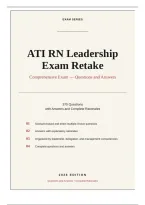
EXAM SERIES
ATI RN Leadership
Exam Retake
Comprehensive Exam — Questions and Answers
370 Questions
with Answers and Complete Rationales
01 Scenario-based and direct multiple-choice questions
02 Answers with explanatory rationales
03 Organized by leadership, delegation, and management competencies
04 Complete questions and answers
2026 EDITION
Questions and Answers • Complete Rationales
, Instructions: This exam contains 370 multiple-choice questions organized into five sections. Each
question has four options labeled A, B, C, and D, with exactly one correct answer. The correct
answer and a concise rationale are provided immediately after each question. Questions are
designed to assess cognitive levels ranging from recall to application and analysis across
delegation, prioritization, legal and ethical leadership, communication, and quality improvement
competencies. Use the rationales to review key concepts and clarify why each distractor is
incorrect.
Section 1: Delegation, Supervision, and Assignment
Q1. A registered nurse (RN) on a medical-surgical unit is planning care for four clients. Which
client should the RN assign to a licensed practical nurse (LPN)?
A. A client admitted 2 hours ago with acute chest pain and a heparin drip
B. A stable client with a chronic leg wound requiring a sterile dressing change
C. A newly admitted client with suicidal ideation awaiting psychiatric evaluation
D. A client receiving the first dose of a new IV antibiotic with possible allergic reaction
Correct Answer: B. A stable client with a chronic leg wound requiring a sterile dressing change
Rationale: The LPN's scope includes caring for stable clients with predictable needs such as chronic
wound care. The client with acute chest pain and heparin (A) requires ongoing assessment and IV
titration appropriate for the RN. A new psychiatric admission (C) needs RN-level assessment. First-
dose antibiotic administration (D) carries allergic risk requiring RN assessment.
Q2. Which task is most appropriate for the RN to delegate to an experienced unlicensed assistive
personnel (UAP)?
A. Teaching a client about a low-sodium diet before discharge
B. Assessing a postoperative client's incision for signs of infection
C. Ambulating a stable client 3 days after an appendectomy
D. Evaluating a client's response to a new pain medication
Correct Answer: C. Ambulating a stable client 3 days after an appendectomy
Rationale: UAP may ambulate stable clients with predictable needs. Teaching (A), assessment (B), and
evaluation (D) are nursing processes that must remain with the RN. The RN retains accountability for
the delegation decision and follow-up.
,Q3. An RN delegates finger-stick blood glucose monitoring to a UAP. Which statement by the RN
reflects appropriate supervision?
A. "Let me know if anything seems unusual."
B. "Document the results and tell me if any reading is below 70 mg/dL or above 250 mg/dL."
C. "Just write the numbers in the chart; I will look later."
D. "Call the provider directly if a reading looks high."
Correct Answer: B. "Document the results and tell me if any reading is below 70 mg/dL or above
250 mg/dL."
Rationale: Supervision must include specific parameters and clear reporting criteria. Option B provides
objective thresholds for escalation. Vague direction (A) or no follow-up (C) is unsafe. Directing a UAP
to call the provider (D) exceeds the UAP's scope and bypasses RN judgment.
Q4. The five rights of delegation include the right task, right circumstance, right person, right
direction, and:
A. Right documentation
B. Right supervision
C. Right evaluation
D. Right communication
Correct Answer: B. Right supervision
Rationale: The ANA/NCSBN five rights of delegation are: right task, right circumstance, right person,
right direction/communication, and right supervision/evaluation. Documentation, evaluation, and
communication alone are incomplete without supervision.
Q5. A charge RN is making assignments for the shift. Which factor is most important when
determining what can be delegated to an LPN?
A. The LPN's years of experience on the unit
B. The LPN's demonstrated competency for the specific task
C. The LPN's preference for certain types of clients
D. The LPN's shift availability
Correct Answer: B. The LPN's demonstrated competency for the specific task
Rationale: Competency for the specific task is the most important factor; experience alone does not
guarantee current competency. Preference (C) and availability (D) may influence assignment but
cannot override scope and competency. The RN is accountable for verifying competency before
delegation.
, Q6. A UAP reports that a client is "breathing funny." What is the RN's best first action?
A. Tell the UAP to reposition the client and check back in 15 minutes
B. Go to the client's room and perform a focused respiratory assessment
C. Ask the UAP to obtain vital signs while the RN finishes a medication pass
D. Notify the rapid response team immediately
Correct Answer: B. Go to the client's room and perform a focused respiratory assessment
Rationale: When a delegatee reports an abnormal finding, the RN must personally assess the client to
validate the data before further action. Delaying assessment (A, C) is unsafe. Activating rapid response
(D) may be needed but should follow RN assessment unless the report clearly indicates immediate
collapse.
Q7. Which principle best describes the concept of accountability in delegation?
A. The delegatee is fully accountable for the outcome of the delegated task
B. The RN retains accountability for the decision to delegate and for adequate supervision
C. Accountability is shared equally between the RN and the delegatee
D. The nursing supervisor assumes accountability once the assignment is made
Correct Answer: B. The RN retains accountability for the decision to delegate and for adequate
supervision
Rationale: Although the delegatee is responsible for performing the task correctly, the RN retains
accountability for the delegation decision, the appropriateness of the assignment, and the level of
supervision. Accountability cannot be delegated away.
Q8. An RN from the float pool is assigned to a pediatric unit. The RN has no pediatric experience.
Which assignment is most appropriate?
A. Administer chemotherapeutic agents to a 4-year-old
B. Care for a stable 10-year-old recovering from an appendectomy
C. Manage a pediatric code in progress
D. Titrate a vasoactive drip on an infant in shock
Correct Answer: B. Care for a stable 10-year-old recovering from an appendectomy
Rationale: A float RN without pediatric experience should be assigned stable clients with predictable
needs. Chemotherapy (A), running a code (C), and titrating vasoactive medications in an infant (D)
require pediatric specialty competency. The charge nurse should match assignment to demonstrated
competency.


