
MGT 8803: STRATEGY FREQUENTLY TESTED ACTUAL
EXAM QUESTIONS WITH CORRECT ANSWERS
Question 1.
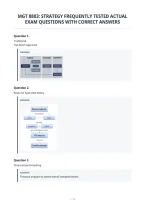
Traditional
Top-Down Approach
ANSWER
Question 2.
Resource base view theory
ANSWER
Question 3.
Financial benchmarking
ANSWER
Financial analysis to assess overall competitiveness
,Question 4.
Resources
ANSWER
Tangible assets: capital, land, buildings, plant, equipment and technology Intangible assets:
brand equity, reputation, partnerships, and intellectual property
Human capital
Question 5.
Business model framework
ANSWER
A business model is how the components of a business fit together to make a profit, or how
value is created and captured by the firm.
In this narrative the key components are identified; and how the components work together in
a mutually supporting business system.
Question 6.
Key activities
ANSWER
The most important things that the business needs to do to be successful
,Question 7.
Ways industries evolve
ANSWER
Barriers to entry can be made more or less difficult - patents expire, industries scale up, buyer
loyalty strengthens, technology obsoletes existing infrastructure, and changes in regulation
can impact barriers to entry
Supplier power can increase through supplier consolidation or can be reduced through vertical
integration
Advances in technology can create new substitutes and leapfrog current product lines and
production capacity. New technologies can obsolete existing products Competitor rivalry
naturally intensifies as industries mature and growth rates stabilize
Socio-cultural, demographic, technological, etc. changes will impact buyer preferences
Question 8.
Threat of substitutes
ANSWER
The substitute offers an attractive price-performance trade-off.
The buyer's cost of switching to the substitute is low.
Buyers are not loyal to any of the industry competitors.
The primary impact of a substitute is the limits placed on the pricing flexible of the industry
competitors.
Question 9.
Competitive advantage
ANSWER
Superior performance relative to other competitors in the same industry or industry average.
Competitive advantage is NOT absolute but judged relative to the average profitability of an
industry or to a firm's direct competitors.
Question 10.
Flat (networked) organizational structure
ANSWER
Front-line employees are empowered to make a range of decisions.
Information flows from the top down and from the bottom up in a flat structure. Few levels of
middle management.
Decentralized decision-making and planning critical in dynamic environments.
, Question 11.
Technological primary impact
ANSWER
Technology is an enabler of new business models, business processes, new products, and
services. Can be efficiency-driven, product sustainable or disruptive in character
Question 12.
Current Ratio
ANSWER
Compares current assets to current liabilities, to see if a business has enough cash to pay its
immediate liabilities. Ratios less than 2 are considered to indicate liquidity risk.
Question 13.
Controlling
ANSWER
Monitors performance, compares it with goals, and corrects any significant deviations
Question 14.
Competitive rivalry
ANSWER
The frequency and intensity of reactions to actions undertaken by competitors for market
share and profitability
Other 4 forces put pressure on this rivalry
The stronger the forces, the higher the intensity
The competition is highly fragmented
Exit barriers are high
Industry growth is slow
Products are not differentiated and can be easily substituted
Buyer switching costs are low
Customer loyalty is low
Economies of scale are very significant and production volumes need to be kept high


