
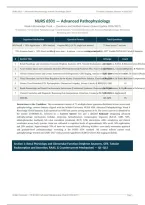
NURS 6501 — Advanced Pathophysiology • Week 6 Knowledge Check Test-Bank Complete Solutions • 2026/2027
NURS 6501 — Advanced Pathophysiology
Week 6 Knowledge Check — Questions and Verified Answers (Latest Update 2026/2027)
75 Questions • Seven Renal Pathophysiology Content Domains • Detailed Rationales with Advanced Pathophysiologic Mechanism
Reasoning and Clinical Correlation
Cognitive Distribution Question Format Total Questions
30% Recall • 50% Application • 20% Analysis 4-option MCQ (A–D, single best answer) 75 items across 7 sections
70% Scenario-based • 30% Direct recallEach item: stem + 4 options + correct answer
Aligned
+ rationale
with 2026–2027 Walden NURS 6501 Week 6 blueprint
# Section Title Q Range Count
1 Renal Physiology and Glomerular Function (Nephron Anatomy, GFR, Tubular Reabsorption and
Q1–Q12
Secretion, RAAS, & Countercurrent
12 Mechan
2 Acute Kidney Injury and Glomerular Disorders (Prerenal/Intrarenal/Postrenal AKI, Acute Tubular
Q13–Q25
Necrosis, Glomerulonephritis,
13 & Nephrotic
3 Chronic Kidney Disease and Uremic Syndrome (CKD Progression, GFR Staging, Anemia of CKD,
Q26–Q38
Mineral-Bone Disorder,
13 & Dialysis Physio
4 Fluid, Electrolyte, and Acid-Base Regulation by the Kidney (Sodium/Water Balance, Potassium
Q39–Q50
Regulation, & Renal Acid-Base
12 Compensation
5 Urinary Tract Disorders (UTI, Pyelonephritis, Obstructive Uropathy, Urinary Calculi, & BPH)Q51–Q60 10
6 Renal-Hematologic and Renal-Cardiovascular Interactions (Cardiorenal Syndrome, Renovascular
Q61–Q68
Hypertension, & Erythropoietin
8 Deficiency)
7 Clinical Correlation and Diagnostic Reasoning (Lab Interpretation, Urinalysis, Creatinine/BUN,
Q69–Q75
& Clinical Application)7
TOTAL Q1–Q75 75
Instructions to the Candidate: This examination consists of 75 multiple-choice questions distributed across seven renal
pathophysiology content domains aligned with the Walden University NURS 6501 Advanced Pathophysiology Week 6
Knowledge Check blueprint. Each question has ONE best answer among options A–D. The correct answer is identified by
the marker [CORRECT], followed by a Correct Answer line and a detailed Rationale integrating advanced
pathophysiologic mechanisms (cellular, molecular, hemodynamic), compensatory responses (RAAS, ADH, SNS,
tubuloglomerular feedback), lab value correlation (creatinine, BUN, GFR, electrolytes, ABG, urinalysis), and clinical
correlation across body systems. Items are calibrated to cognitive levels of approximately 30% recall, 50% application,
and 20% analysis. Approximately 70% of items are scenario-based, reflecting Walden’s case-study assessment approach
and graduate-level pathophysiologic reasoning at the NURS 6501 standard. All content reflects current renal
pathophysiology research and 2026–2027 clinical practice guidelines (KDIGO 2024 CKD staging included).
Section 1: Renal Physiology and Glomerular Function (Nephron Anatomy, GFR, Tubular
Reabsorption and Secretion, RAAS, & Countercurrent Mechanism) — Q1–Q12
Walden University — NURS 6501 Advanced Pathophysiology Week 6 (2026/2027) Page 1
,NURS 6501 — Advanced Pathophysiology • Week 6 Knowledge Check Test-Bank Complete Solutions • 2026/2027
Q1. A graduate nursing student is studying renal physiology. Which segment of the nephron is responsible
for reabsorbing approximately 65% of the filtered sodium and water, and is the primary site of action of
loop diuretics?
A. Proximal convoluted tubule
B. Thick ascending limb of the loop of Henle [CORRECT]
C. Distal convoluted tubule
D. Collecting duct
Correct Answer: B
Rationale: The thick ascending limb of the loop of Henle is the site of action of loop diuretics (furosemide, bumetanide,
torsemide), which inhibit the Na-K-2Cl cotransporter (NKCC2). This segment reabsorbs 20-25% of filtered sodium while
remaining impermeable to water, creating the diluting segment. The proximal convoluted tubule reabsorbs 65% of filtered
sodium and water via Na/H exchange and aquaporin-1 channels, but loop diuretics do not act there. The DCT (5-10%) is
the site of thiazide action; the collecting duct (<5%) is the site of aldosterone and ADH action.
Q2. A researcher is studying solute transport along the nephron. In which segment does the majority of
filtered bicarbonate reabsorption occur, and through what primary mechanism?
A. Proximal convoluted tubule via Na+/H+ exchanger and carbonic anhydrase-mediated conversion
[CORRECT]
B. Thick ascending limb via NKCC2 cotransporter
C. Distal convoluted tubule via Na+/Cl- cotransporter
D. Collecting duct via aldosterone-sensitive Na+ channels
Correct Answer: A
Rationale: Approximately 80-85% of filtered bicarbonate is reabsorbed in the proximal convoluted tubule (PCT) through
the Na+/H+ exchanger (NHE3) on the apical membrane. H+ secreted into the lumen combines with filtered HCO3- to
form carbonic acid, which carbonic anhydrase (CA-IV) on the luminal membrane converts to CO2 and H2O. CO2 diffuses
back into the cell, where intracellular carbonic anhydrase (CA-II) regenerates H+ and HCO3-. The remaining 15-20% of
bicarbonate is reabsorbed in the thick ascending limb and collecting duct (intercalated cells).
Q3. A 28-year-old patient presents with hypertension and hypokalemia. Laboratory studies reveal elevated
aldosterone and suppressed renin. Which segment of the nephron is the primary site of pathologic
mineralocorticoid effect in this patient?
A. Proximal convoluted tubule
B. Thick ascending limb of the loop of Henle
C. Cortical collecting duct principal cells [CORRECT]
D. Distal convoluted tubule cells
Correct Answer: C
Rationale: Aldosterone acts on principal cells of the cortical collecting duct via cytoplasmic mineralocorticoid receptors.
Aldosterone increases apical ENaC (epithelial sodium channel) insertion and Na+/K+-ATPase activity, causing sodium
reabsorption (leading to hypertension) and potassium secretion (leading to hypokalemia). In Conn's syndrome (primary
hyperaldosteronism), aldosterone is autonomously secreted and renin is suppressed. Spironolactone and eplerenone are
competitive aldosterone antagonists used in treatment.
Walden University — NURS 6501 Advanced Pathophysiology Week 6 (2026/2027) Page 2
,NURS 6501 — Advanced Pathophysiology • Week 6 Knowledge Check Test-Bank Complete Solutions • 2026/2027
Q4. Which structure in the kidney is responsible for sensing changes in blood pressure and initiating the
renin-angiotensin-aldosterone system (RAAS)?
A. Macula densa cells of the distal tubule
B. Juxtaglomerular cells of the afferent arteriole [CORRECT]
C. Mesangial cells of the glomerulus
D. Podocytes of Bowman's capsule
Correct Answer: B
Rationale: Juxtaglomerular (JG) cells are specialized smooth muscle cells in the wall of the afferent arteriole that
synthesize and store renin in secretory granules. They release renin in response to three stimuli: (1) decreased stretch of
the afferent arteriole (baroreceptor mechanism), (2) decreased NaCl delivery sensed by macula densa cells in the early
distal tubule, and (3) increased sympathetic stimulation via beta-1 adrenergic receptors. The macula densa senses NaCl but
does not release renin. Together, the JG cells, macula densa, and extraglomerular mesangial cells form the juxtaglomerular
apparatus.
Q5. A patient with severe dehydration has decreased renal perfusion. Which mechanism maintains
glomerular filtration rate (GFR) during mild to moderate hypovolemia?
A. Afferent arteriolar constriction and efferent arteriolar dilation
B. Afferent arteriolar dilation and efferent arteriolar constriction [CORRECT]
C. Constriction of both afferent and efferent arterioles
D. Dilation of both afferent and efferent arterioles
Correct Answer: B
Rationale: Renal autoregulation maintains GFR across a mean arterial pressure range of 80-180 mmHg through two
mechanisms: (1) myogenic response (afferent arteriole constricts with increased pressure, dilates with decreased pressure)
and (2) tubuloglomerular feedback (macula densa senses increased NaCl and releases adenosine, constricting the afferent
arteriole). During mild hypovolemia, afferent arteriolar dilation increases renal blood flow, while angiotensin II
preferentially constricts the efferent arteriole to maintain intraglomerular pressure and GFR. Severe hypovolemia exceeds
autoregulatory capacity.
Q6. A 65-year-old patient with type 2 diabetes has a GFR of 45 mL/min/1.73m². Which factor is the
strongest predictor of declining GFR in this patient?
A. Plasma creatinine concentration
B. Glomerular capillary hydrostatic pressure [CORRECT]
C. Glomerular capillary oncotic pressure
D. Bowman's capsule hydrostatic pressure
Correct Answer: B
Rationale: GFR is determined by the Starling forces across the glomerular capillary wall: GFR = Kf × [(Pgc - Pbs) - (πgc
- πbs)]. Glomerular capillary hydrostatic pressure (Pgc, normally ~55 mmHg) is the primary driving force for filtration
and the strongest predictor of GFR. In diabetes, chronic hyperglycemia causes glomerular hypertension (increased Pgc)
initially causing hyperfiltration, then progressive glomerulosclerosis reducing Kf and GFR. Plasma creatinine is a marker
of GFR but not a determinant. Oncotic pressure opposes filtration; Bowman's capsule hydrostatic pressure opposes
filtration.
Walden University — NURS 6501 Advanced Pathophysiology Week 6 (2026/2027) Page 3
, NURS 6501 — Advanced Pathophysiology • Week 6 Knowledge Check Test-Bank Complete Solutions • 2026/2027
Q7. A patient has a serum creatinine of 2.0 mg/dL and a urine creatinine of 100 mg/dL, with a urine flow
rate of 1.0 mL/min. Using the clearance formula (C = U × V / P), what is the creatinine clearance (an
estimate of GFR)?
A. 50 mL/min [CORRECT]
B. 100 mL/min
C. 200 mL/min
D. 20 mL/min
Correct Answer: A
Rationale: Creatinine clearance (Ccr) is calculated using the formula C = (U × V) / P, where U = urine creatinine
concentration (100 mg/dL), V = urine flow rate (1.0 mL/min = 0.001 L/min), and P = plasma creatinine (2.0 mg/dL). C =
(100 × 1.0) / 2.0 = 50 mL/min. Creatinine clearance approximates GFR but slightly overestimates it because creatinine is
also secreted by the proximal tubule. A normal GFR is approximately 120-130 mL/min/1.73m². A GFR of 50 mL/min
indicates CKD stage 3a.
Q8. Angiotensin II has multiple effects that increase blood pressure and extracellular fluid volume. Which
effect is mediated through the proximal tubule and contributes to metabolic alkalosis in
hyperaldosteronism?
A. Vasoconstriction of efferent arteriole
B. Stimulation of adrenal aldosterone release
C. Stimulation of Na+/H+ exchanger (NHE3) and increased bicarbonate reabsorption [CORRECT]
D. Stimulation of posterior pituitary ADH release
Correct Answer: C
Rationale: Angiotensin II directly stimulates the Na+/H+ exchanger (NHE3) on the apical membrane of proximal tubule
cells, increasing sodium reabsorption and hydrogen ion secretion. The secreted H+ combines with filtered HCO3- to form
CO2 + H2O via carbonic anhydrase, effectively reabsorbing bicarbonate. This contributes to metabolic alkalosis in
hyperaldosteronism and volume-expanded states. Angiotensin II also stimulates aldosterone release (which causes K+
secretion and H+ secretion in the collecting duct) and ADH release (water reabsorption).
Q9. A patient receives an ACE inhibitor for hypertension. Which mechanism explains the medication's
effect on renal hemodynamics and potassium balance?
A. Increased efferent arteriolar constriction and decreased potassium excretion
B. Decreased efferent arteriolar constriction and increased potassium excretion [CORRECT]
C. Increased afferent arteriolar constriction and decreased sodium reabsorption
D. Decreased afferent arteriolar constriction and decreased potassium excretion
Correct Answer: B
Rationale: ACE inhibitors block conversion of angiotensin I to angiotensin II. Reduced angiotensin II leads to decreased
efferent arteriolar constriction, reducing intraglomerular pressure (lower GFR) and lowering systemic blood pressure.
ACE inhibitors also decrease aldosterone secretion (which normally promotes K+ secretion in collecting duct), so
potassium excretion is reduced — explaining hyperkalemia risk. ACE inhibitors are renoprotective in diabetes by reducing
intraglomerular pressure and proteinuria, but they require monitoring of potassium and creatinine, particularly in CKD,
dehydration, and concurrent potassium-sparing diuretic use.
Walden University — NURS 6501 Advanced Pathophysiology Week 6 (2026/2027) Page 4


