
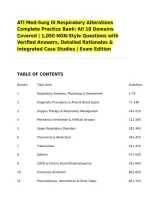
ATI Med-Surg III Respiratory Alterations
Complete Practice Bank: All 18 Domains
Covered | 1,050 NGN-Style Questions with
Verified Answers, Detailed Rationales &
Integrated Case Studies | Exam Edition
TABLE OF CONTENTS
Domain Topic Area Questions
1 Respiratory Anatomy, Physiology & Assessment 1–70
2 Diagnostic Procedures & Arterial Blood Gases 71–140
3 Oxygen Therapy & Respiratory Management 141–210
4 Mechanical Ventilation & Artificial Airways 211–280
5 Upper Respiratory Disorders 281–340
6 Pneumonia & Atelectasis 341–410
7 Tuberculosis 411–470
8 Asthma 471–530
9 COPD & Chronic Bronchitis/Emphysema 531–600
10 Pulmonary Embolism 601–650
11 Pneumothorax, Hemothorax & Chest Tubes 651–710
,Domain Topic Area Questions
12 Pleural Effusion & Thoracentesis 711–760
13 Acute Respiratory Distress Syndrome (ARDS) 761–800
14 Respiratory Failure 801–850
15 Lung Cancer & Thoracic Surgery 851–900
16 Obstructive Sleep Apnea & Other Sleep Disorders 901–940
17 Respiratory Medications & Pharmacology 941–1,000
18 Comprehensive Review & Integrated Case Studies 1,001–1,050
Total: 1,050 Questions
DOMAIN 1: RESPIRATORY ANATOMY,
PHYSIOLOGY & ASSESSMENT (Questions 1–
70)
Q1. Which structure creates the greatest portion of the pressure gradient
that drives inspiration?
A. Diaphragm
B. Sternum
C. Rib cage
D. Abdominal muscles
Answer: A
Explanation: The diaphragm is the primary muscle of inspiration, creating
,negative intrathoracic pressure that draws air into the lungs. During quiet
breathing, the diaphragm accounts for approximately 70% of tidal volume.
Q2. A nurse is assessing a client with shortness of breath. Which of the
following findings should the nurse identify as the earliest sign of
hypoxemia?
A. Restlessness and confusion
B. Cyanosis of the lips
C. Oxygen saturation of 88% on room air
D. Clubbing of the fingers
Answer: A
Explanation: Restlessness and confusion are early neurologic signs of
hypoxemia because the brain is highly sensitive to decreased oxygen.
Cyanosis is a late sign, and clubbing develops over time with chronic
hypoxemia.
Q3. A nurse is auscultating a client's lungs and hears noisy wheezing. Which
condition is most commonly associated with this finding?
A. Asthma
B. Pneumonia
C. Pleural effusion
D. Atelectasis
Answer: A
Explanation: Wheezing is caused by narrowed airways and is most
, commonly associated with asthma, though it can also occur in COPD and
other obstructive conditions. Pneumonia and pleural effusion typically
produce crackles or diminished breath sounds.
Q4. Which assessment finding is most indicative of hypoxemia in an adult
client?
A. Respiratory rate of 18/min
B. Oxygen saturation of 88%
C. Blood pressure of 130/80 mm Hg
D. Heart rate of 72/min
Answer: B
Explanation: An oxygen saturation below 90% indicates hypoxemia and
requires immediate intervention. Normal respiratory rate and heart rate do
not indicate hypoxemia.
Q5. A nurse is assessing a client who has a 40-pack-year smoking history
and presents with progressive dyspnea, barrel chest, and pursed-lip
breathing. Which condition should the nurse suspect?
A. Asthma
B. COPD
C. Pneumonia
D. Tuberculosis
Answer: B
Explanation: The combination of progressive dyspnea, barrel chest


